

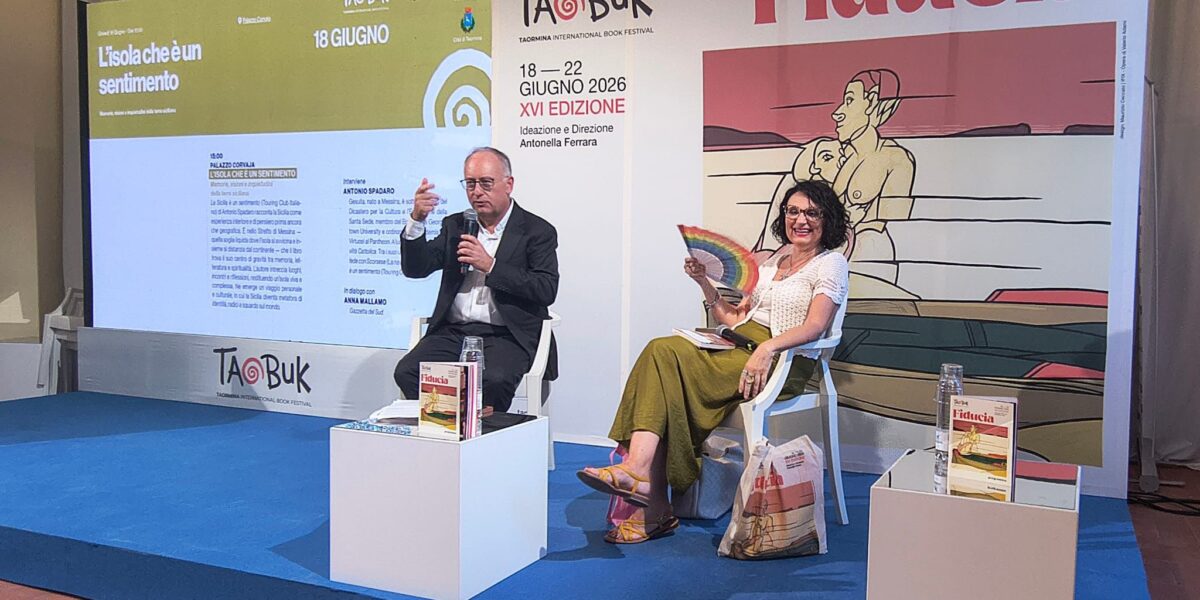
It is a long, large polyptych of the Strait which, with the colors of a writing of refined lyricism, Father Antonio Spadaro paints in the precious volume “Sicily is a feeling. Journey on the edge of the Strait” (Touring Club Italiano), but it is also a poem, a musical score, which gives us the gift of an education in time and gaze, to suggest to us the perception of that reality which we look at, touch, skirt, cross, perhaps without actually seeing. And instead we must let ourselves go to that gaze, just as it was equally precious to let ourselves go and listen to the living words of Father Spadaro, from Messina, Jesuit, undersecretary of the Dicastery for Culture and Education of the Holy See, long-time director of “La Civiltà Cattolica” and member of the scientific committee of Taobuk, in dialogue, yesterday at Palazzo Corvaja, with Anna Mallamo, journalist of the Gazzetta del Sud and writer (winner, among other things, of the SuperMondello” with his “In the dark I see it”, Einaudi): both “close”, because “the lesson of the Strait is unique, constant, continuous” – said the journalist – recalling that Father Spadaro, a fine theologian and philosopher, signed the preface to the encyclical “Magnifica humanitas” of Pope Leo XIV for Feltrinelli.
The event was held yesterday at Palazzo Corvaja, on the opening day of the XXVI edition of Taobuk, which saw the intervention of the president and artistic director Antonella Ferrara.
«To say that Sicily is a feeling – so Father Spadaro – means to be in agreement with my land. I wrote this book on the beach of Capo Peloro, there I realized that my theological way of seeing the world, reality, derives from a vision of my land that asked me to agree in front of the sea. But it is that sea that has a land in front of it, that sea of shores and edges that look at each other and look at us, with all the elements that agree even when, or rather especially when, they are opposite.” It is what Father Spadaro calls “the dialectic of the Strait, the harmony of differences which, however, requires tuning”, because “the gaze – evoked Mallamo – must continually go between opposites, between sand and rock, between one taste and another, between high and low, between edge and tear, between enjoyment and wound, between drama and beauty”. It is the «philosophy of the Strait according to which the otherness here is immediately recognisable, tangible – writes Father Spadaro in what he defined as a novel, made of reality and invention – and which becomes an extraordinarily lively metaphor of the complex and ambivalent experience of the human spirit. Reciprocity of relationship, of agreeing, precisely, which remains unattainable without the effort of crossing.”
And then it is necessary to read this precious guide to the gaze to find that “agreement”, to not give in to the daily sirens of disenchantment, it is necessary to agree with that beauty that forces us to think, with its sunrises, sunsets and full moons, with its silences, “metaphysical events” Spadaro calls them, but also with its wounds. Because that of the Strait is not the happiness of an earthly paradise, without history and unchanged. Instead it is the place of challenge, of enchantment that can be ambiguous and hurt. And precisely on the terms of “wound” and “window” (every word, every semantic meaning of Spadaro is lyrical, effective, in harmony with the world), Mallamo paused to reflect on the idea of «border, edge and tear that the Strait contains, not the barbed wire that hinders, but rather the gaze to be given to the other, because both the narrowness and the border coincide with a close relationship between two sides that look at each other». «In the idea of edges that close a wound, a tear, we must avoid a misunderstanding – Spadaro clarified – that the tear must be healed with a bridge. The threads between the two shores are already there, for example those drawn between the two pillars on the opposite coasts, Messina and Calabria, which today are relics of modern archeology, which however do not create a contrast, because there is the thread of imagination that unites them. The two shores are separate, yes, Ulysses knew this well, but this conflict creates identity, the genius loci, and harmony, which is made up of contrasts.” «It’s true – he continued – that there is a sense of limit. But if there were no limit, there would be no sense of enjoyment. Every border, every limit exists by virtue of its transgression, its overcoming. And even crossing the Strait imposes “transgression”. This is why I talk about “cross-strait philosophy”.
And this “philosophy of the Strait” is one of the voices of “Mediterranean. Myths, horizons, visions”, just published in the beautiful series “Passaggi di dogana” by Perrone editore: describing the Mediterranean, together with Father Spadaro, are Errico Buonanno, Domenico Dara, Anna Giurickovic Dato, Paolo Di Paolo, Maura Gancitano, Carmen Pellegrino, Rosella Postorino, Dario Voltolini, through whose imagination reflections on «a geographical space with ethical value – recalled Anna Giurickovic Dato, in dialogue with Giulio Perrone yesterday at Palazzo Corvaja – which still dreams of being open, shared, a living sea that should unite and not become an object of possession». Among the events, also the dialogue between Giovanni Malagò, president of the Milano Cortina 2026 Foundation, and Paolo Valentino, journalist from Corriere della Sera.