

The first thing that strikes you is not what you see. It’s what it feels like. An acrid, persistent, layered odor: stale humidity, fermented waste, old sweat, food cooked outdoors. It’s a smell that doesn’t go away, that sticks to your clothes and your throat. The San Ferdinando tent city announces itself like this, even before the shacks, before the faces, before the words.
Then a shapeless agglomeration of sheet metal, plastic, frayed sheets and cardboard opens up. A place that shouldn’t exist and has instead existed for years, growing, changing, getting worse. We enter accompanied by Michele Vomera, director of the diocesan Caritas of Oppido-Palmi. Here Michele needs no introduction. He walks and nods goodbye, someone stops him, someone calls him by name. He’s a constant presence, and that changes everything.
That cold that doesn’t go away
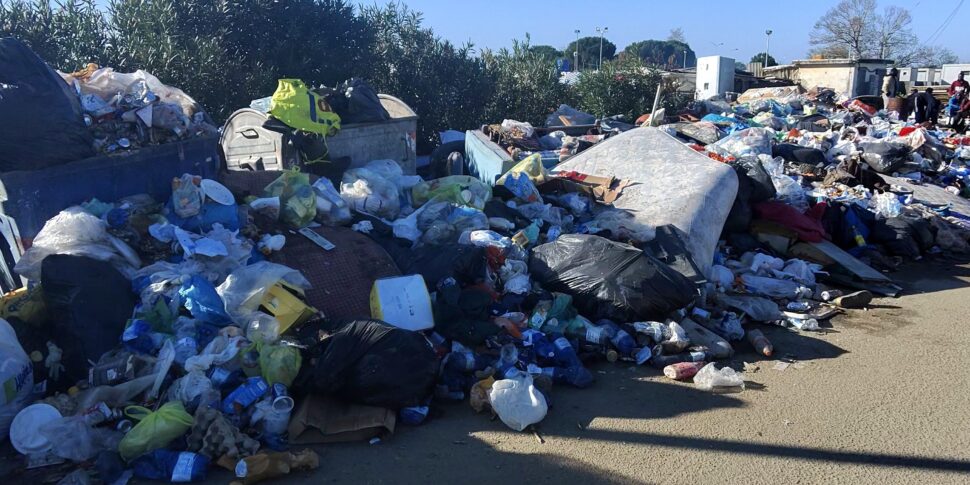
The air is already stinging at the entrance. It is a cold that has nothing to do with the mild Piangiano winter, but with abandonment. The dirt road is a blade of mud when it rains and a cloud of dust when the sun dries. On the sides, waste piled up with a logic that is entirely internal to the camp: better outside than inside. Swollen black bags, bottles, torn mattresses, remains of bicycles. Every now and then the pile is taken away, but after a few days it is identical to before. Sometimes, when there is no alternative, it is set on fire.
They still call it tent city. It’s a convenient, almost institutional word, but you just need to look around to understand that the word lies. This is an open-air slum. The ministerial tents, created as a temporary solution, were swallowed up by makeshift constructions: barracks next to the barracks, made with cardboard, sheet metal, advertising tarpaulins, wooden planks. Each material had a second life. Every free space has been occupied.
A cumbersome “problem”.
In this period the attendance is around six hundred. In the off-season months they drop to just over one hundred. They are African labourers, almost all young people who arrived from the sea, men who follow the agricultural calendar: Calabria, then Puglia, then Campania for tomatoes. Invisible when they work, very visible when they stop. And that’s when the tent city becomes cumbersome, a “problem”.
«The situation is dramatic – says Michele as we walk among the barracks – we are in a state of abandonment. There are associations, volunteers, us at Caritas, Emergency, the Municipality that does what it can. But a revolution would be needed.” The public order problems of the past are no longer there, but that’s not the point. «The important thing – he explains – is not to arrive only in spot moments. We are always here. When you are a constant presence you are not perceived as someone who invades or exploits.”
Inconveniences galore
A laborer passes by on a bicycle and suddenly brakes. “There’s no power.” An electrical panel burned out before Christmas and half the pitch is in the dark. Electrical wires twisted like vines, improvised connections, exposed cables. Months ago the flames devoured an electrical panel, which was then restored by Caritas. Today we are back to square one.
The bathrooms and showers, built just a year ago, are already collapsing: broken doors, slimy floors, smell of mold and urine, no hot water. Washing yourself is an act of resistance. The health and hygiene emergency is evident, but there is another that is silently advancing: mental health. «Many are sick», says Michele, while a man passes by us talking to himself. Another migrant takes him by the arm and calmly pushes him away. “The suffering, the loneliness, the poverty, probably even the use of substances.”
An assistance that is not enough
Caritas distributes around two hundred meals twice a week. It’s not enough. It can’t be enough. The camp is divided into zones, almost informal neighborhoods. Escape spaces have been eroded inch by inch. We arrive at the mosque: clean, well-kept, redone with new sheet metal. Around the bazaars, bicycle mechanics, improvised butchers. When the State retreats, life organizes itself as it can.
Michele invites us not to stop at the image of San Ferdinando alone. In other settlements in the Plain the situation is different. In Rosarno the old ghetto was cleared and replaced by a solidarity village. In Taurianova a social village was born in a confiscated property. In Drosi you experience widespread hospitality. However, there remains an invisible band of workers who live isolated in the countryside, exposed to different but equally serious risks.
We continue walking and come across a shack different from the others, almost a villa, with well-kept flowerbeds and flowers ready to bloom. «It is proof – says Michele – that here too the good can win over the bad». A little further on, the “bicycle cemetery”, then two tied sheep, marked red.
A structure designed for less than 200 people
At the exit we meet Ferdinando, a Caritas volunteer, who helps with documents, contracts and pay slips. In the listening desk there is also a bed for basic medical examinations. The maps tell a harsh truth: the tent city was designed for around 190 places and ended up hosting up to 900. The escape routes have disappeared. A camp created to protect has turned into a trap. There, in a corner that Michele points out to us, years ago a person died in a fire. The firefighters couldn’t get there: too narrow, too dense. The flames were stopped by fire extinguishers positioned by Caritas.
Let’s go out. Men sitting along the sidewalk look into space. Young faces, old looks. «This is no longer an emergency, it has become a status», says Michele, launching an appeal to the institutions and civil society. “Without immigrants our countryside would remain abandoned.” The smell lingers. The images too. In San Ferdinando, the outskirts of the Bel Paese, Italy shows what it is willing to tolerate. What he prefers not to look at.