

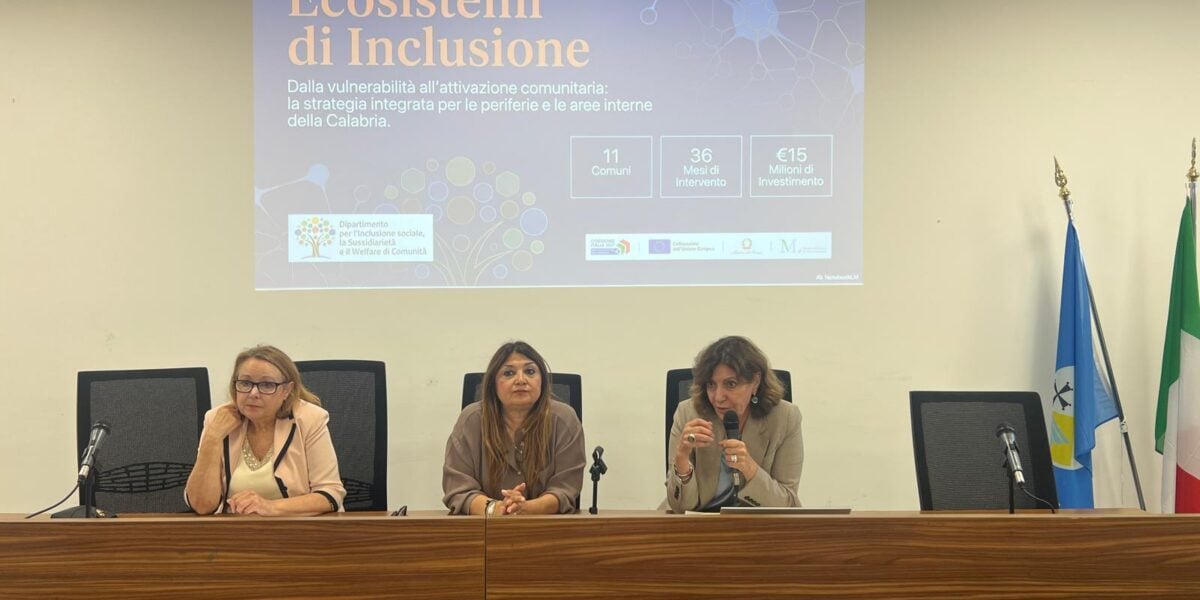
“Today starts the P.Art.ECIPO project created to combat social degradation in the peripheral areas of Calabria. With 15 million euros we have financed 11 projects aimed at people in conditions of social and economic vulnerability, lonely elderly people, people with disabilities, but also subjects who unfortunately, too often, become objects of discrimination, such as prisoners, regular migrants, homeless people: all those people who today risk becoming invisible. Congratulations to all the Municipalities, co-protagonists with the Third Sector of this path of local welfare, for the quality of the proposals presented and for the commitment to supporting the invisible of our land”.
Thus the regional councilor for social inclusion, welfare and equal opportunities, Pasqualina Straface, opened the meeting with the interested municipalities and the subjects involved in the various proposals of the P.Art.ECIPO project – Articulated and Coordinated Programs in Organized Suburbs, the measure with which the Calabria Region wants to break down environmental and social inequalities so that all citizens can have the same opportunities.
The general director of the Welfare Department, Jole Fantozzi, and the sector manager, Gabriella Rizzo, also took part in the initiative.
“With P.Art.ECIPO – continued councilor Straface – the Calabria Region, also at the instigation of President Roberto Occhiuto, is implementing a concrete measure of local territorial welfare. We are not talking about abstract interventions, but about projects designed to enter neighbourhoods, suburbs, hamlets, places where the conditions of poverty are strongest and where fragility often remains invisible. The objective is to reduce the distances between citizens, improve access to services and make the local communities”.
The admitted projects concern 11 Lead Municipalities and are Cosenza, Reggio Calabria, Vibo Valentia, Roghudi, Motta San Giovanni, Campo Calabro, Palmi, Corigliano-Rossano, Cirò Marina, Villa San Giovanni and Domanico, with interventions lasting 36 months. The resources finance territorial programs based on partnerships and local networks, with the involvement of Third Sector bodies, schools, universities, provincial health authorities, chambers of commerce, employment centres, associations and social entities.
In detail, the projects admitted are: Educational Community of the Municipality of Cosenza, for 1,773,189.74 euros; ROUTES – Traveling along the Roads of Inclusion of the Municipality of Reggio Calabria, for 3,882,304.35 euros; Light in the suburbs of the Municipality of Vibo Valentia, for 2,390,145.87 euros; KOINE’ 3.0 of the Municipality of Roghudi, for 836,520 euros; RADICI of the Municipality of Motta San Giovanni, for 640,692 euros; Border Bridges of the Municipality of Campo Calabro, for 636,540 euros; TAURIANA of the Municipality of Palmi, for 832,371.25 euros; I Luoghi Cerniera of the Municipality of Corigliano-Rossano, for 1,985,360 euros; Protagonists of Change of the Municipality of Cirò Marina, for 923,880 euros; Piale Partecipa of the Municipality of Villa San Giovanni, for 755,063.60 euros; SPECTATORS of the Municipality of Domanico, for 343,933.19 euros.
“We wanted to meet directly with the admitted Municipalities – remarked the Welfare councilor – to share times, obligations and operational methods, but above all to build a common framework of responsibility. These projects will work if they are capable of producing real services: listening desks, territorial centers, support for families, interventions for minors, elderly people, people with disabilities, migrants, homeless citizens, people at risk of poverty or discrimination”.
The actions envisaged by the projects concern access to services, the social secretariat, support for families with minors, the fight against educational poverty, psychological support, mediation, employability guidance, internships, training, job orientation, home care, social transport, the distribution of primary goods, the regeneration of public spaces and the construction of fixed facilities in the target areas.
From the project proposals emerges a complex picture of needs: school dropout, educational poverty, loneliness of the elderly, youth unemployment, family fragility, urban marginality, isolation of hamlets, difficulty in accessing health and social services, presence of vulnerable communities, phenomena of exclusion and hidden hardship.
In fact, during the meeting, the common aspects connected to the start of the project activities were examined, with particular attention to the agreements, the formalization of the partnerships, the implementation procedures, the monitoring and reporting of the interventions.
“The most important fact – the regional councilor finally highlighted – is the method. P.Art.ECIPO does not finance individual activities unrelated to each other, but territorial ecosystems of inclusion. We ask the Municipalities and their partners to work together, to co-plan, to listen to the communities, to build personalized paths and to transform the suburbs into places of participation and opportunities. I thank all the Municipalities and the partner subjects for the quality of the proposals presented. This path represents an important challenge: bringing welfare where the need is greatest strong, support the invisible of our land and demonstrate that even in the most fragile areas it is possible to build communities that are fairer, more inclusive and more capable of a future”.