

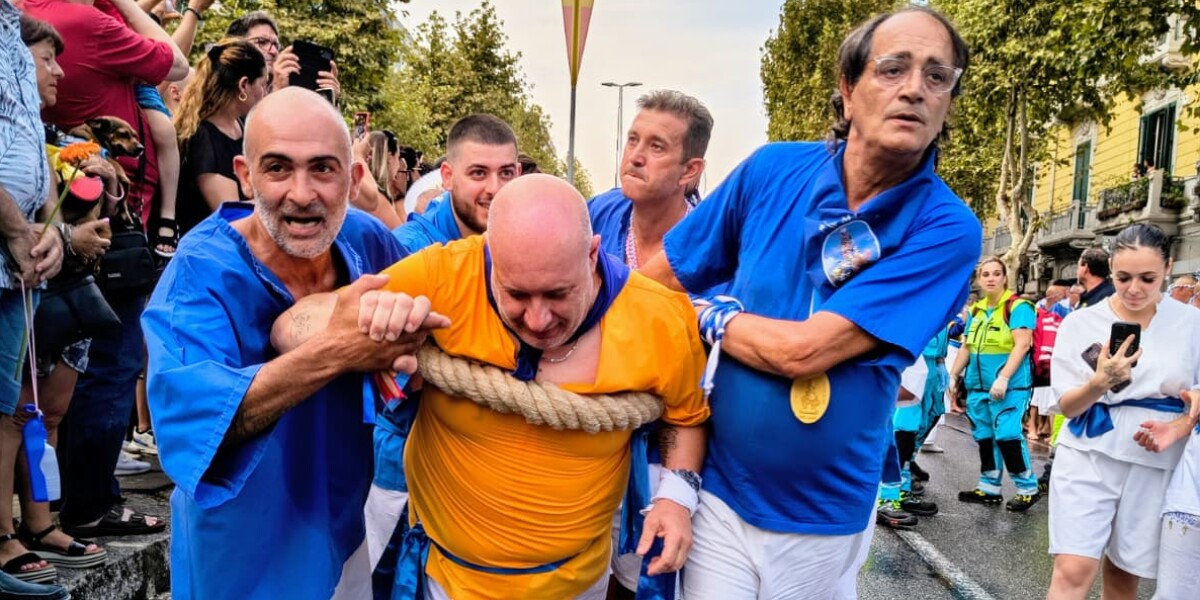
Everything has been said and written about her. What else to add? It is a procession, like there are many in Italy and in countries of Catholic faith. A popular celebration? Yes, but so are trade fair-style events, Vinitaly or Woodstock. And then, what are those profane aspects, which have little or nothing religious about them? We are in 2026 and we are still talking about tradition, identity, the Marian vocation of a city…
So what can still be said and written about her? Just the story of an experience. That of each of us. You can share it with others, but it is absolutely yours, only you experience it in that moment, even if you then realize that you are part of a multitude, of hands that grasp a rope and hold each other, of feet that bleed, of shining eyes, of hearts that beat in unison.
And so, yes, it’s true, it’s a procession. But you don’t experience it like when you go as a tourist to another city and see the Ceri race or the bull race or a horse Palio. No, you experience it from the inside, first within yourself, then in that enclosure made up of rowers and shooters, and gradually in an ever wider dimension, until it involves the whole city, and even beyond, an entire world that revolves around this symbol and that stops when the Vara stops. It’s like experiencing a mystical state. And mystics have no words to describe their experience. They just live it. You realize their profound transformation just by looking into their eyes, but with speeches and reasoning they would never convince you.
It is not a procession like the others. Those who live in Palermo tell you about “their” Santa Rosalia, in Catania they tell you about Sant’Agata, but the Vara of Messina is the Vara of Messina, she has no equals, she has no terms of comparison, she cannot be confused or labeled, she escapes exclusively rational schemes, the mind that discriminates and judges.
You immerse yourself in that flow. You are a wave in the ocean. And you swim, as if you were crossing the sea, but without having any goal, without wanting to reach a shore. You just surf, there’s nothing else needed. And you feel that next to you, in thousands, they are making the same journey, unique for each one, but which binds you inextricably to others.
It’s not just a popular celebration. The word celebration derives from the Latin “Festus”, that is, festive, solemn. And it is clear that the Assumption is a solemnity. But Vara cannot be explained only as a popular festival. It has something dramatic, in the authentic sense of the term (the Greek one, drama, i.e. action), like a grandiose show where, however, theater and life are one thing, one path. You are the lead actor, as if there was no one else on stage. But you are because everyone else also experiences this event like you, as protagonists. Those who pull, those who guide, those who cling, those who scream, those who pray, those who smile, those who let themselves be carried away by the current, those who cast doubts and skepticism and get involved. A spectacular staging where one must necessarily be an actor, one cannot just be a spectator.
We are in 2026 and we still talk about identity and tradition, as if they were reactionary values or an excuse for not facing the present of a city, and of a people, with a thousand contradictions? There is no answer to this question. Because it’s the question that doesn’t make sense. If we are here, it is because someone preceded us, because centuries and centuries of women and men who lived on the banks of the Strait, forged and shaped us, as in a blacksmith’s workshop and in a ceramist’s laboratory. The problem is not reliving moments of a past that never returns, but being able to make History and the Future coincide, in the present moment.
Here it is, yet another article on Vara. Take it for what it’s worth. It adds nothing to what we already know. But it is the story of an experience. Mine, yours, ours.