

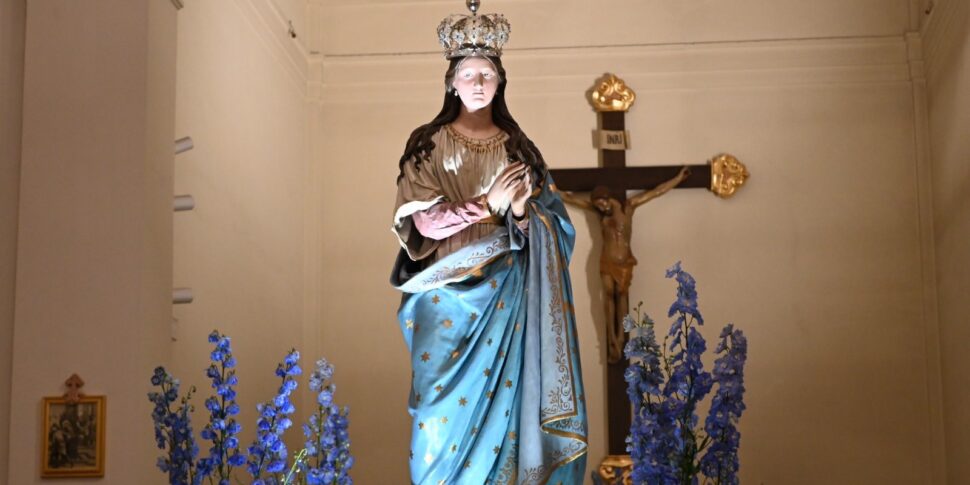
Religious traditions are a strong identity element of rediscovery of their roots. Recuing them becomes important above all with a view to a renewed social path and of faith such as that made by retreat, which preserves important traces of Marian devotion. Like that of Santa Maria di Gesù with retirement, which yesterday returned to parade through the streets of the district.
A branch bond with the Madonna, over three centuries long; Two churches were named after her in 1643, deriving from each other and therefore called “superior” respectively – at the bottom of the carousel valley with retirement – and “lower”, at the entrance of the same. It was the Carmelite Fathers who gave the name to the ancient building erected together with the convent on the carousel avenue in the second half of the 12th century in Santa Maria di Gesù, subsequently destroyed by the flood of 1854; The current building was built in 1934. On June 6, 1971, the simulacrum of S. Maria di Gesù did the church door for the last time to cross the retreat routes; The work, in Roman cardboard, dates back to the mid -19th century; 53 years have passed since that day and the inhabitants of the district have never stopped hoping to be able to put themselves back on the way Mary.
It was Don Claudio Sirni who presided over the solemn mass before the procession, concelebrated by the new parish priest Don Antonio Gugliendolo, in the presence of the faithful and a representation of the civil institutions (the mayor Federico Basile, a representation of the fifth municipality) with the animation of the exclusive Schola Canthorum “Santa Maria di Gesù”.
The original site of Viale Carostra is connected to the discovery of the marble statue created by the Palermo sculptor Antonello Gagini kept and venerated in the current church. The prodigious event is attributed to the young Franciscan monk Antonino di Trapani da Messina, who thanks to a warning dream found the statue – 44 years after burial – practicing the excavations at the ancient church; Here the observant minors, to whom the area was sold in 1418 by the Cistercian religious, gave birth to Marian devotion handed down to the present day. The chronicle of the discovery of the simulacrum, drawn up by Antonio D’Angelo in 1924, is kept in a manuscript found in 1988 among the papers of the parish archive of the retreat village.