

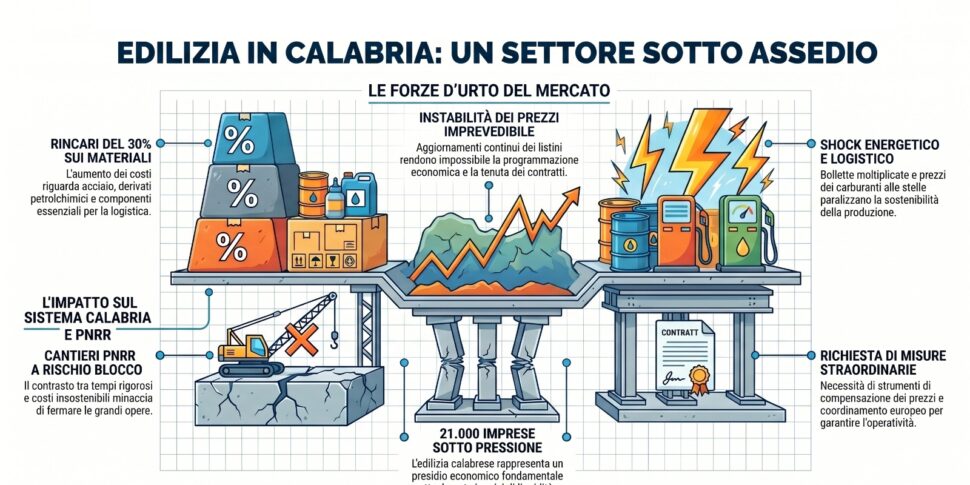
For over a month we have been living in a world turned upside down, illustrated by negative impulses that continue to shake the fragile social and economic balance to its foundations. The suspension of imports of petroleum products from the Gulf is pushing up the prices of various commodities, extending their delivery times. Businesses, small and large, vibrate with tensions in the midst of a production system bent by the superb turbulence of the crazy increases in energy product prices. Violent increases in raw material costs are putting a wide range of companies under pressure. The construction sector is also part of the front line of the price war and markets devastated by the conflict, which in Calabria closed in 2025, continuing to represent a significant presence with over 21 thousand units, within the regional production scenario which shows less quantity, more specialization, greater selectivity.
The young regional president of Ance, Roberto Rugna, does not hide his concern for the effects of the war in the Middle East. «The situation – explains the number one manufacturer – is already very serious and should be read for what it is: not a contingent critical issue, but a structural phenomenon that risks producing lasting effects on the entire sector. International tensions are causing a general increase in energy and raw material costs, with immediate repercussions on the construction supply chain. We are not just talking about petrochemical derivatives, but also essential materials such as steel and logistics-related components, the cost of which is strongly influenced by transport. The most worrying fact is the instability: prices not only grow, but they do so in an unpredictable way, with continuous updates that make the planning of works and the economic stability of contracts extremely complex. In this context, the risk is not just an increase in costs, but a progressive loss of balance in the entire production system.”
The full article is available in the print and digital editions