

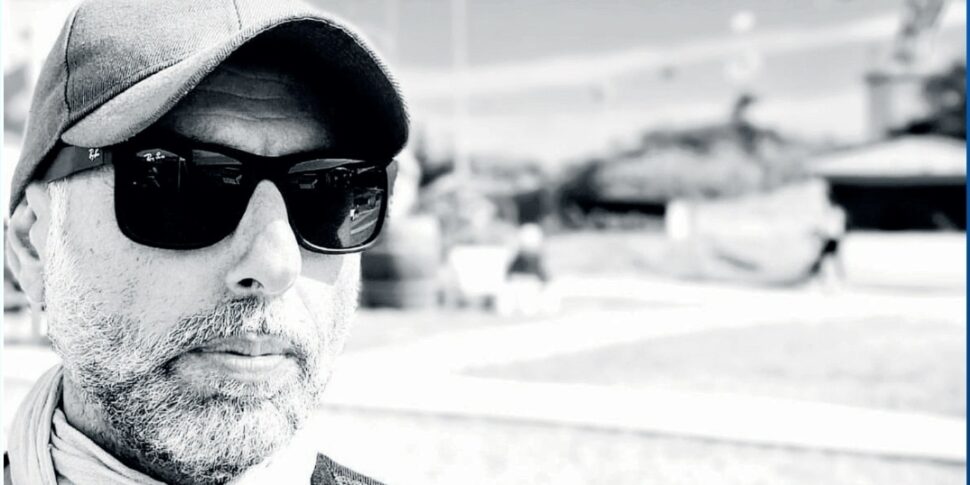
A strong story about human misery and the dark side that dwells in each of us at the center of «La deriva», a new novel by the writer from Messina Graziano Delorda and his first collaboration with the independent publishing house Fox&Sparrows, now nominated for the 2026 Campiello Prize. Nine years after «Droid è la notte» (Augh!) and in parallel with the two volumes of «Lo dice mia nonna!» – self-published collection of Sicilian proverbs illustrated by the Messina cartoonist Lelio Bonaccorso – the author returns by narrating a drift of feelings, objectives and illusions, through a writing in images very similar to the cinematic story.
The story is that of Carlo Piccolo, a man marked in his youth by a tragedy that occurred in the village between Calabria and Basilicata where he used to spend the summer, leaving the Milanese suburbs for a while. Delorda presents him to us as a lonely person without certainties in the ruthless “Milan to Drink” of the 1980s, where everything seems to turn in reverse, mixing love with hate, sincerity with betrayal, childhood with nightmare. In a succession of events, the protagonist will embark on a slow but inexorable drift that will accompany him among specters, obsessions and guilt that have never subsided, in which the boundaries between innocence and cynicism will seem to dissolve, until they merge into a vortex of emotions.
«My writing has always been a stream of consciousness in which the narrative idea was developed subsequently – the author tells us -. In this case, however, I had no idea how to illustrate it, but I was well aware of the basic postulate to be dissected: to dispel the myth of the noble savage. The objective was to build a surprising story about human decay where the cleanest has the trouble, because we all have this dark side that we carry with us from birth.”
Is this a vision that belongs to you?
«It doesn’t belong to me one hundred percent, but I was interested in analyzing it on a narrative level. To put it like Louis-Ferdinand Céline, one of the writers I love, it has always been the devil who sells the most in life and for this reason I wanted to create a miserable, almost disgusting character who could accompany the reader towards this personal drift.”
The novel also subtly addresses the rampant yuppism of the 80s and 90s…
«The desire to fulfill oneself in the elusive work that ennobles man is one of Carlo’s major worries, as he states: “Everyone asks me what job I do in life, but no one asks what I am like or what I would have liked to do”. The novel underlies a criticism of that unbridled yuppism for which money and professional achievement were the guiding star of all young up-and-comers, a means to acquire symbols of status such as the designer belt or the big car.”
During the course of the story, elements seem to emerge that almost justify the deplorable behavior of Carlo and the other characters. Is that so?
«It is a very simple story, but in simplicity I intended to dissect this basic postulate on human littleness. When I finished the novel for the first time, in 2020, I said to myself “That’s okay, let’s leave it alone for now”. And after a month Covid broke out…”.
We could say that the writing was highly prophetic about the collective drift of recent years…
«In the midst of what was happening then I realized that the pessimistic vision of life present in the text was not so far from reality. Today, after Gaza, the Ukrainian conflict and everything that is happening in America, the situation has even worsened and this confirms how much the myth of the noble savage has really been overestimated. If they had told me in the 1980s that we would end up like this, I wouldn’t have believed it. It is a scenario that would not have been imaginable even in the most dystopian and post-apocalyptic science fiction novels. This shows that reality sometimes surpasses fantasy.”
To introduce the reader to the atmosphere of the text, the cover by the designer Michela De Domenico from Messina, with a human face that echoes both the iconic painting “The Scream” by Edvard Munch and the pictorial distortion of Francis Bacon.