

Add the Gazzetta del Sud as a source
«Each project is a cruel selection between infinite possibilities». In the words of Stefano Boeri, the architect and urban planner who created the Bosco Verticale residential complex inaugurated in Milan in 2014, there is perhaps the most intense definition of contemporary architecture: an unstable balance between imagination and limit, between research and matter, between utopia and responsibility. And it is precisely in this “crazy and exciting” tension that an idea of the city as a fluid ecosystem, shared between human beings, nature and biodiversity, takes shape. A model – that of the “living” building that changes and grows like the trees and shrubs distributed on the balconies – which, conceived as “a provocation”, is today capable of speaking both in Milan and in Southern Italy, where the relationship between city, vegetation and climate has always been closer than in many Northern European metropolises.
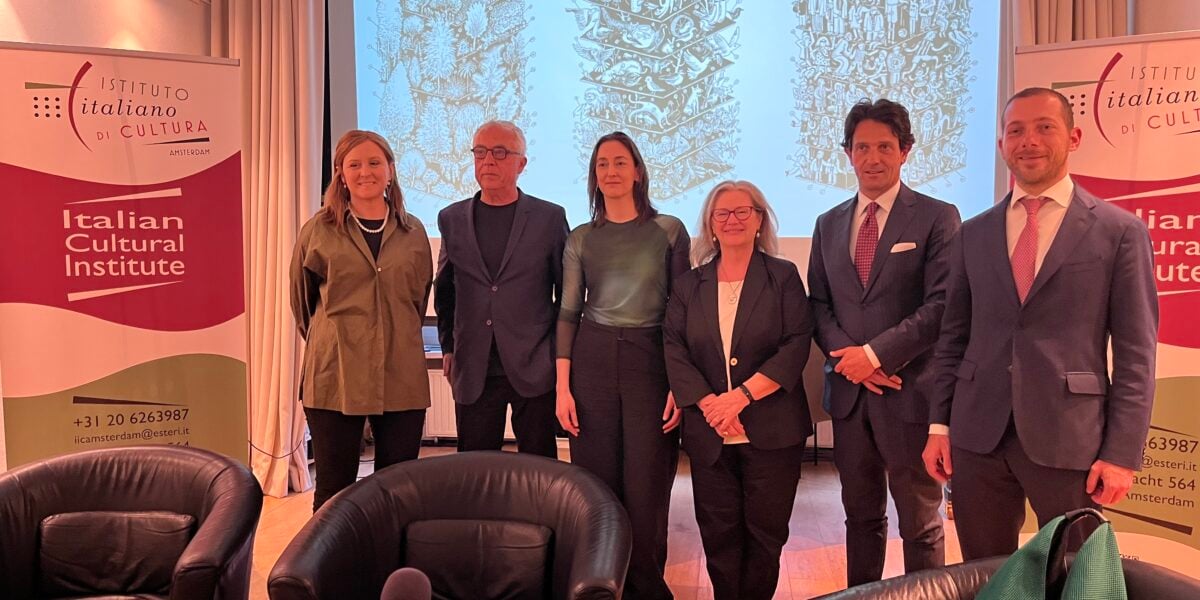
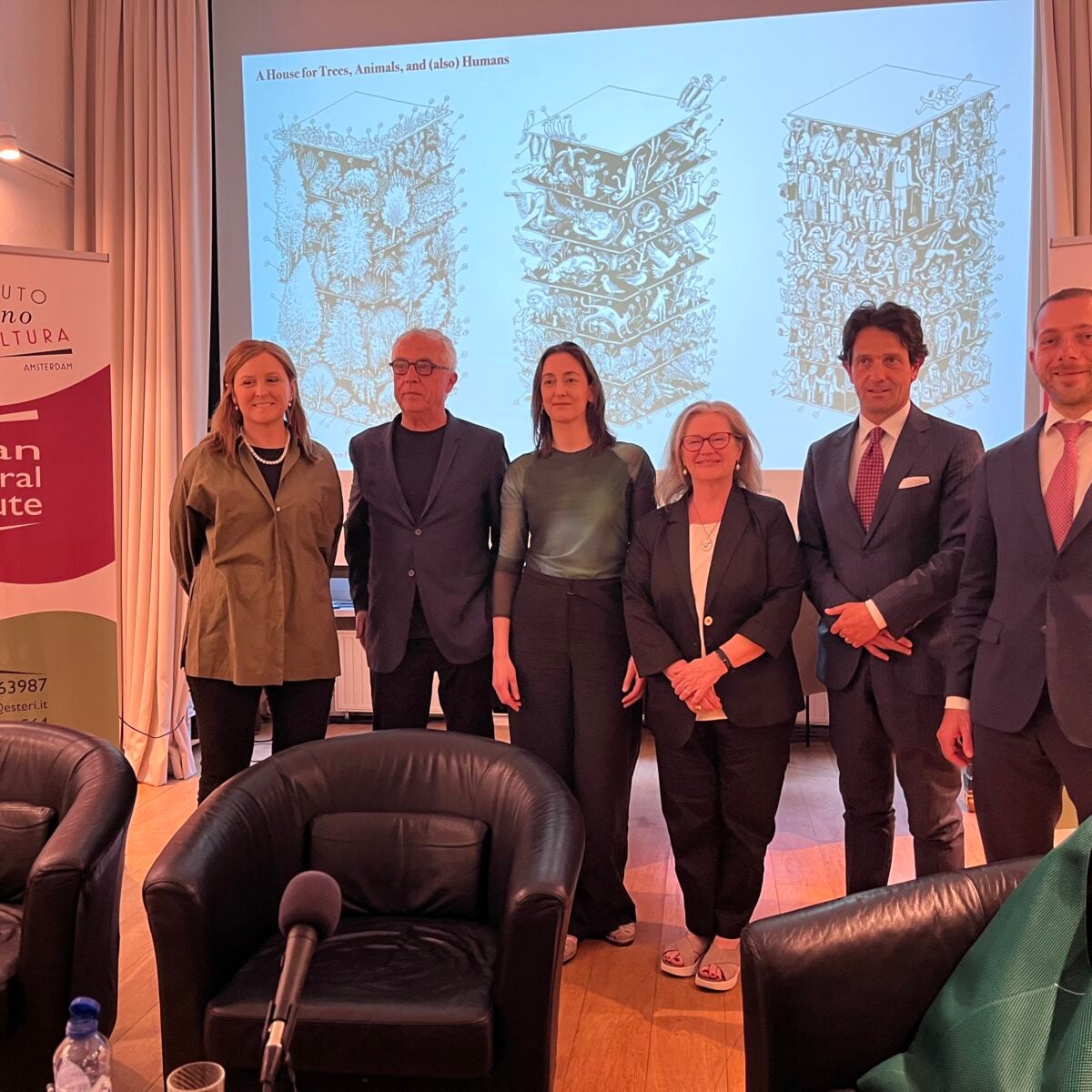
It is from this vision that the presentation of the volume “Bosco Verticale, Morphology of a Vertical Forest” (Rizzoli, 2025), promoted by the Italian Embassy in the Netherlands and the Stefano Boeri Architetti studio, began at the Italian Cultural Institute in Amsterdam. A design reality, the latter, which has developed a strong and recognizable identity for its integrated and multidisciplinary approach that ranges from architecture to design, with constant attention to the geopolitical and environmental implications of urban phenomena.
Opened by the Italian Ambassador to the Netherlands, Augusto Massari, and introduced by the director of the Italian Cultural Institute in Amsterdam, Veronica Manson, the event offered much more than the presentation of a book. From the very beginning, a broad, almost poetic reflection on the concept of urban ecosystem emerged.
Boeri’s vision is secular, but in fact it intercepts a very Italian and Mediterranean sensitivity, recalling in certain aspects the horizon of the “Canticle of Creatures” by Saint Francis of Assisi, in the year of the eight hundredth anniversary of his death: the idea that trees, water, animals and human space belong to the same relational ecosystem. A theme that in Southern Italy, where the landscape remains an integral part of cultural identity, takes on a particular resonance.
The meeting, rather than celebrating the Vertical Forest of Milan as a symbol of sustainable architecture of the 21st century, opened a profound, almost philosophical reflection on the possibility of rethinking urban spaces as places of cohabitation between different forms of life. A redefinition of the role of architecture itself, not only as the construction of buildings but as the creation of relationships. An aggregating, civil, ecumenical art. It is no coincidence that the structure of the book recalls the growth of a tree, punctuated by roots, trunk, branches and leaves. In the wake of the pioneering project carried out in Milan, the Stefano Boeri Architetti studio has also exported the model to the Netherlands. Among the most significant examples are the Trudo Vertical Forest in Eindhoven, which applies the concept to social housing, and the Wonderwoods Vertical Forest in Utrecht, the first mixed-use vertical forest with also public functions.
Ambassador Massari recalled the attention shown to Boeri’s projects by Queen Máxima of the Netherlands, sensitive to the issues of sustainable innovation, and underlined how the collaboration between Italy and the Netherlands is contributing to the promotion of more resilient urban structures capable of reintegrating nature into the city space. In the context of this synergy promoted by Italian cultural diplomacy, the very crowded event saw Stefano Boeri and Francesca Cesa Bianchi – partners, together with Marco Giorgio and Pietro Chiodi, of the studio which has offices in Milan, Shanghai and Tirana – dialogue with the Dutch architect, researcher and teacher Katja Hogenboom on the role of urban forests as eco-social infrastructures.
Boeri insisted on the need to overcome the traditional separations between nature and culture, recalling how even trees have their own “technology” in the way they use light, water and vital processes. A gaze that is not only anthropocentric and has accompanied his research for years, inspired by the desire to “cross borders”. The Vertical Forest, he explained, was born twenty years ago during an international competition on the future of Paris. A disruptive challenge that later became a global symbol of sustainable architecture.
Also significant is the reflection on the work that Boeri conducts today with the students of the Polytechnic of Milan: a laboratory in which students are asked to take the point of view of animals and other forms of life present in the city, even imagining a sort of “parliament of other living beings”. Not a sentimental exercise, the architect specified, but a way to develop new sensibilities and new forms of urban intelligence.
In the final dialogue the theme of the Bridge over the Strait of Messina also emerged. Boeri said he was fundamentally in favor of the work, while underlining the need to address the seismic risk with absolute priority and noting that after forty years of debates and investments, the project continues to be described “in a confusing way”. The Bridge, he observed, could represent an opportunity for infrastructural modernization and integration of Sicily with the rest of the country. “Sicily is not just history, it is also modernity”. A very strong phrase that overturns the traditional narrative of the South. In Boeri’s words, a vision of the South emerges far from nostalgic stereotypes: not an immobile museum of Mediterranean memory, but a territory capable of producing urban innovation, environmental research and new models of coexistence between nature and the city.
Through the Vertical Forest and its international evolutions, the message that emerges from Stefano Boeri’s work appears clear: imagining greener cities does not just mean adding trees to buildings, but radically rethinking the way in which human beings inhabit the world together with other forms of life.