

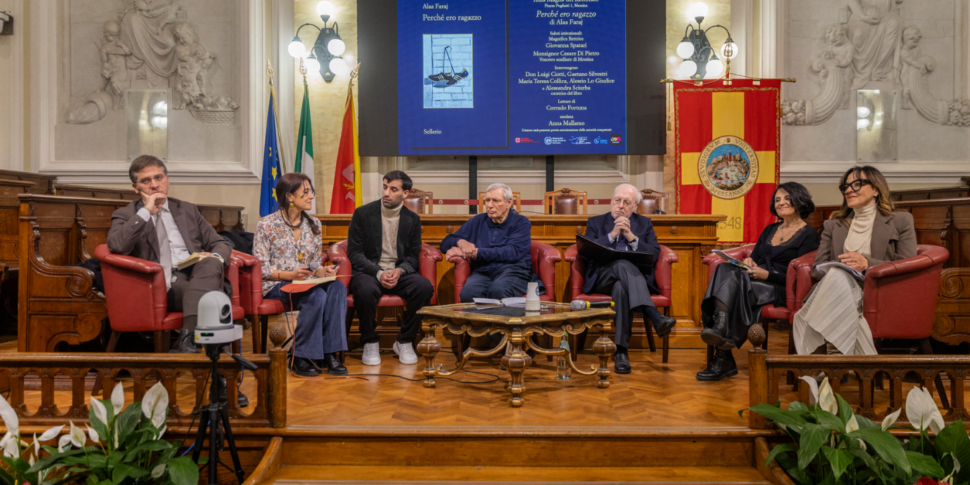
It speaks the language of pain and resistance, but never of anger, «Why I was a boy» (Sellerio), the book written by Alaa Faraj, at the center of a meeting at the Rectorate of the University of Messina. A title that is the cry of pain but also of hope of Alaa, a young Libyan footballer, born in Benghazi in 1995, torn from the lives he could live when on the night of August 15th 2015, a few miles from Lampedusa, in that boat on which he was for his dream of freedom, 49 people died of asphyxiation in the hold and Alaa with others was identified as smugglers. Hence the arrest, the trials, and the sentence of 30 years in prison. Then, last Christmas, the granting of pardon, but partial, with a decree signed by the President of the Republic Sergio Mattarella and the reduction of the sentence by 11 years and 4 months.
Another painful journey in which Alaa’s life was filled with many things, including the writing of this book, born from the meeting in 2023 with Alessandra Sciurba, professor of Philosophy of Law at the University of Palermo and activist in defense of human rights, as part of the “Spazio Acrobazie” laboratory inside the Ucciardone. Between letters with Alessandra, human experiences and memories, a story was born which travels Italy with its naked words, uniting the voices of many with that of Alaa, “who looks us in the eyes and questions us”, recalls Sciurba.
In the presence of Alaa, granted by the competent authorities, the rector of the University of Messina Giovanna Spatari recalled how «this book gives back to the written word its profound ethical lesson, of questioning consciences». And in the meeting promoted by Caritas, the Archdiocese of Messina, Libera and Cesv and the University of Messina, and moderated by the writer and journalist of the Gazzetta Anna Mallamo, the auxiliary bishop Monsignor Cesare Di Pietro defined Alaa as “a teacher of new generations for his broken but not defeated youth”, and exhorted with the young man’s own words, “we will make it”, “for a fair justice of which the Constitution is one of the few remaining bulwarks”.
«An extraordinary human document of dignity and resistance – said Mallamo at the opening of the speeches accompanied by the intense readings of the text by the actor Corrado Fortuna –, a luminous story in which there is a vivid and curious look at the beauty of this land of dreams and hope where he found prison, but also many chains of solidarity. A book written with a creative word of pure enthusiasm, with that gaze that looks at us and discovers things about us that we didn’t know, crossing dramatically current themes.”
Because Alaa’s story is not just his, but that of around 3000 people, in the last 10 years, accused of being smugglers. And the exhortation to amplify Alaa’s voice with our voices was joined by that of Don Ciotti, who calls Alaa “brother”, admiring his kindness and gratitude for a country, ours, where there is also “a hemorrhage of humanity. Alaa does not hold a grudge against anyone, and speaks of «hope which is a pain that does not give up but is also trust in our laws, in the many people who got involved with him for fair justice. And we are here not to give up, to arrive at a truth” concluded Don Ciotti, embracing Alaa.
Then the illustrious jurist Gaetano Silvestri, former president of the Constitutional Court, who said he was “intellectually and emotionally involved” by Alaa’s story, and impressed by the word “dignity” recurring in the book. «This young man’s youth was confiscated, his freedom was taken away but not his dignity, which was never lost even in the worst moments. And the dignity which is also trust in the rule of law is the root of our Constitution where the term often appears.” Justice “is human and can make mistakes”, stated Silvestri, quoting Socrates from Plato’s Crito and recalling how Alaa, respectful of our laws, “was always in the company of his conscience”.
“There are those who leave to escape wars and misery, and there are those who chase a dream which alone is worth the risk of life” said Maria Teresa Collica, professor of criminal law at Unime, focusing on an important point in Alaa’s history. «And for this reason he faces the Mediterranean, because paradoxically the sea is the only friendly place, as many Italians did in the past with the Atlantic. This book makes us reflect on how security policies deal with immigration, depending on the governments that alternate and in which since 2017 the legislator affects the migrant and those who help him. Luckily our law has developed antibodies and many repressive measures end with dismissal.”
The professor of Philosophy of Law at the University of Peloritano, Alessio Lo Giudice, also greatly appreciated the book for its attention to otherness, and insisted on the fact that “we are faced with a case of full-blown injustice, and it is significant that we talk about it on Remembrance Day”. And remembering, with finesse, that “we must always avoid the standardization of judgement, take into account the context and the singularity of the case, otherwise it is not possible to find justice in the law”, he hoped for another story for Alaa, a full justice, as Sciurba did who, quickly going through the facts, with emotional accents, said she was honored by the meeting with Alaa.
Finally he, Alaa himself, moved, addressed kind words of gratitude to everyone. «Prison wasn’t all dark for me – he said – even there I found the healthy and supportive part of Italy. Your country is wonderful. The pardon, thanks to President Mattarella, was a Christmas miracle. I was convicted without evidence and therefore I must continue until the review can remove the label of convicted felon.”
“This is humanity, this is the world we would like” concluded Mallamo, but it was everyone’s thought, feeling.