

That music was a destiny for Giacomo Puccini was written in the stars, not just a question of notes but a fire that had nourished him since he was a child, a space in which to calm the turmoil of life and study that of love. And music seems to be a destiny for Maestro Filippo Arlia who, fresh from the Mozarteum in Salzburg, made his debut on Friday evening at the “Cilea” Theater in Reggio Calabria with the premiere of “Tosca”, directed by Mario De Carlo, even if «it is not my first Puccini – he said -, in my repertoire there are already “Madama Butterfly” and “Turandot”, but “Tosca” is certainly the Puccini of all, a a bit like “La Traviata” it is everyone’s Verdi.
Conducting “Tosca” means dealing with a score that burns with passion and theatrical truth. It is a work that leaves no room for distance: every bar is tension, every pause is dramatic breathing, every orchestral explosion is destiny that is fulfilled.”
And for this “Tosca” of all, created with the collaboration between the Tchaikovsky Conservatory and the Polis Cultura (the latter, with the organizational direction of Lillo Chilà), the Cilea (“a wonderful theater, in Italian style, with a warm audience that loves opera very much”, says Arlia) hosted the beautiful scenic setup, from the original sketches by Nicola Benois, curated by Sormani Scenografie of Milan and illuminated, between chiaroscuro and bright colors, by the Light Designer Lorenzo Tropea (lighting master Claudio Bagnato). Everything, says the director and costume designer De Carlo, «through gestures, sets, costumes, props, declares how brilliantly lugubrious emerges from this masterpiece, marked by sinister ambiguity, revealing what Michel Foucault calls «the splendor of torture», a world which recognizes its greatest splendor in the flashes of suffering and death».
And the score burns with passion, with great theatricality from the first act: already in the basilica of Sant’Andrea della Valle the mechanism of the “splendor of tortures” is revealed when a ragged Cesare Angelotti, former Bonapartist consul who fled from Castel Sant’Angelo (the baritone Francesco Villella) bursts in and takes refuge in the chapel where his sister, the Marchesa Attavanti, made him find the keys and women’s clothes with which dress up. And it is there that the painter Mario Cavaradossi (Samuele Simoncini, tenor with a warm timbre and good stage presence) meets him, who is working on a canvas of the Virgin in the basilica. Angelotti hides for the arrival of the sacristan (Francesco Auriemma) and Tosca (the soprano Bianca Margean).
If the character of the opera is the voice, it is his crystalline voice that announces it even before being seen, and if the voice is a mystery, the body is everything, itself a narrative element in its dominating the scene. Yellow dress like the jealousy that will betray her (the costumes designed by Mario De Carlo and made by Sartoria Bianchi in Milan are beautiful), but which for her is also a sign of love. A very dear role that of Tosca à la Margean, to which she lends her rich and luminous voice, with all the register changes that modulate the pathos of the interpretation.
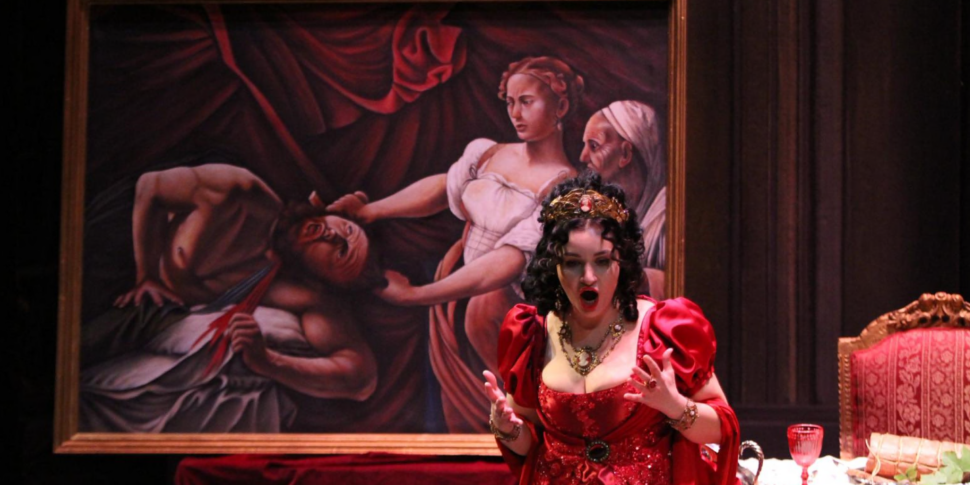
And it is the orchestra itself – Arlia recalls – that “becomes the characters’ inner voice”, accompanying them and urging them on, while the tension grows when Baron Scarpia enters the scene, an exceptional Carlos Almaguer (baritone) who gives great stage presence to the ambiguous chief of the papal police, “bigot satyr”, especially in the second act which opens on Palazzo Farnese. Now a blinding, funereal red dominates, which seems to make even the sacred furnishings bleed in contrast with the lascivious atmosphere of the scene, woven by strong opposing tensions.
Also red is the sumptuous dress, of passion and death, of the diva Tosca, once again a prima donna, seized by the Luciferian Scarpia, violence hidden behind lewd attentions, with Cavaradossi, prisoner and tortured, in the background. We listen to love, despair, believe, deceive, and despair again, with the beautiful “Vissi d’arte” by Tosca, a climax of emotions supported by the musical one, until what the painting with Judith and Holofernes shows, in foreboding evidence, happens. Soon everything is consumed, in the third act the events precipitate, there is only a brief space for quiet, softened by the lyricism of the elegiac “E lucevan le stelle”, which Cavaradossi intones with a moving tone: it is a Roman dawn with poignant colors seen from Castel Sant’Angelo, where a Tosca dressed in purple bursts in, still a speaking colour. It almost seems as if mourning suits her as she performs her final act.
A “Tosca” highly acclaimed by the public, a tribute from Arlia together with the impeccable Calabria Philharmonic Orchestra, to her Calabria, «land of contrasts between intense light and sudden shadows, lives within this musical reading» and which are found in Tosca «with the same emotional intensity».
And among those who contributed to the excellent performance of the opera, Emanuele Campilongo and Giuseppe Calabretta (the gendarmes Spoletta and Sciarrone), Andrea Borzachiello (jailer), the International Oper choir directed by Giovanni Mirabile, the Children’s Choir “Note celesti” directed by Alessandro Bagnato. And again, Andrea Calabrese (substitute master), Serenella Fraschini and Francesca Allegra (collaborating masters), Marco Labate (assistant director), Grazia D’Agostino (costume assistant), Carmen Staiano (stage director), the Gruppo Acconciatori Reggini for hair and make-up and MG Multiservizi for the staging.