

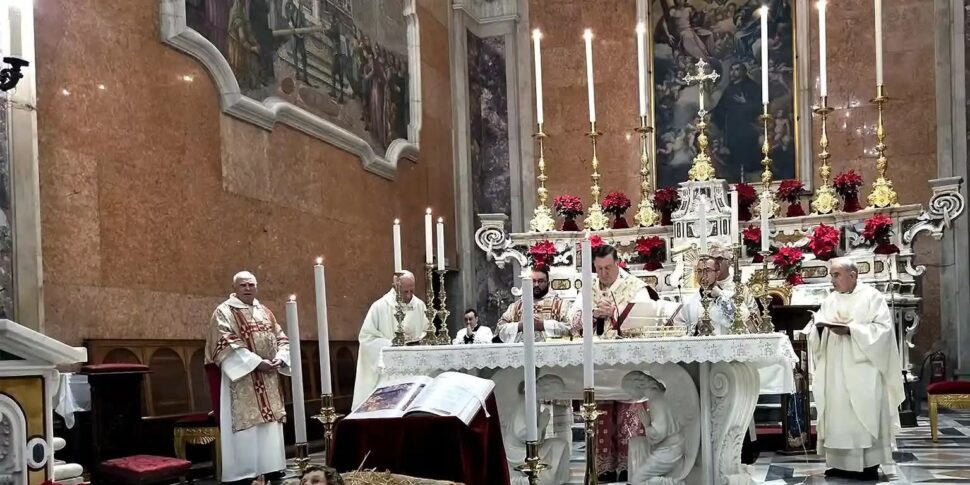
In the Christmas Eve Mass, celebrated in the Basilica of the Immaculate Conception, Archbishop Claudio Maniago gave the diocesan community an intense and profoundly timely reflection, centered on the heart of the Christian message: the peace that is born from the Child of Bethlehem and asks to become a concrete responsibility in history.
«To us a child is born: his name is Prince of Peace». From this proclamation of the prophet Isaiah, echoed by the singing of the angels on the holy night, the Archbishop invited the faithful to welcome, like Mary, Joseph and the shepherds, “the light of this night and with it its peace”, because Jesus, Emmanuel, “seeks people who bring and communicate his peace”.
Not just the absence of war
At the heart of the homily, Msgr. Maniago clarified that Christian peace does not coincide with a fragile truce or the absence of conflicts. “Peace does not just mean the absence of war – he stated – but fraternal, personal and community life, animated by truth and love”. A peace continually threatened by sin, which generates selfishness, enmity and violence, and from which man cannot free himself.
Hence the strength of the good news of Christmas: God himself moves towards humanity to heal “this disease, this virus that attacks the mind, the heart and human relationships”. Celebrating Christmas therefore means opening real spaces – spiritual, cultural and social – to the action of the Son of God, allowing his grace to enable us to reject “the unfair logic of contrasts”.
Peace that sets in motion
Recalling Pope Francis, the Archbishop underlined that the peace of Jesus is neither static nor intimate: “It sets you in motion: it doesn’t isolate you, it makes you go to others, it creates community, it creates communication.” It is a free, fruitful peace, which does not fade in difficulties, but continues to shine “even when the dark shadows of problems descend, because it is full of hope”.
A clear invitation, addressed to the faithful, to first let the peace of the Lord grow within themselves. Often – he observed – internal discomfort is attributed only to external factors, risking fueling anger and discouragement. The encounter with Christ who “knocks on our door” allows us to re-read our lives, to reconcile with ourselves and to generate a peace rooted in the good experienced and given.
Families, peoples, the world
The reflection then expanded to family life and global scenarios. In families, the peace of Christ becomes patience, the ability to valorize the good, an antidote to quarrels and divisions. But those who truly welcome the Child of Bethlehem also feel a universal brotherhood that does not allow indifference in the face of the tragedies of the world.
With strong words, Msgr. Maniago recalled the absurdity of the war in Ukraine, the tragedy of the Middle East and the many conflicts that bloodied the planet, defining them as a “bloody shame that stains our humanity”. Believers, he reiterated, cannot resign themselves: «War is never a fatality; it is always a defeat for humanity”, as Saint John Paul II recalled. For this reason, Jesus’ disciples know that peace is a gift from God, but it requires a courageous response, made up of prayer, penance and persevering commitment.
At Mary’s school
In the final passage, the Archbishop invited the community to put themselves “at the school of Mary, teacher, mother and model of communion and peace”. Where Maria arrives, he stated, “tensions ease, the darkness is overcome and hope is reborn which does not disappoint”. It is the hope that accompanies the Church’s journey and illuminates even the most difficult nights in history.
Welcoming the Child born for us then means saying, with humility, our own “yes”, uniting it with that of the Virgin of Nazareth, so that the Almighty continues to accomplish great things. A Christmas that does not remain confined to the ritual, but becomes a life choice and daily commitment to be builders of peace in the world.