

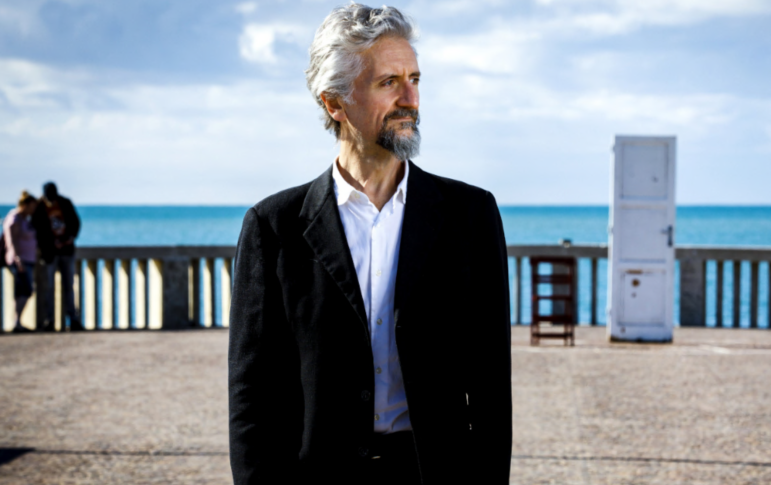
It is called “Poveri Cristi” and is the latest theater show by Ascanio Celestini, a Roman actor and writer, above all a “storyteller”, currently on tour throughout Italy. On March 28th, at 9pm, it will be on stage in the Politeama “Mario Foglietti” in Catanzaro. «Who are the poor things? I am – says Celestini – the last of the class when there were differential classes for the poor; the black sheep in the asylum who solved the problem for those on the outside, but not for those on the inside; the one who is nailed to some illness without guilt, but also without a future, etc. And if I say “etc” I have said it all. I said everyone.” He describes them “as saints because every day they perform the miracle of remaining in the world”. And in an interview he tells us many other things.
The novel and its meaning
“Poveri Cristi” is also a novel published in 2025 by Einaudi which begins like this: «Christ did not come down from heaven, but rose from the earth. This is the first sentence, but it could end here.” How do you explain it to us?
«Because the characters try to transcend to get out of their complicated present. A miracle would be needed, but unfortunately they have nothing divine about them even if they tend towards the sky.”
The choice of characters
Among the many “Poor Christs” created by his writing, he stages only a few every evening. What are the selection criteria? Geographical, temporal, actor-author intuition, other?
«I use technical, not qualitative, criteria. For example, I avoid longer, more complicated stories and choose those that are understandable even without context. However, they are all events, taken from a previous trilogy (“Laika”, “Pueblo” and “Rumba”), which take place in a parking lot, between a warehouse and a supermarket, a small place that helps the spectators’ understanding. What interests me most of all is the humanity of the characters.”
Language and writing
In a show like this, the choice of language is fundamental: how does he operate in his writing workshop?
«When they tell me “you speak on stage as in life” for me it is a great compliment. They are all stories whose structure and possible variations I know well. I know the words of the surgeon as well as the blacksmith, the bourgeois and, indeed, the last ones, because I have looked for them and met them, it is my job. I always say that there are those who cook for the family and those who are professionals for the restaurant. I am the professional of the cuisine of words.”
Theater and storytelling
You have dedicated yourself above all to narrative theatre, alone on stage: is this a definitive choice or do you intend to amaze us with texts with dialogue and multiple performers? And, for both yes and no, what are the main reasons?
«I don’t believe in the concept of narrative theater because all theater is the narration of stories, like Shakespeare, for example. Rather, I am against the division of roles that exists in directorial theatre. In my opinion, the actor who goes on stage is completely responsible for what he brings to the stage. The viewer must feel that I am speaking directly to him. There is no need for an assembly line for direction, scenography (I only use a few objects), lights etc., I can do everything. With me there is only one musician, Gianluca Casadei, because together we can improvise. With other actors alongside, improvising is almost impossible.”
Religion and culture
In his texts he dealt with religious themes, from Jesus to Saint Francis, and also with Pasolini, an author who had a very personal relationship with religion. How do you stand between the Gospels and Pasolini?
«Like all those born in our area: I have a Catholic background and, even if I am not a believer, I do not deny it. Ritual belongs to me, as it probably belonged to Pasolini, we grew up with the stories of the Gospels. I have doubts about God but not about the culture of the words of Christ, who was certainly a non-violent pacifist, a value that we lack today.”
The last ones in the center
In his hierarchy of values, the last are the first (just to stay on the evangelical theme). Is this a choice also linked to your life?
«Yes, I would like to bring the latest to the fore. I return to the previous answer: Jesus communicated with the word and then performed concrete acts with miracles. They were like compensation for the least. As if he were telling them: it’s possible. Even more I admire Saint Francis who made himself last by choice. But then faith is something else.”
The relationship with the public
While always touching on extremely serious topics, you also have the ability to make people smile: is this a way of being or is it the search for greater complicity with the public?
«I look for complicity, but not to get approval, I don’t work on the joke. The actor stays behind the story he tells and doesn’t use stratagems. The viewer must imagine characters and places, like in a film. The smile makes people well disposed towards their imagination.”
The future of the “Poor Christs”
One last question: in this world where warmongering is growing, are the “Poor Christs” destined to increase? What will be their fate?
«Probably yes, because they are people who have no alternatives, as were, for example, the victims of the Cutro shipwreck, a place where I recently returned for the anniversary. The last are those who find themselves on the top floor of a skyscraper when a fire breaks out: they have no alternative to their fate. We are, not least, the ones who have to get busy: getting under the skyscraper with fire hydrants, with ladders, with the tarpaulin. Perhaps we need a conversion to really see the last: I think of Father Alex Zanotelli, when he says that it was the African slum dwellers who sent him to Europe to “convert the white tribe””.