

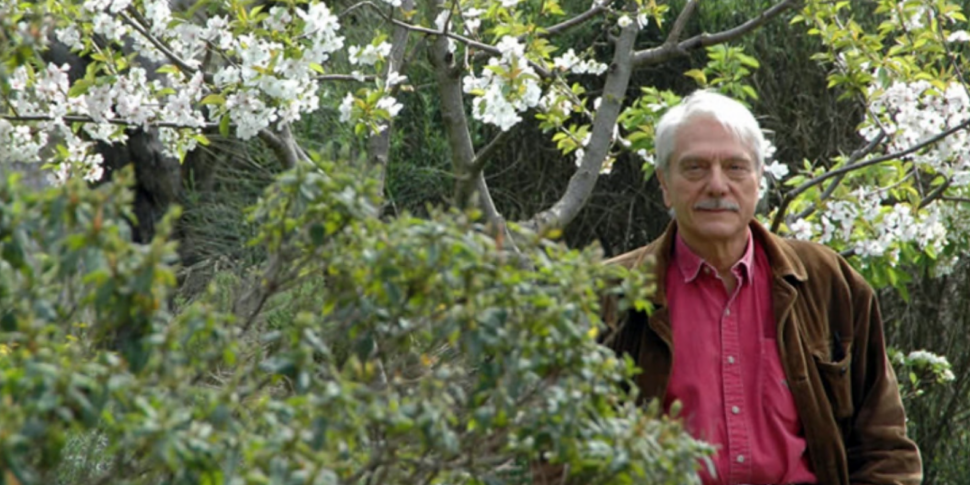
A life between law and writing, that of Domenico Cacopardo, former state councilor, writer and journalist, born in Rivoli (Turin) but Sicilian throughout, by family ancestry and by life lived in “his” Messina, “the only city I have always loved” – he says – and in “his” Letojanni, always looked at with a dreamy gaze even when the narrative theater of troubled stories or dark and criminal cases. Today, on April 25th, he will celebrate 90 years of an existence full of professional commitments, experiences, meetings and crossroads. «Ninety years that I have lived peacefully – he tells us – not a goal, just a date, important yes because I get there after having faced various health misadventures, including five tumors resolved with the excellent surgery of the National Health Service. Important because a few months ago I started collaborating again as a columnist with the Gazzetta di Parma and then I started finishing the latest novel with Italo Agrò, former public prosecutor and successful criminal lawyer in the last decade.”
And the one with writing was certainly a fundamental encounter, a way to talk about Italy by moving into another room, that of narrative fiction unfolded in his 21 novels, from «Il caso Chillè» (Marsilio, 1999) to the last, «I am your destiny» (Ianieri, 2024), with the Agrò series in the middle, started with «L’endiadi del Dottor Agrò» (Marsilio, 2001), who, from his first investigation as a student, in «Agrò and Marshal La Ronda» (2013), will become more disenchanted than come to his senses, a character who «unfortunately due to unfortunate circumstances did not end up on TV where, like “The Chillè Case”, he could have been». And within all historical novels to continually reinterpret the past, and the detective story often deconstructed or taken as a method to linger on the gray areas of the psyche and investigate the link between power, crime and corruption, on justice, on amoral familism, on misunderstanding and deception.
The art of writing, Nabokov said, as the art of seeing the world and therefore as a potential resource for narration. How do the magistrate, the writer, the journalist see the world?
«The passage of time has deprived me of friends and teachers from whom I have drawn in the past. Today, the generous utopia of an international order strong with quasi-state tasks and capable of preventing the resolution of conflicts through war has collapsed like a Chinese balloon. And with it many certainties have dissolved. First of all, consider the democracy of our country immune from risks and dangers. If we had talked about it in the early 1990s we would have been thought to be out of our minds. Instead, since then there has been the dissolution of the first Republic, the emergence of Berlusconi and a second Republic, fake-bipolar, unsuccessful and generally authoritarian (think of the electoral mechanism that severed the relationship between representatives and representatives). We are back in the middle of the ford.”
In the beginning there was “The Chillè case”. How did it all come about?
«Randomly. I had more than ten typescripts with stories, kept in the library of the house of my great-grandfather Saverio, the last Bourbon magistrate at the head of the court of Reggio Calabria. One day in August 1998, my son-in-law, a journalist, struck by what would become “The Chillé case”, suggested that I send it to Gian Arturo Ferrari (Mondadori) and Cesare De Michelis (Marsilio). Two yeses came, but De Michelis told me he wanted to publish it immediately: and it was Marsilio.”
And then there is Italo Agrò’s series with his “method”.
«The “Agro method” reproduced, si parva licet, the more famous “Falcone method”: work, work and work. For this reason Falcone was hated in the judicial offices of Palermo. But this is another story, one of those that we Italians wanted to archive, closing our eyes.”
Betrayal and lies, prejudice rooted in communities, imposture and truth confused to the point of crime, themes present in your novels: do you feel more Sciascia-like or more Manzonian-like?
«I answer neither and nor. Of course there are both. But I am the result of the meeting between my father, an engineer from Messina, a boy from ’99, then a high state official, and my mother, the 18th daughter of a socialist family (also communist after ’22), a partisan leader, a monsignor in the Vatican, a professor of Latin and Greek. The partisan uncle, for a year or so, lived with my family, in my room. One cigarette after another, at night, he explained freedom and revolution to me.”
The historical setting has been present since “The Chillè case”, in the twentieth century post-Messina earthquake. But it is certainly, together with the eighteenth century, the Sicilian seventeenth century that he privileged.
«The seventeenth century, the golden age of Messina, a meeting place for artists and great merchants who imported goods from the East. Of the silk and tapestries that enriched the great Flemish and French residences. The Senate of Messina corresponded with the Pope and the Emperor.”
In your narrative progress you have followed a Peloritan geography, also engaging in linguistic research that extends from Messina to the Ionian area. So is there a Cacopardian Sicily?
“I don’t know. There are my eyes, my head that are amazed by the landscapes, the archaeology, the architecture, the painting. The women and men of Sicily no longer amaze me. Unfortunately”.
The goal for her was to leave. But with narration and imagination he returned to Sicily and remained there.
«Ulysses’ restlessness. The day of arrival and the day of departure, both happy for opposite reasons.”
With “I am your destiny”, from 2024, together with the theme of feminicide there is a conclusion that predicts a 2026 in which an attempt to divide Italy takes place with the constitution of Padania. And instead in this 2026 much more happened…
“Fortunately, so far the dystopia has not come true, even if Italy’s enemies still roam the sacred palaces.”
And today, the desire to tell?
«With slow maturation, it is there. I would like to make it in time.”