

It’s still raining in Calabria. Above all, it is raining increases while the shutters are raised with difficulty, the petrol stations are attacked, and in the bars you can now pay for the coffee without looking at the change anymore. Normality, here, has taken on the opaque tone of numbers that the crisis quickly multiplies. Today, yet another signal will come from electricity bills. And it was Arera (Regulatory Authority for Energy, Networks and the Environment) who communicated it. From this morning (and it is not an April Fool’s joke) an increase of 8.1% is expected for the most fragile customers. It is the effect of global tensions that flows down the supply chain and is deposited in family budgets. The crisis in the Middle East continues to compress energy markets, and Calabria feels the longest echo of it. Energy returns to being a heavy, unstable and unpredictable cost that weighs on the budgets of the weakest.
Fuel and price increases
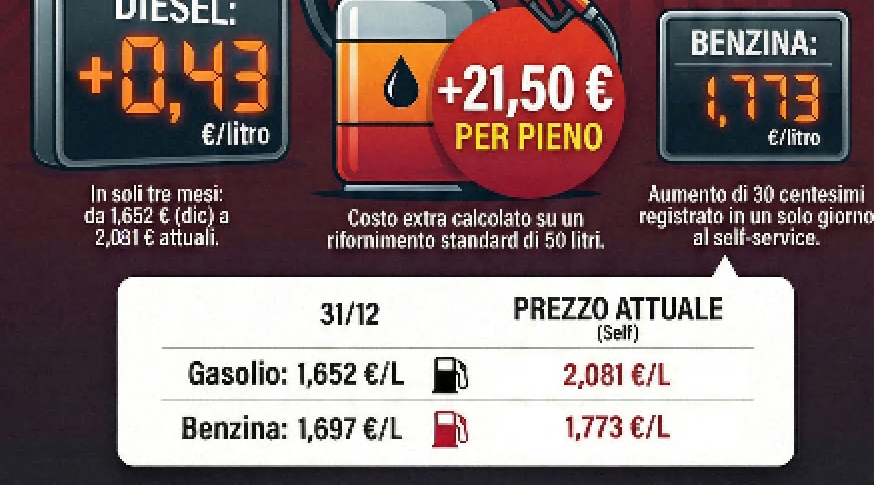
But it’s not just the price of light. Petrol and diesel define, more than any other macroeconomic indicator, what has happened in the balance sheets of businesses and families. In three months, diesel prices have risen by over forty cents per litre: translated, an average full tank costs at least twenty euros more. This is a blow that accumulates in household accounts and, above all, in the costs of small businesses. In Calabria, the increases at the charging station are more significant than elsewhere.
Live trucking
It is not surprising, then, that tension has shifted to the road haulage front. The trucks remain stationary, or threaten to do so. The squares are filled with permanent assemblies, the tone becomes more rigid. The sector speaks openly of an emergency. Diesel above two euros per liter is no longer sustainable for companies already exposed to increasingly reduced margins and to clients who struggle to recognize the increases. A minefield that shapes the current crisis in the chain that links the cost of energy to the final price of goods.
Stocks and scenarios
Meanwhile, out-of-stock signs are increasingly appearing at distributors. It is not just a question of price, but of actual availability of stocks. Tensions in the Strait of Hormuz, a crucial hub for global energy flows, are also reflected in local deposits. The perception is that of a scarcity of raw materials which not only concerns the present, but anticipates worse scenarios. And as the deadline for the excise duty cut approaches (scheduled for Tuesday 7 April), the risk is that the next increase will be even more violent and more difficult to absorb.
Businesses and transition
What makes the picture more fragile is the climate among small and medium-sized businesses. Confapi Calabria’s protest marks the fracture with the Government. The reduction of resources allocated to Transition 5.0 is seen by the national vice-president, Francesco Napoli, as a breakdown of the implicit pact between the State and the production system. The companies had planned investments, taken risks, oriented strategies. Now they find themselves faced with a downsizing which, in a context already marked by increasing energy and logistics costs, risks slowing down, if not blocking, innovation processes. Moreover, in Calabria the economic fabric is largely made up of small-sized businesses and any change in the scenario weighs more than elsewhere. The technological transition is a necessity to remain in the market. Reducing the tools means compressing the possibilities of being competitive.

Find out more in the digital edition
To read everything, buy the newspaper
or download the digital version.