

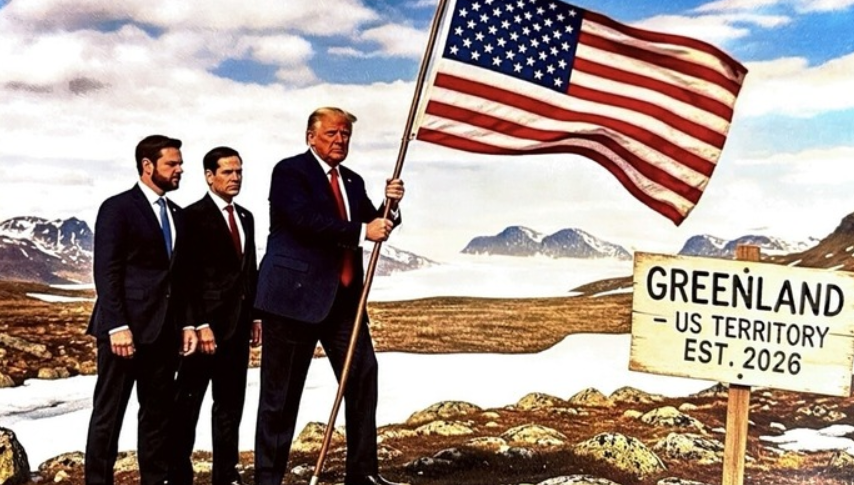
European leaders will not “put up too much resistance” to his attempt to buy Greenland. The president of the United States said this while speaking to journalists in Florida, also threatening a 200% tax on French wines and champagnes.
Trump then confirmed that he had invited Putin to join the “Peace Council” for Gaza and rejected Emmanuel Macron’s decision not to join the “Board of Peace” for the reconstruction of the Strip, stating that “nobody wants” the current French president. “Well, no one wants him because he will leave office very soon, so that’s fine,” the tycoon told journalists as quoted by CNN. “I will apply 200% tariffs on his wines and champagne and he will join” the board for Gaza, “but he is not obliged to do so,” the US president said.
Greenland: meeting in Davos with Rutte
“I had a very good phone call with Mark Rutte, the Secretary General of NATO, about Greenland. I arranged a meeting between the various parties in Davos, Switzerland. As I told everyone, very clearly, Greenland is critical to national and global security.” US President Donald Trump writes it in Truth. “There is no going back – everyone agrees on this! The United States of America is by far the most powerful country in the world” and “we are the only power that can guarantee peace throughout the world – and we do it, simply, through force”.
Eliseo: “Trump’s threats of tariffs on French wine are unacceptable”
US President Donald Trump’s threats to impose 200% tariffs on French wine and champagne are “unacceptable” and “ineffective”. A source close to French President Emmanuel Macron told AFP on Tuesday after Trump expressed the threat regarding Paris’ intention to reject his invitation to join the Board of Peace.
China: “Invited by Trump to the Board of Peace”
China has confirmed that it has received an offer to join the Board of Peace from US President Donald Trump. This is what Foreign Ministry spokesman Guo Jiakun said.
The Elysée confirms: “A G7 summit proposed on Thursday in Paris with Russia”
Emmanuel Macron proposed in a “private message” to Donald Trump to host a G7 summit in Paris on Thursday, to which he could invite, “on the sidelines” of the meeting, “the Russians”, which would be a novelty in almost four years of war in Ukraine. The American president published this message on his social network Truth, and it was authenticated by the French president’s entourage. In the message, Macron also proposes to invite the Ukrainians to this meeting, as well as the Danes, to discuss disagreements over Greenland and the Syrians.
Weber: “The European Chamber will suspend the agreement on tariffs with the USA”
“Acting with threats on the tariff front is completely unacceptable. And this is why the European Parliament has decided, together with the three large groups, to suspend the trade agreement” with the USA. This was announced by the president of the EPP group Manfred Weber, explaining the decision to postpone the European Chamber’s approval of the tariff agreement signed in Scotland. “It is the most powerful tool we have at the moment, the US will not be able to access our products at zero tariffs”, he underlined.
Lavrov denounces the ‘law of the strongest’ in international relations
International relations today seem to be based on the “law of the strongest”. Russian Foreign Minister Serghei Lavrov said this, underlining that Moscow “will defend its interests without attacking the rights of others and without letting others attack its own”. After citing developments in Venezuela, Iran and Greenland, Lavrov said that “solutions must be found that respect a balance of interests” on a basis of “equality and mutual respect”. Lavrov was speaking during the traditional annual press conference.
European stock markets are deteriorating rapidly, with the climate of volatility triggered by Trump’s new threats to the EU regarding tariffs for Greenland. Government bonds are also in tension while gold and silver reach new records, respectively at 4,729 dollars an ounce and 95.28 dollars. The Stoxx 600 index falls by 1%. Milan (-1.3%), London and Frankfurt (-1.1%), Paris (-1%), Madrid (-0.9%) decreased. The lists are weighed down by the industrial sector (-1.5%), the technological sector (-1%) and the luxury sector (-1.4%). On the currency front, the dollar continues to weaken. The euro rises to 1.1719 on the greenback.
“The moral role of the United States of America in confronting evil in the world and building a just peace is reduced to partisan categories that encourage polarization and destructive policies.” The complaint from three influential American cardinals close to Leo is unusual in its methods and tone, and was immediately relaunched by the Osservatore romano, the newspaper of the Holy See.
The archbishop of Chicago, the city where Prevost comes from, card. Blaise Cupich, the Archbishop of Washington, Card. Robert McElroy, and the Archbishop of Newark, Card. Joseph William Tobin, all three present at the conclave that elected Leo, take a position on American foreign policy after the military blitz in Venezuela and the threats to Greenland. The inspiration for the joint declaration (which however does not contain the signature of the president of the United States Episcopal Conference, Paul Coakley, received by United States President Donald Trump just on January 12th) is taken from Pope Prevost’s speech to the diplomatic corps at the beginning of the year: Leone pointed the finger at “the rampant war fervor” and the war which is becoming “fashionable” again, giving way to multilateralism.
“The United States – Cupich, McElroy and Tobin write – has entered into the deepest and most heated debate about the moral basis of America’s actions in the world since the end of the Cold War” and they cite “events in Venezuela, Ukraine and Greenland” which “have raised fundamental questions about the use of military force and the meaning of peace”. The three cardinals underline how “the balance between national interest and common good is framed in highly polarized terms”.
Furthermore, “the moral role of the United States of America in confronting evil in the world, in upholding the right to life and human dignity, and in supporting religious freedom – they underline – is under scrutiny and the construction of a just and sustainable peace, so crucial to the well-being of humanity, is being reduced to partisan categories that encourage polarization and destructive policies”.
“We seek to build a truly just and lasting peace”, is their appeal, “we renounce war as an instrument for short-sighted national interests and proclaim that military action must be seen only as a last resort in extreme situations, not as a normal instrument of national policy. We seek a foreign policy that respects and promotes the right to human life, religious freedom and the improvement of human dignity throughout the world, especially through economic assistance”.