

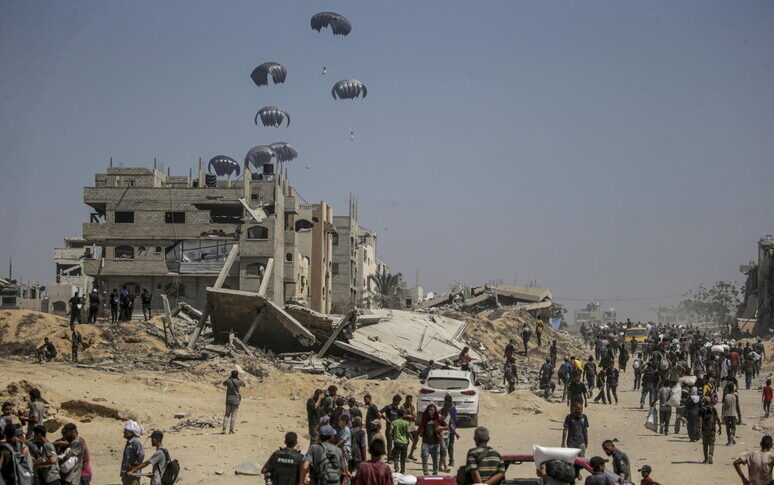
A month after the signing of the peace agreement between Israel and Hamas, there is a war of numbers on the humanitarian aid delivered in the Gaza Strip to the exhausted population, while the collapsed health infrastructure is unable to provide the necessary care.
The green light for the entry of aid trucks is being used as an instrument of pressure by the Netanyahu government to push the Palestinian terrorist group to return the bodies of the Israeli hostages. The crux is represented by the Rafah crossing, the reopening of which has been postponed several times as a consequence of the delay in the return of the remains of the hostages and of an attack on 28 October attributed by Israel to Hamas.
On the one hand, Israel and the United States say that every day hundreds of trucks cross the borders of the enclave, while Palestinian authorities, UN sources and various NGOs continue to denounce the difficulties in getting humanitarian supplies into Gaza in sufficient quantities to alleviate the serious famine – 55 thousand Palestinian children suffer from acute malnutrition – while 90% of the population remains displaced.
US President Donald Trump’s 20-point peace agreement establishes, for the first phase of its implementation, the entry of at least 400 trucks of humanitarian aid into the Palestinian enclave every day during the first five days of the ceasefire and an increasing number of 600 trucks thereafter. The agreement also provides for the immediate return of displaced people from the southern Gaza Strip to Gaza City and the north, the restoration of infrastructure (water, electricity, sewage), the renovation of hospitals and bakeries, the entry of the equipment necessary for the removal of rubble and the reopening of the roads.
Even today, UNRWA reported that 5,000 trucks owned by the agency are stranded in the besieged enclave. The UN agency for the relief and employment of Palestinian refugees in the Near East was banned by Israel last year, which demands the removal of its branded logo before allowing vehicles to enter.
The World Food Program (WFP) reiterated its call to open all entry points to flood Gaza with food and medical aid, stressing that no explanation has been provided for the continued closure of the northern crossings. Finally, a ship arrived from Türkiye with 900 tons of aid.
As a summary of these first 30 days, the White House stated that on average 674 aid trucks have passed through Gaza every day since the ceasefire came into force on October 10, with a total of almost 15 thousand trucks registered up to the beginning of November. “The United States is leading a historic effort to respond to the critical needs of the people of Gaza at this time,” a White House spokesperson said, insisting that President Trump’s administration is committed to treating Palestinians “with dignity and respect.”
Humanitarian workers “have reached more than one million people with home food parcels since October 10, while the production of meals in Gaza has increased by 82% since the end of September”, added the same source. Finally, the US administration highlighted that the eggs appeared on the shelves of Gaza for the first time since February, when Israel began a total blockade of all humanitarian aid in the besieged Strip, and that in a few weeks 17 thousand cubic meters of drinking water were delivered per day, increasing availability in the north of the enclave by 130% in the month of October alone.
These positive numbers and the proclaimed improvement in the living conditions of civilians are however strongly contested by the Palestinians, who denounce an “orchestrated hunger”, and by humanitarian organizations according to which the situation remains dramatic for 2.4 million people.
For the Gaza government, only 4,453 commercial and humanitarian aid vehicles have transported supplies to the Strip since the start of the truce, just 28% of the promised 15,600, for an average of 171 trucks per day. “These limited quantities are well below the minimum humanitarian threshold,” the Gaza government office said, calling for the entry of at least 600 trucks a day to deliver essential goods such as food, medicine, fuel and cooking gas.
The Palestinian government also accused Israel of “engineering hunger,” saying Israeli authorities have banned over 350 staple food products – including eggs, meat, cheese, vegetables and dietary supplements – while allowing low-value products such as soft drinks, chocolate and crisps sold at inflated prices. “This shows that the occupation is deliberately implementing a policy of manipulating food as a weapon against civilians,” the Gaza authorities underlined.
The United Nations Office for the Coordination of Humanitarian Affairs (OCHA) has noted improvements in the southern Gaza Strip since the truce, with families eating two meals a day compared to one in July. However, food security in the northern Gaza Strip remains in catastrophic conditions. United Nations spokesman Farhan Haq said that while humanitarian access has improved, “the urgent needs of the population are still immense”, with aid convoys limited to the Kerem Shalom, Al-Awja and Kissufim crossings.
The health issue
On the healthcare side, hospitals and other medical infrastructure have been largely destroyed by months and months of Israeli attacks. Just today, the World Health Organization (WHO) reported that the Al-Kheir hospital in Khan Younis has resumed operations after being forced to close due to the IDF raids in February 2024. The WHO contributed to the renovation of the hospital by restoring “water, sanitation, electricity and structural systems” and providing essential medical equipment and medicines.
A new 20-bed nutritional stabilization center was also opened at Al-Kheir Hospital, bringing the total number of such centers in Gaza to eight, with 90 beds for the treatment of severe malnutrition. A stabilization center provides care for children suffering from acute malnutrition with medical complications such as infections and dehydration.
As of the end of October, according to OCHA, only 14 of the 36 hospitals in the Gaza Strip were partially functional – eight in Gaza City, three in Deir al Balah, three in Khan Younis – but they are understaffed, lacking adequate medical supplies and overcrowded with patients.
Less than a third of pre-conflict rehabilitation services are operational, and many face imminent closure, warned Rik Peeperkorn, WHO representative in the West Bank and Gaza.
According to the WHO, in the Gaza Strip there are over 16 thousand patients still waiting to be evacuated for treatment abroad, underlining the need for more countries to welcome the sick and injured, who cannot be treated locally as a consequence of the total collapse of the infrastructure, the lack of medical supplies, blocked at the border, and of fuel.
Finally, the WHO specified that thousands of injured people require urgent surgical interventions that cannot be performed within the Palestinian enclave, asking the competent authorities to facilitate their transfer to hospitals outside Gaza, in what represents another humanitarian emergency.