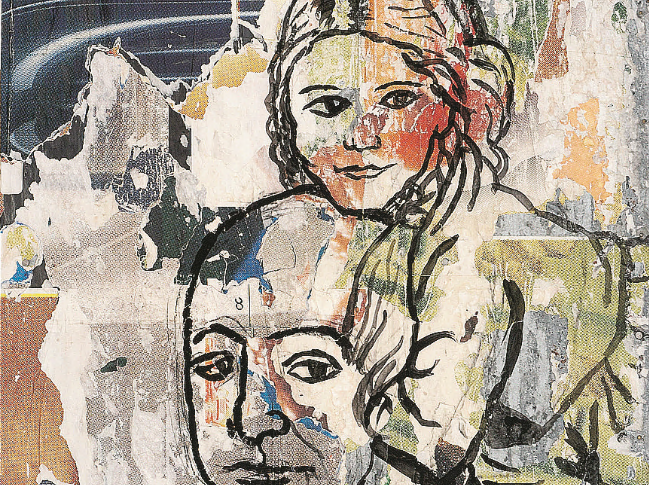
«Goodbye to the Italian American», «to the inventor of décollage». Summary of a life made of exile and tears. Words with which Mimmo Rotella greeted himself twenty years ago, when on 8 January 2006 he passed away at the age of 87, in the house where he had lived his last years in Milan. Twenty-one since, in 2005, shortly before his death, he opened the doors of his personal House of Memory in his hometown, Catanzaro, the place where it all began. In that house-museum, in the 1940s her milliner mother created lovely hats. It was there that Rotella began to harbor his love for art: «Sometimes, once the work was finished – he said – I would see those scraps of fabrics with beautiful colors on the floor. And that’s where I found the inspiration for my works.” He returned to that house-shop for the inauguration, perhaps in an attempt to reunite forever with that “harsh land”, “loved-hated”, from which he always felt the need to escape. A “rip” that perhaps he hoped to mend. He failed and returned to Milan. To his exile. Again, he left his land.
The first time was in 1943: in Naples and then in Rome, where he made his debut as an “epistaltic poet”, a form of poetry he invented that was born from a set of whistles, sounds, words and onomatopoeias. Then, America. An inexhaustible frenzy as a somewhat bohemian artist made him a citizen of the world, even becoming the inspiration for «An American in Rome» by Steno, starring Alberto Sordi in 1954: his eccentric behavior whereby, returning from Kansas City to Rome in the 1950s, he went out with “American-style” shirts and extremely exaggerated clothes, did not escape the eye of his friend the screenwriter Lucio Fulci, who inserted those surreal touches in the film. Sordi played the caricature of a Rotella who in those years was looking for “Zen enlightenment”. And it was precisely in the Rome of those years that he made his first breakthrough.
The epiphany came one morning in ’53: «I was walking around Piazza del Popolo, I was in crisis, I didn’t want to paint anymore, then I saw a torn poster. I stop. I have a heart attack, a kind of shock. Maybe this is the new message, I tell myself.” That day décollage was born. From that moment on, 50 years of a luminous career within the great artistic ranks of Nouveau Réalisme, with one exhibition after another in the largest cities in the world and a life always with a suitcase in hand: London, Buenos Aires, New York, Paris. Yet, despite the influences of avant-gardists from all over the world, Rotella maintained: «I have Magna Graecia within me».
And today, 20 years after his death, Rotella returns home. His exile, “the result of that impotence of not being able to do and the desire to do, my desire to measure myself with the world”, perhaps sees a pause. In his Casa della Memoria, from tomorrow to March 29, the «Autorotella» exhibition, curated by Alberto Fiz and promoted by the Mimmo Rotella Foundation. The exhibition itinerary takes its name from an autobiography of the same name on the years between 1966 and 1970 and spans the last thirty years of production (from 1969 to 1999), between experimentation with styles and new techniques, in which a vocation for self-portraiture prevails. A representation of the self which for Rotella has nothing to do with narcissism. It is his way of questioning himself, of trying to represent in his own face those changes dictated by the influence of mass society.
From the emulsified canvas «Autoportrait», to the portrait on sheet metal «Napoleonic Self-portrait» in which décollage and painting transform the face into a mask, up to the portraits with his daughter Asya, to the bronze sculptures and caricatural drawings, each self-portrait brings with it the explosive force of an artist who is a citizen of the world who finds himself in those pieces of fabric spread on the floor, in what he has always called home.