

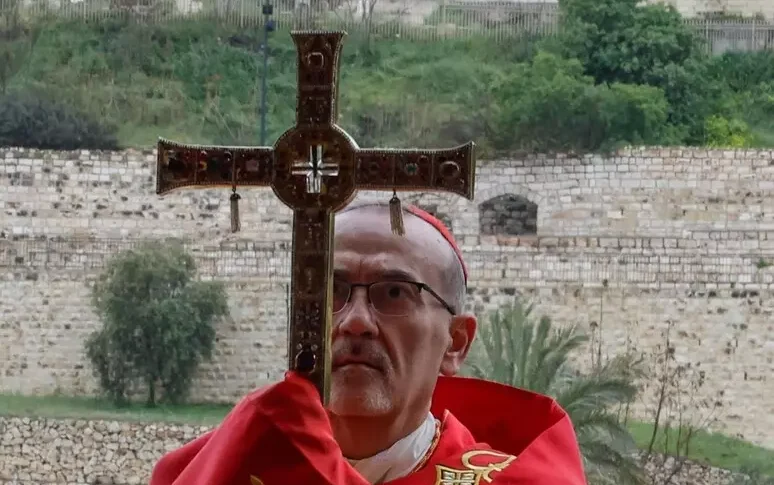
The clergy will be able to enter the church, there will be no procession or gathering, the rites will be broadcast live. The case raised by the Israeli police’s stop on the Latin Patriarch of Jerusalem who wanted to celebrate Palm Sunday privately on Sunday at the Holy Sepulcher has closed with an agreement.
The police will let Pizzaballa and the other religious authorities enter the basilica symbol of Christianity in Jerusalem, but the Holy Week rites will still not be able to take place according to exact tradition due to the restrictions that weigh on all the religious components of the Holy City in this time of war, since the Iranian missiles also fell on the Old City.
No Via Crucis for the Via Dolorosa, for example, the very one Jesus traveled carrying the Cross to the place of his execution.
“The Latin Patriarchate of Jerusalem and the Custody of the Holy Land confirm that the issues relating to the celebrations of Holy Week and Easter at the Holy Sepulcher have been addressed and resolved in coordination with the competent authorities. In agreement with the Israeli Police, access was guaranteed to representatives of the Churches in order to celebrate the ceremonies and preserve the ancient traditions” states the official note which also expresses “our sincere gratitude to Isaac Herzog, President of Israel, for his prompt be careful.”
“Naturally – the joint note also says -, in light of the current war situation, the current restrictions on public gatherings remain in force. Consequently, the Churches will guarantee the live broadcast of liturgies and prayers to the faithful in the Holy Land and throughout the world”.
The note ends with a note that condenses the whole meaning of Pizzaballa’s protest, which still today has received the support of Madrid, Athens, Brasilia and Canada: “Religious faith constitutes a supreme human value, shared by Jews, Christians, Muslims, Druze and others”, “especially in times of conflict, like the ones we are experiencing, safeguarding freedom of worship remains a fundamental and shared duty”.
The comment of the Holy See
The Israeli side still insisted today on the need to respect the security measures since the “threat is real and imminent” while looking favorably at the agreement reached.
“Cult and human life are preserved” commented, for example, the Israeli ambassador to the Holy See. Then there was the face-to-face meeting at the Farnesina with the Israeli ambassador to Italy Jonathan Peled, who had been summoned by minister Antonio Tajani. “Italy requires respect for the exercise of religious freedom” the Farnesina announced at the end of the discussion. The ministry also underlines that Cardinal Pizzaballa’s reasons and methods of protest were “absolutely understandable and totally acceptable” and it is not believed that “further comments from officials could help progress the discussion”.
The Easter incident thus appears to be over. In the background, however, remains Cardinal Pizzaballa’s concern for an increasingly weakened local Christian community, which is experiencing the drama of a massive exodus, of activities that are dying out, of continuous limitations that push them to migrate elsewhere in a difficult test of resistance. “It will be another subdued Easter for us.”
The Israeli ambassador from Parolin for clarification
Following the unpleasant episode that occurred on March 29, Palm Sunday, involving Card. Pierbattista Pizzaballa and Fr. Francesco Ielpo”, “card. Pietro Parolin, Secretary of State, accompanied by Msgr. Paul Gallagher, Secretary for Relations with States, met with Yaron Sideman, Ambassador of Israel to the Holy See. During the conversation, regret was expressed for the incident, regarding which clarifications were offered, and the agreement reached between the Patriarchate and the local authorities regarding participation in the liturgies at the Holy Sepulcher was noted.” Thus a Vatican statement.