

Presence and opportunities for discussion: to build trust in the written word, and in those who spend their professional commitment in conveying it. This is what the time of virtual distance, of agentic technology and of a rampant post-truth, which raises distrust and doubts, demands.
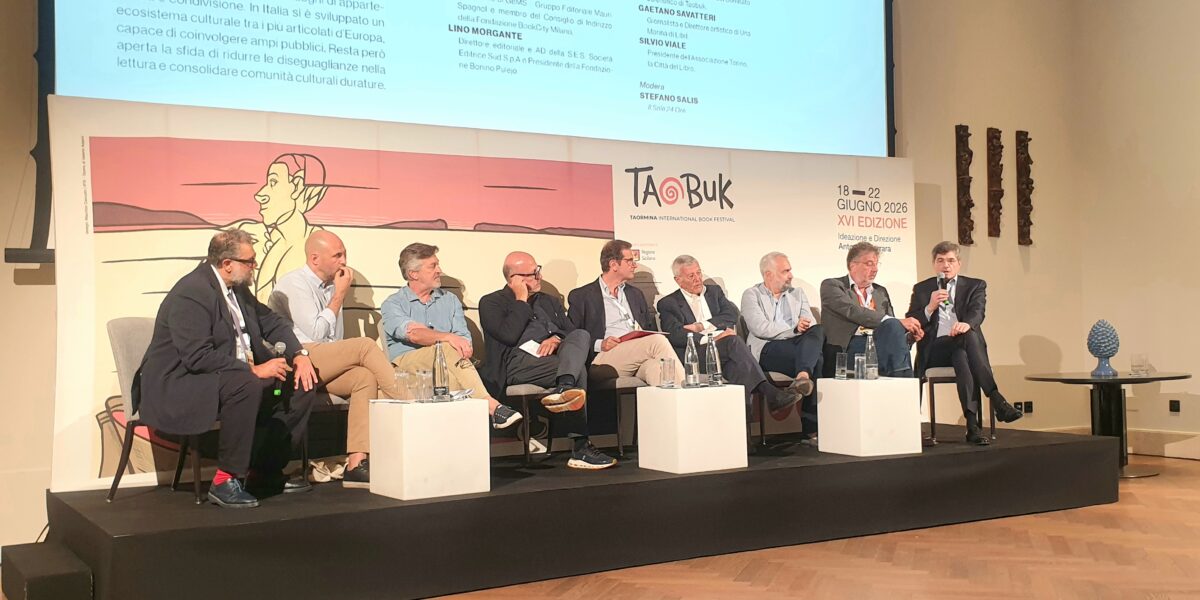
In one of the most complex and voice-rich meetings of the entire Taobuk festival, the gazes from different angles were concentrated on a single universe: that of publishing and journalism, which regularly finds a privileged space for synthesis at the festival.
The main theme this year, linked to the festival’s claim, was that of “Trust that unites – Festival, territories and communities”. Fabio Del Giudice, general director of the Italian Publishers Association, spoke in the halls of the San Domenico; Stefano Mauri, president of GeMS Gruppo Editoriale Mauri Spagnol; Lino Morgante, president and editorial director of Società Editrice Sud Gazzetta del Sud Giornale di Sicilia; the publisher Giulio Perrone; Nino Rizzo Nervo, president of the Taobuk Scientific Committee and director of the Gazzetta del Sud; Raffaele Bonsignore, president of the Chiazzese Foundation; Gaetano Savatteri, journalist and director of the “Una Marina di libri” festival; Silvio Viale, president of the “Torino la città del Libro” Association (owner of the Salone del Libro brand since 2019) and CEO of the company that organizes the key event of the Italian book scene from a technical and commercial point of view.
With the moderation of Stefano Salis of Il Sole 24 Ore, after the greetings of the president of Taobuk Antonella Ferrara – who annually chooses to dedicate a significant in-depth analysis to the theme in the articulated program, structured according to the concept of the event – a broad and fruitful overview of some of the most important Italian cultural events was conducted, comparing experiences and points of view.
Viale recalled the impressive organizational and reorganization commitment of recent years (the transfer of the brand took place shortly before the pandemic) reiterating the real ability of large-scale events such as the Turin Book Fair to consolidate public trust precisely thanks to being there, to being present.
This was echoed by Del Giudice who, in reference to the experience of Più Libri Più Liberi (the national fair for small and medium publishing, scheduled for the 25th edition in December in Rome) underlined its value in terms of meeting opportunities, also recognized by local administrations.
Mauri, president of the second largest Italian book publishing group with over 20 historic publishing houses (including Garzanti, Longanesi, Salani, Guanda) highlighted the attractiveness of the festivals on the places that host them, integrating irreplaceable moments to make those who write and those who read directly known. He then noted that for publishers the margins are very small, but above all he wanted to emphasize the value of the book as an “oasis of trust”, as an “act of responsibility and in-depth analysis, before publication”, in the age of fakes and books written entirely, overnight, with AI.
Perrone expressed the point of view of small publishing houses, which thanks to trade fair events are able not only to experience the dynamics of their sector more closely, but also to meet a wide audience, with the possibility of showing their specificities, against any risk of standardisation. Savatteri, recounting the experience of “Una Marina di Libri”, a festival that brings together independent publishing in Palermo, underlined the effort of each publishing company, which invests in being present precisely where it knows it can consolidate the trust of its audience.
Bonsignore outlined the programs of the “Lauro Chiazzese Foundation for Art and Culture”, a historic Sicilian cultural body established in 1954 in Palermo by the Cassa di Risparmio, and underlined the need for events such as literary reviews to strive to gain the trust of those who are furthest from cultural environments.
A strong theme, taken up by director Rizzo Nervo, who applauded the variety of events spread throughout the country, attended by a qualified and already interested public. But according to the president of the Taobuk scientific committee, there is a deep wound, a social gap to be filled by intercepting those who do not read books or newspapers and follow the intellectual life of the country less. In conclusion, Morgante also echoed this reasoning, outlining the universal value of the theme chosen for the festival, the trust capable of inspiring global reflection. In the world of information, in particular, the issue of trust is central and is what guides the public in the choice of different newspapers. A trust that does not depend on technological progress, as demonstrated by the millions of readers of Japanese newspapers, and which – the president of Ses reiterated, referring to the structured media literacy experience carried out by the Group with its newspapers in Sicily and Calabria – must be regained starting from young people, schools and universities, strategic environments for stimulating the pleasure of reading and for training a growing audience, orienting it towards quality journalism and critical thinking.