

The wind of spirituality is blowing again, driven by a new age of anxiety. Geopolitical turbulence shakes every certainty and apprehension seeks in the transcendent a renewed confidence in the future. As in a puzzle of premonitory coincidences, this year marks the 800th anniversary of the death of Saint Francis of Assisi (1181/82–1226), patron saint of Italy and central figure of world spirituality for his message of peace, as well as poverty and love for nature. Values that bind Assisi to Calabria and its patron saint, San Francesco di Paola, with an ancient and tenacious thread. And not only because, according to tradition, the parents of the Paola saint obtained the birth of their son after requesting it through the intercession of Francis of Assisi, then giving him that name.
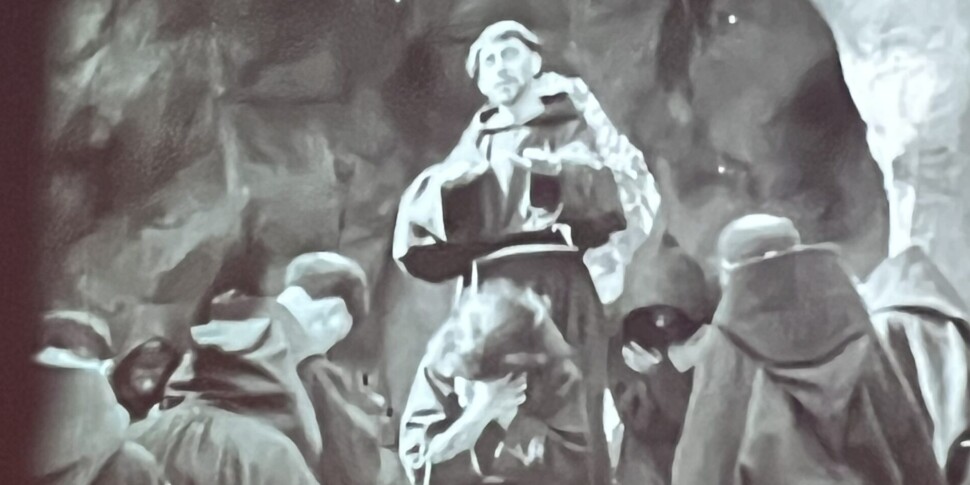
That thread, which crosses Sicily and unravels from the Mediterranean to the places of peace seekers, is the ecumenical charm of Franciscan spirituality: a force capable of speaking different languages over the centuries, from preaching to popular devotion, up to cinema and music. It is the thread that is reunited in the masterpiece of silent cinema “Frate Sole” (Italy 1918), dedicated to the figure of the saint of Assisi and revived for his extraordinary ethical impact by various Italian Cultural Institutes around the world on the occasion of the eighth centenary of his death.
Today, its evocative power is restored by the soundtrack performed live by Mario Mariani, the composer from Pesaro capable of transforming sound into an immersive experience. The same artist who, living for a month in a cave in the company of a baby grand piano, attracted the media’s attention and that of a sea of young people, becoming a true icon of an “artistic hermitage”. A strong-willed and courageous personality, the one evoked by the filmic language also at the Italian Cultural Institute in Amsterdam, where the extemporaneous and passionate soundtrack of “Friar Sun” returned not only the story of a saint, but the echo of a shared sensitivity that continues to speak even without words. Behind the images of the Poor Man of Assisi who renounces all material goods after meeting a leper, an ideal of purity emerges made up of essentiality, poverty, relationship with nature, asceticism, silence and contemplation.
They are the cornerstones of Franciscanism that still today attract a culture in search of authentic mysticism, but also an imagination deeply rooted in the South. Here, two centuries after the Umbrian friar, his silent revolution found continuity in Saint Francis of Paola, founder of the Order of Minims: an even more austere community than the Franciscans, marked by a hermitic and mystical spirituality, linked to the legacy of Mediterranean monasticism of which Calabria was the cradle.
It is in this space – between history, mythification, faith, popular devotion and artistic representation – that Mariani’s musical reading fits. The exceptional nature of his performances, based on improvisation and extemporaneous inspiration, lies precisely in their unrepeatable nature. And in this sense, his evocative personal journey reinforces the symbolic dimension of the project: in 2011, transforming an isolated mountain cave into a place of meditation and listening, he gave life to a “zero impact” festival which later became an annual international event.
Also attentive to social issues, he has signed projects such as “Francesco Povero” performed by the choir of the Community of San Patrignano, and “Fragments of life, songs and freedom” with the Opera prison, both brought to the Piccolo Teatro in Milan.
Suggestion, emotion and nostalgia for the sacred ran through his performance like an intense shiver in Amsterdam, at the Italian Cultural Institute of the Italian Embassy in the Netherlands, directed by Veronica Manson. Completely immersed in the evocative power of the film, Mariani created the soundtrack of “Frate Sole” live, expressing his eclectic and theatrical style, in which the piano, integrated with unusual instruments, transforms into an orchestra. This while the filmic images, inspired by medieval and Renaissance iconography, conveyed the depth and humanity of Francis.
This engaging dialogue between piano and images “was born at the end of the Eighties”, says Mariani. “I was a student at the conservatory when the Pesaro film festival called me at the last moment to replace a pianist. I found myself playing for the first time on images that scrolled in front of me, without any real preparation. I had to invent everything. I played even seven, eight hours a day, on films I had never seen, having only a few lines of synopsis”.
Was your method born from that forced immersion?
“Wagner came to my aid, with his leitmotifs: associating a musical theme with the characters, making them talk to each other. That was my real school, between 1989 and the early nineties. Then I continued to study, to collect silent films: today I have an enormous archive, almost a film for every season of life”.
His music brings Franciscan spirituality into the present. How much does this sensitivity still speak to the South, between Sicily and Calabria, where popular devotion is alive?
“Very much”, replies Mariani. “Saint Francis was, in a certain sense, the first ecologist: he understood that nature is not something to be trampled on, but a living reality, a creature. Like man, like animals. Everything participates in the same spiritual dimension.”
And he adds: “I see a parallel between human and divine creativity. Ours is limited, imperfect, but tends towards something higher. Even in music: what I do in these cases is not written, it is not fixed. It is created every time. My score is the images. Exactly as it happened then, at the end of the Eighties”.