

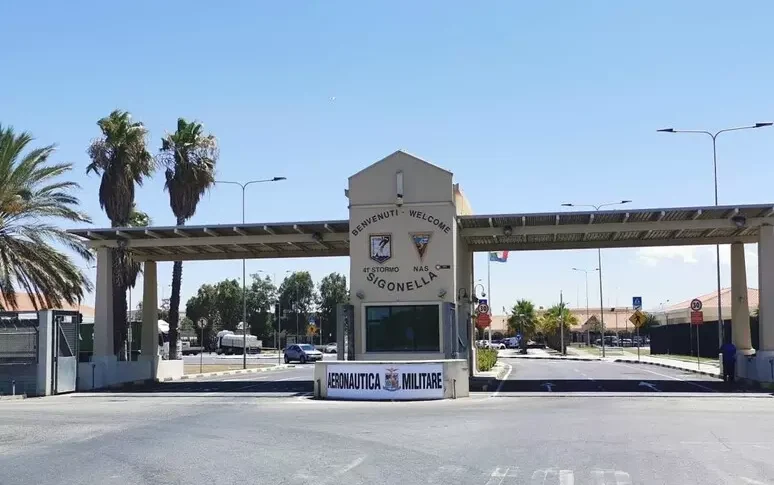
The Sicilian air base of Sigonella is a sort of “Aircraft Carrier of the Mediterranean”, one of the most strategic installations for NATO and cooperation between Italy and the USA in the region. In 1985 he was at the center of a clash between the Craxi government and the Reagan administration over the Achille Lauro crisis, which went down in history as “the night of Sigonella”.
The military airport has been active since 1959
Active since 1959, the military airport is a “mixed” base, under Italian control, but used by the US Navy and Air Force and hosts the MQ-9 Reaper drones and EP-3 surveillance aircraft. The Naval Air Station Sigonella (Nas), on the border with the territory of Motta Sant’Anastasia, a few kilometers from Catania, is spread over two main operational areas: Nas I, which acts as logistical and administrative support, and Nas II, where the runways, hangars and flight activities are located. The latter is shared by the US Navy with the Italian Air Force and represents the operational heart of the base.
A fundamental base for military operations in the Mediterranean
The base is key to military and security operations in the Mediterranean, North Africa and the Middle East and is used for maritime patrol missions, surveillance, logistical support and intelligence operations. Among the most frequently used aircraft are maritime patrol aircraft such as the Boeing P-8 Poseidon and surveillance drones such as the Northrop Grumman RQ-4 Global Hawk.
Sigonella is also an important hub for NATO operations, contributing to cooperation between the United States, Italy and other allied countries. Over the decades, Sigonella has been involved in numerous international missions, including support operations during regional crises and humanitarian interventions.
The 1985 crisis and Craxi’s role
In collective memory, Sigonella is linked to the crisis of 1985, when the Prime Minister, Bettino Craxi, opposed the handover to the Delta Force of Abu Abbas and the other terrorists responsible for the seizure of the cruise ship Achille Lauro and the killing of an American citizen, Leon Klinghoffer. On the night between 10 and 11 October, the plane carrying the Palestinian commando headed to Tunisia was intercepted by US fighters and forced to land in Sigonella. The American military wanted to capture them but Craxi opposed it because the crime had occurred on an Italian ship, therefore the jurisdiction belonged to Italy. Hence the order to the military – carabinieri and air force – to surround the plane to prevent the intervention of the American special forces. An armed conflict between two NATO allied countries came close.
Over the years, the military importance of the base has grown, in proportion to the increase in intensity of the crises in the Middle East. «Sigonella – said in 2009 the then Chief of Defense Staff, Vincenzo Camporini – was chosen for its geographical and strategic position for surveillance in the Mediterranean», as the intelligence center of the Alliance.
Sigonella is a crucial base for the war in Libya
In 2011 the «Arab Springs» arrived, and with them the war in Libya. At that stage the base also proved crucial for the evacuation of American diplomatic personnel after the attack on the Benghazi consulate. Washington sent several marine units to Sigonella and landed, among other things, two large CH-53 Sea Stallion helicopters for the transfer of men and materials to ships off the Mediterranean. About four thousand air missions departed from the base, the US State Department recalled. «Italy’s role was also crucial in protecting civilians. After the Benghazi tragedy, Italy helped us evacuate our personnel,” Hillary Clinton said in 2012.
In the summer of 2021, it was a fundamental piece of Operation Allies Refulge, the US State Department’s plan for the safe evacuation of US citizens, special immigration visa applicants and other at-risk Afghans, as quickly and safely as possible. Working in collaboration with its allies in the Italian Air Force and the Italian government, Nas Sigonella served as a transit point for displaced people before their subsequent movement to other locations. A confirmation of the ever-present strategic role of this platform in the Mediterranean.