

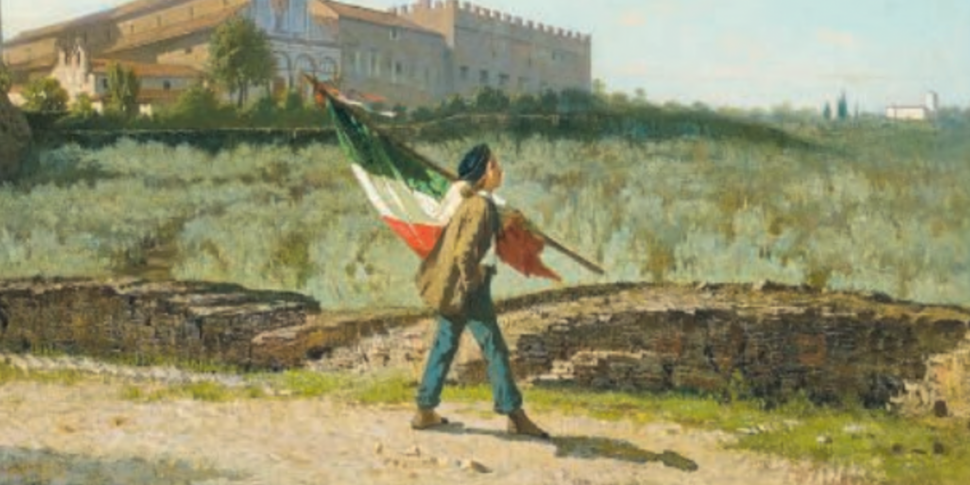
Accustomed as we are today to seeing the abstract, the informal, the conceptual and so on, it does not immediately come to mind that the Macchiaioli were an avant-garde. Instead, it is enough to read a few lines of a review from 1862, to which – it is not clear whether by convention or truth – the nickname Macchiaioli is traced back, to understand how the group which had its center in Florence, but united painters from almost all of Italy, represented a moment of rupture with the past and set up a whole way, both of painting and of choosing subjects and places, in search of a realism also deriving from positivist ideas, based on science and “concrete facts”.
«In the heads of their figures – wrote among other things the critic Giuseppe Rigutini referring to the details of the paintings – you look for the nose, the mouth, the eyes and the other parts, you see shapeless spots: the nose, the mouth and the eyes are there, you just have to imagine them!». In fact, the so-called “spots” are areas of uniform color that replace the traditional contours and chiaroscuro, a pictorial technique that was decidedly new at the time and which, with accentuations farther from realism, was somehow taken up by the French Impressionists. That term “Macchiaioli”, born as a derogatory term, was eventually accepted by the group that gathered in the Caffè Michelangiolo, becoming a sort of emblem, gradually substantially accepted by contemporaries and then falling into oblivion for a long time. Rediscovered in the twentieth century, especially between the two wars, the movement is now, after a series of important exhibitions, considered not only exemplary of a historical period linked to the achievement of the unification of Italy, but also – and above all – capable of creating painting, then new, but now worthy of being celebrated for having produced a whole series of masterpieces now recognized as such.
The Milan exhibition
A new retrospective, scheduled in the Palazzo Reale in Milan until 14 June, now adds to the ever-increasing value of those painters by proposing “a more in-depth reading of this exhilarating experience”, featuring over one hundred works. A goal certainly achieved by this exhibition, produced by Palazzo Reale, 24 Ore Cultura – Gruppo 24 ore and Civita Mostre e Musei, and curated by Francesca Dini, Elisabetta Matteucci and Fernando Mazzocca. The exhibition itinerary, divided into nine stages, refers to a chronological period between 1848 and 1872 (the date of Mazzini’s death), strongly linking the Macchiaioli to the historical events of the Risorgimento and thus putting an end to their pictorial revolution together with the disappointment of what for them, convinced Mazzinians, had been a “betrayed revolution” in republican values, sealed here by the «Study of head for the last moments of Giuseppe Mazzini” by Silvestro Lega.
The artists and characteristics of the movement
This is not only the value of the exhibition: the reconstruction of artists and events that led to the birth of the movement was important, that is, starting from those painters who, like Giuseppe Mussini and above all the Neapolitan Domenico Morelli, starting to innovate with respect to classicism without detaching themselves from it, opened the path to the true Macchiaioli, namely Giovanni Fattori, Vincenzo Cabianca, Odoardo Borraci, Telemaco Signorini, Giuseppe Abbati and Raffaello Sarnesi, supported by the critic Diego Martelli, to whom we must add Giovanni Boldini from Ferrara before his move to Paris, where he achieved celebrity with his portraits of women. Without forgetting also the influence that came from the aesthetic concept exposed in 1855 in France by the manifesto “Realism” by Gustave Courbet.
In these artists there are two fundamental characteristics, in addition to painting often en plein air: the ability to narrate the war from behind the lines to grasp the truth and not the heroism (Fattori’s works are exceptional on this topic) and the attentive look at the scenes of everyday life, including those of the peasants, a true revolutionary act. «Every century has its task of civilization to provide», wrote Signorini, who for his «Pascoli a Castiglioncello», a scene of authentic rural life, had unjustly had to suffer the following critical judgement: «an omelette filled with jellied cows». The Milanese exhibition focuses heavily on Fattori from Livorno, the most famous Macchiaiolo, and the Florentine Signorini, and also allows us to fully rediscover, among nuns, peasant women, internal gardens of bourgeois homes and working-class women in their homes, the sincere art of Silvestro Lega, Vincenzo Cabianca, Odoardo Borrani and others.
The final masterpiece
But it is singular how in the end it is a masterpiece by Telemaco Signorini, painted in 1898, therefore beyond the dates taken into consideration, which leaves an important memory in the visitor and which, stylistically, goes beyond the experience of the movement and relaunches towards the Belle Époque period. It is “La toilette del giorno”, set in a Florentine brothel, and belonged to the maestro Arturo Toscanini, in whose Milan apartment it was seen by Luchino Visconti who reconstructed it in a scene from his film “Senso”. Of course, even though it is still Signorini, it may be an inconsistency with the historically rigid path of the exhibition. But could we have given up a work of this quality, where the girls portrayed seem to be preparing to leave the canvas and come towards us, while we can almost hear the chatter of their awakening? Impossible (fortunately)!