

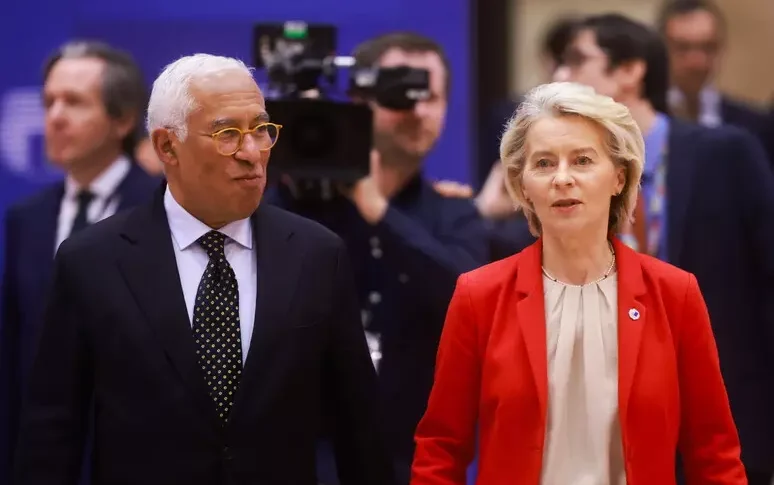
Almost five hours of debate without cell phones and in a limited format. On the table, a fixed menu: transatlantic relations with the new, unpredictable to say the least, Donald Trump’s America.
The Gaza Board: for and against
The conclusions were oral because, being extraordinary, the summit did not include a written text. In this case, however, it was almost an advantage for the EU leaders. On Trump, the unity shown by the EU is growing but it certainly does not include all the capitals. The Gaza Board was signed by Hungary and Bulgaria. It was flatly rejected by Spain. While other countries took their time, including Italy. Although, returning from Davos, Trump wanted to have a hand in it once again. “Giorgia Meloni and Karol Nawrocki told me that they want to join, but first they have to complete the necessary formalities,” the American president said, according to media present on Air Force One. Palazzo Chigi did not want to respond to his words even if contacts between Rome and Washington in the last few hours cannot be ruled out.
The constitutional question
Certainly, the tycoon’s statements are destined to make noise, especially in Italy. Where in the last few hours it had clearly emerged that, with the current statute, the Peace Council for Gaza would conflict with article 11 of the Constitution. In Brussels, “several elements of the statute” of the board are causing concern, which concern the scope of competences, the governance structure and compatibility with the United Nations Charter. Doubts that do not, however, exclude a willingness to “collaborate” with the Trump administration “in the implementation of a comprehensive peace plan for Gaza”, provided that the board operates as a transitional administration in full compliance with UN Security Council Resolution 2803.
Trump’s Europe vs America
Upon his return to the United States, Trump once again focused on the topics dear to him in these: from Greenland to Europe, sparing no attacks. In Brussels, by now, they seem almost aware that this will continue until the Midterms. Dialogue and firmness, without fueling further escalation, is the strategy that the Commission and the European Council want to maintain. Without impulsive reactions, but with credible retaliations always on the table. On some points, such as the sovereignty of Greenland, there is a red line that should not be crossed for Europe. On others, such as Arctic security, there is a willingness to work with Washington. At the summit there was also talk of strategic autonomy, an inevitable fate now for both Ursula von der Leyen and Antonio Costa. Just as “the firm commitment to the principles of international law remains unchanged”, we read in the conclusions.
The EU towards alternative partners
From tomorrow the EU will return to the ground to build its alternative network to the partnership with the USA. Community leaders will be in India on Tuesday 27th for a trade agreement that promises to be crucial. While, on Mercosur, the impression is that neither the majority of governments nor Berlaymont Palace want to wait for the EU Court of Justice, as voted for by the European Chamber. “The countries have already given the OK for the provisional application of the agreement”, underlined Costa, inviting the Commission to move forward.