

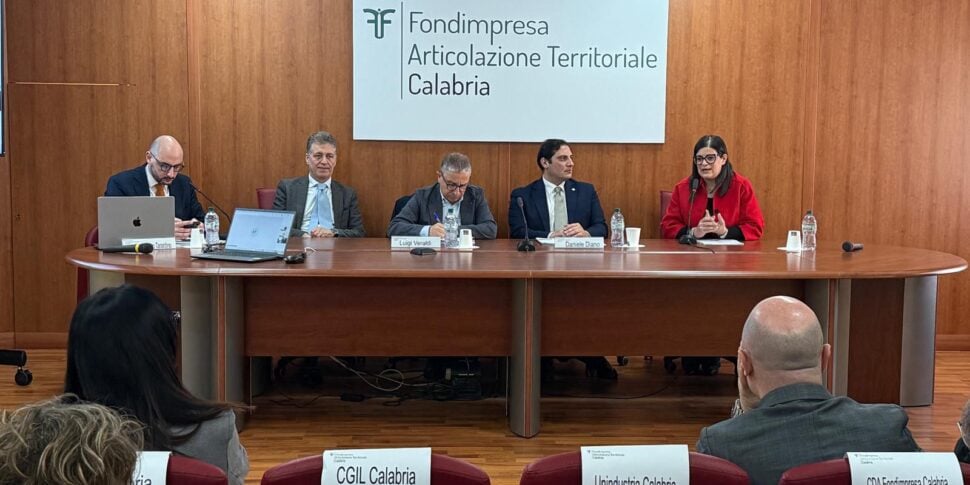
Training as a tool for economic growth and a factor in cohesion, awareness and quality of relationships in the workplace. This is the message that passed through the day of presentation of the Evaluation Monitoring 2025 – “Human resources and training for growth and innovation”, promoted by Fondimpresa Calabria and which took place yesterday in Catanzaro, coinciding with the inauguration of the new regional headquarters of the Fund (located in via A. Lombardi, 10).
An event that brought together businesses, social partners and representatives of the production system to reflect on the real impact of funded training and its strategic role in the development of Calabrian businesses.
Solidity of businesses
The meeting was opened by the president of Fondimpresa Calabria, Daniele Diano, who reiterated how investing in skills means investing in people and, consequently, in the solidity of businesses and the regional economy: «The companies that grow the most – he underlined – they are those who have chosen to focus on people, recognizing training as a decisive tool for dealing with change and innovation».
Vice President Luigi Veraldi recalled the joint nature of Fondimpresa, founded on continuous dialogue between employer and union representatives. And he supported the need to strengthen dialogue with institutions so that training becomes a structural lever of policies for work and development in Calabria.
The effects of training
Providing a national overview of the monitoring action carried out by Fondimpresa was Maurizio Bernava, member of the Strategy and Business Development Management Committee of Fondimpresa and national coordinator of Evaluative Monitoring. Bernava illustrated the value of the tool as a method of analyzing the effectiveness and impact of financed training, underlining how Fondimpresa is today one of the few companies committed to systematically measuring and evaluating the effects of training on work organisation, productivity and professional growth of workers, in a context marked by rapid technological changes and a growing need for skills.
The stories
The protagonists of the day were the “Training Stories”, which provided a concrete snapshot of how training can impact not only on company processes, but also on the human dimension of work. The testimonies of AZ spa, Aschenez srl, Colacchio Food srl and Metal Carpenteria srl highlighted a common element: the training contributed to strengthening relationships between colleagues, improving internal communication and building a greater sense of belonging to the company.
From the experiences described, it emerged how the training courses promoted collaboration between workers from different departments and territories, reducing conflicts, increasing mutual trust and creating a more cohesive and participatory company climate. A transversal impact which, in addition to improving organizational efficiency, has made work more aware, motivated and shared. Reasons that pushed company representatives to testify how training often translates into a strategic asset for the company and therefore into a real competitive advantage to be spent on the market.
Training as a tool
The conclusions were entrusted to Celeste Logiacco, secretary of CGIL Calabria, and Aldo Ferrara, president of Unindustria Calabria. Logiacco reiterated the value of training as a fundamental right of workers and as a tool to promote inclusion, safety and quality of work. Ferrara underlined the central role of human capital in regional economic growth, highlighting the need to expand the number of companies that use the tools made available by Fondimpresa: «Without updated and widespread skills – he stated – there cannot be solid and lasting growth».
The day confirmed Fondimpresa Calabria as a strategic support for the development of the regional production system, capable of accompanying companies in innovation processes by enhancing work and people. A clear invitation to Calabrian companies: using Fondimpresa tools means investing not only in competitiveness, but in the quality of work and in the relationships that hold organizations and territories together.