

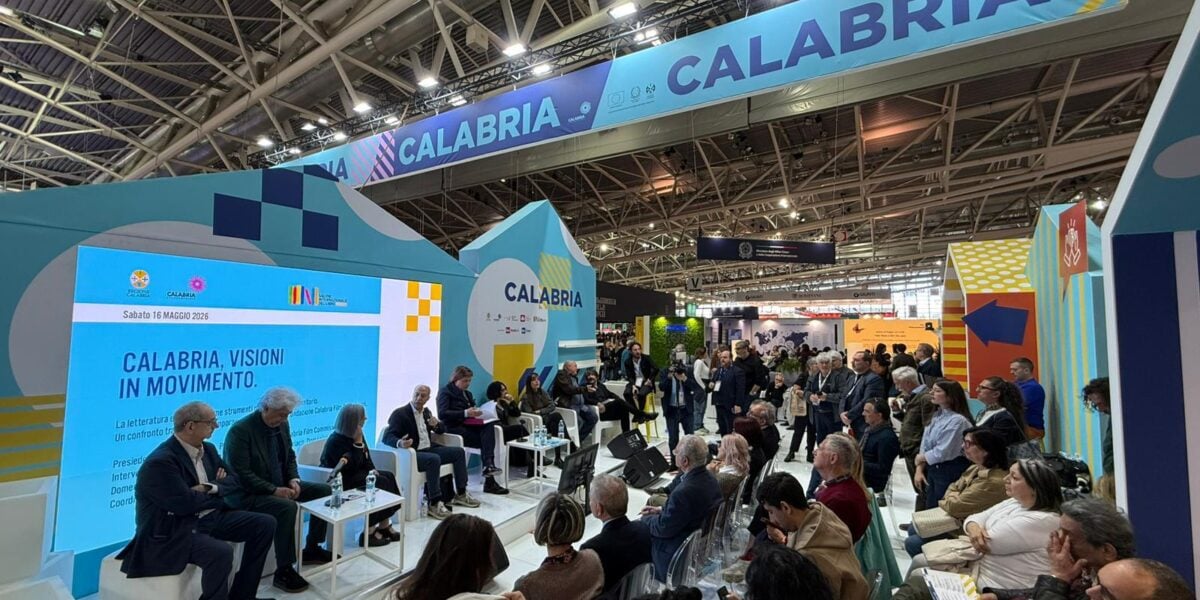
Great participation and strong involvement at the Turin International Book Fair for the panel “Calabria, visions in movement”, promoted by the Calabria Region and the Calabria Film Commission, an opportunity for discussion dedicated to the contemporary narration of Calabria through literature and cinema.
The meeting focused on the role of the written word and images in the narrative of the territory, giving rise to a dialogue between some of the most authoritative contemporary Calabrian writers and the Calabria Film Commission Foundation, with the aim of building a new vision of Calabria, far from stereotypes and capable of restoring its complexity, identity and transformations.
The bridge between literature and cinema in the words of Anton Giulio Grande
The meeting was opened by Anton Giulio Grande, president of the Calabria Film Commission, who underlined the desire to “create a bridge between literature and cinema”, ideally recalling Italo Calvino’s “Invisible Cities”.
“A vibrant and complex Calabria in literary narration – declared Grande – told through eight voices that have transformed our land from a place of passage to a place of landscape, not immobile but in movement, in the sign of a convergence between the written word and the cinematographic image”.
The writers Carmine Abate, Angela Bubba, Domenico Gangemi, Gioacchino Criaco, Domenico Dara, Annarosa Macrì, Anna Mallamo and Vito Teti spoke. Giampaolo Calabrese, director of the Calabria Film Commission, coordinated the debate.
Plural identity and the risk of stereotypes: the interventions of Teti and Gangemi
During the discussion, Vito Teti highlighted the cultural value of the initiative: “This is an initiative that was needed. I thank the Film Commission. Calabria is a complex and contradictory land, with a plural and changing identity. I claim the need for a realistic look that is not in contradiction with narrative fiction”.
Focusing on the theme of representations of the region, Domenico Gangemi drew attention to the risk of a univocal narrative of Calabria: “Too much has been written about the ‘ndrangheta in Calabria, fueling the equation of Calabrians as equals ‘ndrangheta. After several books on the time I have chosen to distance myself from this narrative, because it risks reinforcing a prejudice that goes beyond the real demerits of our land”.
From the background of “Anime Nere” to the strength of the images: Criaco and Abate
With a memory linked to the cinematic genesis of “Anime Nere”, Gioacchino Criaco recounted the difficulties encountered at the beginning of the project and the new situation of dialogue with the Film Commission: “When we went around to present the project, the Film Commission at the time didn’t even receive us. It took us four years to make the film. Francesco Munzi’s extraordinary work and the awards obtained then demonstrated the value of that choice”.
Reflecting on the relationship between writing and images, Carmine Abate underlined: “Seeing one’s book become a film, observing images and landscapes previously described only with words, makes us understand even more how beautiful this land is and how much it deserves to be told through cinema.”
Culture as lifeblood and the theme of return: Macrì and Bubba
Annarosa Macrì focused on the value of culture as a founding element of the community: “Writers and directors, books and cinema represent the lifeblood of a community. The cultural life of a region coincides with the life of Calabria itself”.
Angela Bubba instead recalled the themes of migration and the return to the origins: “It is important to talk about the wandering, the departure, but also the return to one’s roots, which can happen in a thousand different ways and not just physically”.
Beyond the glossy village: the reality of the villages and the meaning of writing for Mallamo and Dara
In her speech, Anna Mallamo highlighted the need to overcome a stereotyped representation of the South: “Cities are often missing from the narratives of Calabria. We are condemned to the image of a land made only of postcard villages, while the villages preserve absences, difficulties and profound truths. If you want to tell something authentic, you don’t have to go to the glossy village but to the real town”.
Closing the panel was Domenico Dara’s reflection on the most intimate meaning of writing: “Literature is the attempt to make up for the shortcomings of life, for what we felt was absent in everyday life. I believe that this is the deepest meaning of writing”.
The panel confirmed the growing dialogue between cinema and literature as tools for the cultural and identity enhancement of contemporary Calabria, in a perspective capable of looking to the future without giving up the complexity of its roots.