

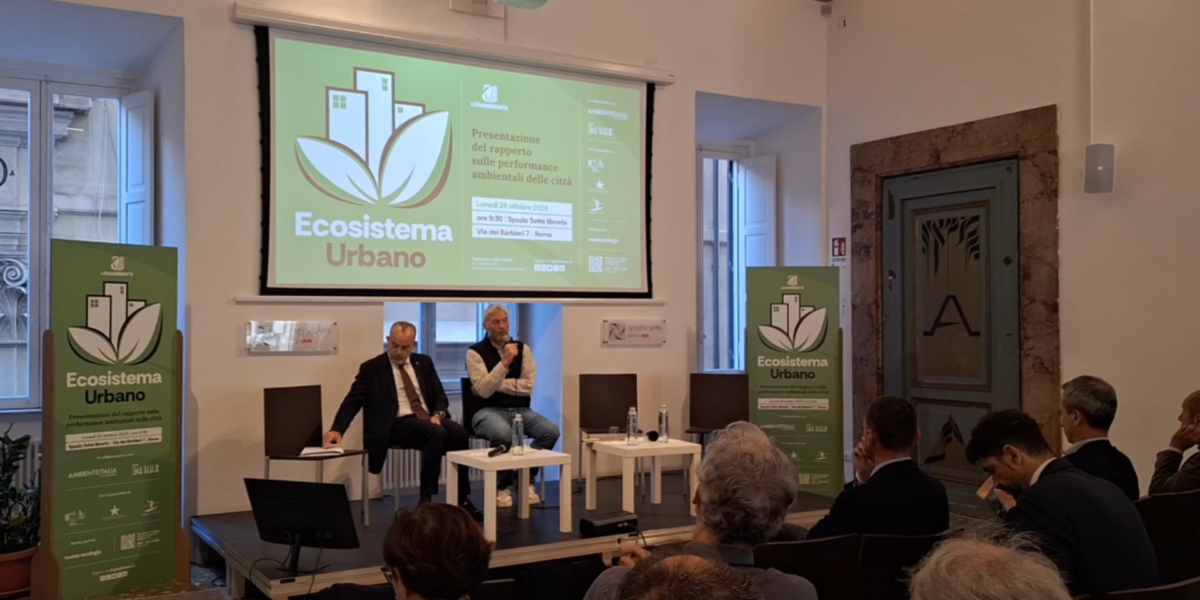
In Italy, the climate crisis and environmental emergencies continue to leave their mark even in urban areas, while the response capacity of cities is still too slow and timid. The only ones to prove more reactive are the medium and small ones, while the large cities, while confirming an overall but slow movement, remain in trouble. The confirmation comes from the new data and the ranking of Ecosistema Urbano 2026, the annual report by Legambiente and Ambiente Italia, in collaboration with Il Sole 24 Ore, which photographs the environmental performance of 106 provincial capital cities of Italy where almost a third of the population of the Peninsula lives.
In 2026, the average impact of “sustainable performance” which concerns air, water, waste, mobility, urban environment and energy in the cities examined will rise to 55.72%. A growth of just almost two points more (+1.88%) compared to the last edition (53.84%) and which returns to 2024 levels (55.80%). Smog, land consumption, and cars in circulation remain the major urban critical issues to be addressed in the 106 capitals: in particular, the peaks in ozone (O3), the litmus test of air pollution in the city, are of particular concern, as is the increase in land consumption equal to 4726 hectares in the five-year period 2019-2024 (it is as if in Italy a city as large as Bologna had arisen from nothing), in the face of a drop in population of 322,000 inhabitants overall. The number of cars in circulation rises to 70 compared to just over 68 in the last edition. Good news comes, however, from separate waste collection whose average in the 106 capitals stands at 66.15% (about one percentage point more than last year, 65.14%) and from the use of public transport, annual per capita trips on buses rise to 103 compared to 86 last year. Progress has also been made in reducing water dispersion. The average value of water that is wasted drops to 34.7%, while in 2024 it was equal to 36.1%.
The general ranking
In the Peninsula where investments are made in sustainability and far-sighted urban policies, the results can be seen first-hand. This is demonstrated by Mantua, Trento and Bolzano who lead this year, in first, second and third position respectively, the general Urban Ecosystem ranking. In particular, Mantua establishes itself as the undisputed green leader of this 2026 edition with a “sustainable performance” index that reaches a score of 81.29%, while Trento with 76.53% and Bolzano with 75.47% are the only two cities in the ranking above 75%. This year too, the top ten in the ranking are dominated by the medium and small municipalities of the north-east: in addition to Mantua, Trento and Bolzano, Cremona (4th with 74.77%), Reggio Emilia (5th in the ranking with 72.40%), Bergamo (6th with 71.45%), Parma (7th with 71.03%), Pordenone (8th with 70.79%) stand out. In ninth place is Cosenza (70.62%), the first southern city to move up the ranking (it was 16th in 2025), returning to the top ten this year, while Naples falls to the bottom of the ranking in 106th position with an environmental performance index of 30.80%.
Calabrian data
With Cosenza in ninth place (70.62%) – the only city in Southern Italy to be among the top ten in the ranking – which stands out for the results achieved, to find another Calabrian capital you need to scroll down the ranking to 81st place, occupied by Catanzaro with 47.99%. Followed by Vibo Valentia, in 99th place with 39.30%, Crotone, in 101st with 39.09%, and Reggio Calabria, in 105th with 35.45%, in the last positions of the ranking. For Reggio Calabria, in particular, this is a situation that has been going on for a long time: in recent years, the city has constantly fluctuated between last and penultimate position.
Anna Parretta’s comment
“The Urban Ecosystem report gives us, once again, a realistic and merciless photograph of the state of Calabrian cities, outlined through the main environmental components: air, water, waste, mobility, urban environment and energy”, comments Anna Parretta, president of Legambiente Calabria. “Aside from the positive data of the city of Cosenza – explains Parretta – which stands out, for example, in terms of domestic water consumption and in the energy sector, the other capitals highlight significant difficulties in various areas, in particular in waste management, in the purification system and in water networks, with dispersion rates of up to 50%, in public transport and sustainable mobility, as well as in the availability of accessible urban greenery. We hope that the interventions implemented by the Calabria Region will produce concrete effects in the near future, but it is necessary to underline the extreme urgency for public administrations to activate increasingly incisive actions to improve our cities, called to face the consequences of climate change in already burdensome contexts. We must make them more liveable and guarantee the well-being of citizens”.
Four priorities for intervention
A photograph full of chiaroscuro taken from the Ecosistema Urbano 2026 report, now in its 33rd edition and presented today in Rome and in live streaming, the data of which can also be consulted on the interactive map ecosystem.legambiente.it and on that of Sole24ore https://lab24.ilsole24ore.com/economia-urbano/. The numbers summarize well the areas of intervention on which we need to work to accelerate the pace, guaranteeing citizens more sustainable and resilient cities, and above all safer in terms of combating the climate crisis. For this reason today Legambiente, starting from the analysis of its new report, indicates to the Government four priorities for intervention, asking it to: 1) provide for greater allocations of economic resources for the cities, after the end of the PNRR, 2) make the climate change adaptation plan (PNACC) operational by allocating in the new budget law the economic resources necessary to implement the priority interventions 3) just as it is essential to approve a national law against land consumption and 4) provide for more mitigation and adaptation interventions that have at the nature-base Solutions (NbS) centre.
Cianfani: progress too slow
“In most of the Italian capitals – declares Stefano Ciafani, national president of Legambiente – adaptation to the climate crisis as well as the ecological transition are still going too slowly. The result is that we have too many cities chasing chronic emergencies and the effects of the climate crisis such as heat waves and extreme weather events. We are not even there on the reduction of hydrogeological risk and on the initiatives to materialize the idea of the sponge city, useful for dealing with increasingly frequent and destructive extreme events in urban context. This is why it is essential to accelerate the pace and for the Government and Parliament to give their contribution. Otherwise we will continue, as we have done up to now, to appreciate only some signs of change, the result of the ability and courage of a few Mayors of the Bel Paese. It is time to reverse course with structural and long-term environmental policies and not with stopgap measures”.
Laurenti: double speed
“The data from the 2026 edition of Ecosistema Urbano – declares Mirko Laurenti, from the scientific office of Legambiente and editor of the report – tell us about a country where cities move at a double speed, between difficulties and some improvements, and where the differences are increasingly marked between the north and the south of the Peninsula. What is certain is that cities are trying to react to the increasingly stressful urban emergencies, perhaps also driven by the arrival of exceptional funds linked to the recorded urban climate emergencies in the country or to extraordinary contributions, such as for projects linked to the PNRR, but they do so in a non-synergistic manner. We need a national urban strategy which, together with a common direction, truly puts the cities at the center to initiate an expanded and shared planning that goes well beyond the single municipality or territory and is capable of building truly effective responses that look at the vast area. This path is fundamental.
Starting again from the big cities
The large cities, although confirming slight movements like last year, remain clearly behind. The smog that suffocates Bologna, Genoa, Milan, Naples, Padua, Palermo, Rome, Turin or Venice; the increasingly high number of cars in circulation (Rome, Turin, Catania); the separate collection of waste which, compared to an average that has been constantly growing for years in all the capitals, sees some large urban areas in serious difficulty in keeping up and still far behind the national average (Bari, Rome, Naples, Catania), and with Palermo which in this edition slightly exceeds 20% of Rd, the last among the capitals for which data is available. Then there are those who still waste more than a third of the drinking water released into the water networks (Naples, Bari, Genoa, Venice, Catania, Palermo, Messina); those who are unable to stop the consumption of new land, another great urban emergency (Venice); those who do not dedicate adequate space to pedestrians (Genoa) or cycling (Naples, Genoa, Messina, Catania, Rome, Palermo); those who are not yet able to push decisively on renewable energy (Palermo, Naples, Turin, Rome, Venice, Florence).
Some go up, some go down
Among the large cities, Venice is the protagonist of an important comeback from 47th place in the rankings to 31st place. It is the best in terms of number of passengers transported by public transport; it is second overall in terms of land dedicated to pedestrians and improves in the space dedicated to cycling. Florence also did well, taking seventeenth place (last year it was 21st): here the separate waste collection reaches 62.7%, the number of passengers transported by the public transport service reaches 288 trips per capita per year (compared to 247 in the last edition). Improvements also for Milan (50th, last year it was 57th), Padua (33rd, it was 39th in 2025) and Bari (71st, it was 76th in 2025). Sore point for Genoa which relegates 14 positions going from 40th to 54th. Chronic problems in terms of smog are confirmed, while the percentage of separate waste collection improves slightly (it is 52.3% of the total), the quantity of drinking water lost from the network worsens and stands at 34.8%.