

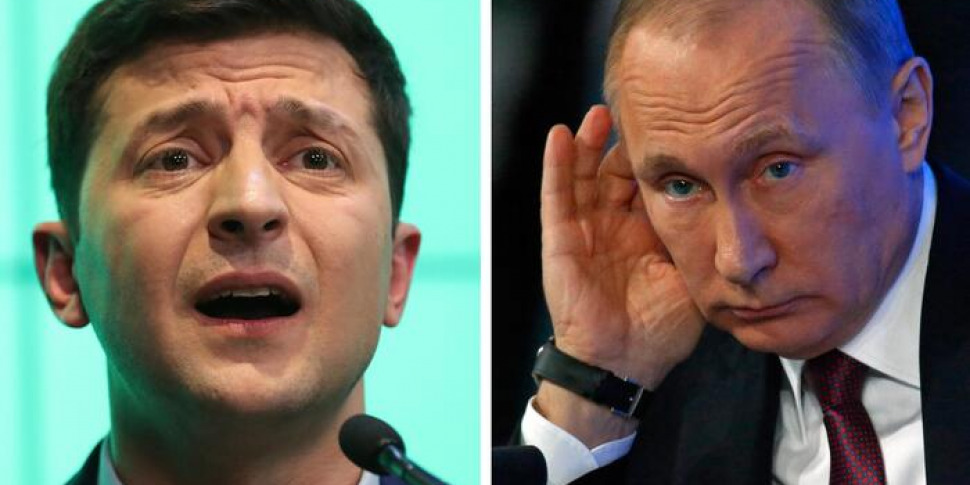
The ‘war of truces’ breaks out between Russia and Ukraine. Moscow, as it had already announced, will silence its weapons on 8 and 9 May in honor of the celebrations for the victory over Nazi-fascism. Kiev replies: we will start earlier, starting from midnight between the 5th and the 6th, “because human life is worth more than a celebration”. But, President Volodymyr Zelensky warns when making the announcement, this does not mean that we will remain inert: “From that moment on – he states – we will act reciprocally”. If they attack us, we will react.
On the holiday of May 9th – the date on which Russians traditionally remember their victory in the Second World War – this year too a more complex game than a simple parade in Red Square will be played. Especially since this time, the Kremlin said, no military means will be deployed, and it would be the first time in twenty years. No tanks, no missiles, no cannons, not even cadets in full uniform. Vladimir Putin and his men know well that Ukrainian drones can reach Moscow. The other night eight were shot down in the skies over the capital, and last night an unmanned aerial vehicle from Kiev crashed into a residential skyscraper. From May 2 to today, 28 drones launched by Kiev’s armed forces have been shot down while flying towards Moscow, according to Russian authorities. “Ukrainian drones could also fly during the parade,” recalls (or threatens) Zelensky, quoted by the Russian agency Tass. And a raid by “Ukrainian terrorism” (in the words of presidential spokesman Dmitri Peskov) right on the parade that celebrates national military pride, under the eyes of the world and the allies, would be too painful a humiliation.
Zelensky knows this and, at least in words, cannot help but take advantage of the enemy’s embarrassment: «Russia – he says – has announced that the parade will take place without military equipment. It will be the first time in many years that they cannot afford military equipment, and they fear that drones could fly over Red Square. This is significant. It shows that they are not strong at the moment.” However, if they attack us that day, the Russian Defense Ministry replies, in retaliation “we will launch a massive missile attack against the center of Kiev”.
In the evening it was Zelensky himself who sent a message of détente, which however sounded above all like a challenge: «To date there has been no official request addressed to Ukraine regarding the method of cessation of hostilities – he says -. We believe that human life has an incomparably greater value than the ‘celebration of any anniversary’. Therefore, as far as we are concerned, our weapons will be silent as early as midnight between May 5th and 6th. Date on which, explains Ukrainian Foreign Minister Andrii Sybiha, Russia «will show if it is serious and what it really wants: peace or military parades. If Moscow is ready to end hostilities, it can do so as early as tomorrow evening. Ukraine is ready. This is a serious proposal to end the war and move on to diplomacy.” And then he calls the world as a witness: «I ask all our partners, all peace-loving States, all the headquarters of international organizations to support this appeal for an end to hostilities».
Bunkers and tightening of controls, ‘Putin fears a coup d’état’
Vladimir Putin is worried about the risk of a coup or a deadly betrayal by one of his loyalists. So much so that he strengthened the surveillance of his collaborators, including photographers and cooks.
This is supported by a report from a European intelligence agency obtained by CNN, according to which the Kremlin has drastically strengthened the Tsar’s personal security following a series of assassinations of senior Russian military officers and increasingly widespread fears of a coup in Moscow. According to the Western 007 report – of which CNN underlines the difficulties in verifying the details – some of these measures were introduced in recent months following the killing of top Russian general Fanil Sarvarov in December, an event which sparked a clash between leaders of the Russian security apparatus. In addition to installing surveillance systems in the homes of his aides, chefs, bodyguards and photographers who work with the president are also banned from using public transport, while the Kremlin chief’s visitors must be double-checked. And those who work closely with him can only use cell phones without internet access. In a squeeze on his personal safety, Putin and his family then stopped traveling to their usual residences in the Moscow region and to the Valdai summer dacha, against which Russia denounced a drone attack by Kiev late last year. Furthermore, European intelligence has not yet recorded visits by the Tsar to Russian military facilities this year, unlike regular trips in 2025. According to CNN, the measures suggest growing disquiet within the Kremlin, which is grappling with increasingly pressing problems both at home and abroad, including economic difficulties, growing signs of dissent and setbacks on the battlefield in Ukraine: according to an AFP analysis, for the first time since mid 2023 Russian forces lost ground in April. Added to all this is the danger of a reversal of the Tsar’s excessive power: according to what is reported in the dossier, since the beginning of March 2026 “the Kremlin and Vladimir Putin himself have been worried about the possible leak of sensitive information, as well as the risk of a plot or attempted coup against the Russian president”. The document even puts forward the name of Serghei Shoigu: the former defense minister, now secretary of the Russian Security Council, “is associated with the risk of a coup since he retains considerable influence within the military high command.”
The arrest on March 5 of Shoigu’s former deputy and close associate, Ruslan Tsalikov, is considered “a violation of tacit protection agreements among the elites, which weakens Shoigu and increases the likelihood that he himself may become the subject of a judicial investigation.” The report provides no evidence to support suspicions about Shoigu. And it is clear that giving voice to an increase in tensions and paranoia within the Kremlin plays into the hands of European intelligence. It is no coincidence that the dossier arrives after Moscow announced important changes to the May 9 parade: this year’s event will in fact take place without heavy weapons. A choice justified by the Kremlin with fears of possible Ukrainian attacks, interpreted instead by Kiev as an admission of weakness on Moscow’s part. But meanwhile, the war is far from weak in Ukraine, where a Russian raid on Merefa, Kharkiv, left seven dead, while two civilians were killed in Zaporizhzhia. Finally, according to the Russian media, Putin has ordered a new change in military leadership by appointing General Alexander Chaiko, sanctioned by the EU for his involvement in the Bucha massacre, as head of the aerospace forces. A signal that is anything but reassuring for Kiev.