

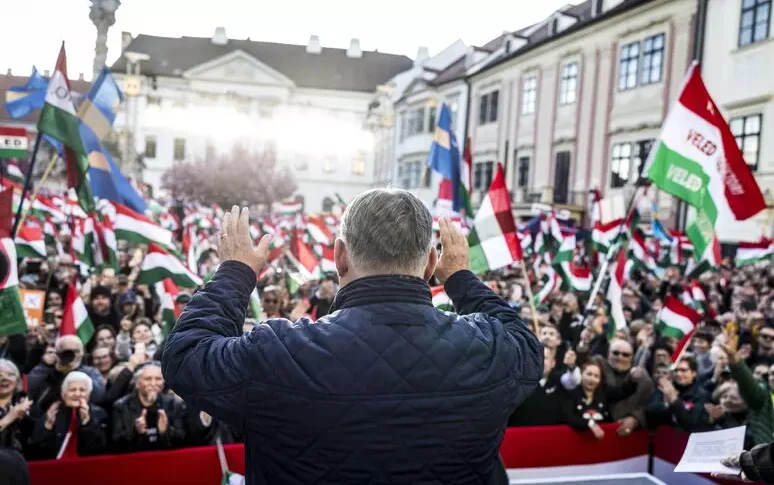
The last moon of Peter Magyar’s election campaign is that of Debrecen. The last stage, the last push before the polls, in the heart of eastern Hungary which for years has voted unitedly for Viktor Orban. «From April 13 «Hungary will be a democracy. Not illiberal and not even popular: simply a democratic state of law”, chanted the leader of Tisza, asking his crowd for a full mandate. It is not enough to win, he insisted: to “dismantle the Orban regime” and “cross the doors of history together” by rewriting the rules – starting with a new Constitution to be submitted to a popular referendum – “a two-thirds majority” is needed. A proclamation that has turned into a remote challenge, finding, 235 kilometers further west, the prime minister’s reply to his grand finale in front of Trinity Square, at the foot of Buda Castle. Cornered by polls that place him on the most uncertain ridge of his long power, the leader of Fidesz did not allow himself to be discouraged: “There are many of us, we will also reconquer Budapest and show how strong the right is”, he assured, claiming a “civic, Christian and national” model built in sixteen years of leadership. And looking up beyond the borders: Donald Trump “is with us”, he recalled, thanking for the endorsement of the American president ready to put “all the economic power” of the United States at the service of his ally. The vote will move the entire country: over 8 million voters, 199 seats up for grabs, a hybrid system between single-member constituencies and lists is expected to be high, with the possibility of exceeding the 70% recorded in 2022, driven above all by the younger ones – over 181 thousand in the first vote – and by the approximately 500 thousand Hungarians abroad, among whom reports of difficulties in voting operations are starting to emerge. The real front line remains the two-thirds threshold: the key for Magyar to change everything, the barrier to resist for Orban.
The rhetoric is a last call, specular and frontal. “Not only does the Tisza flow, it has already flooded throughout the country”, repeated Magyar, recalling the Tisza river which gives its name to his political project, evoking a wave ready to overwhelm corruption and opacity. The 45-year-old lawyer promised scores to be settled with an independent judiciary, secret archives and contracts to be opened, public funds to state media to be cut, claiming a team “not of button pushers, but of true representatives”. “If necessary we will go to Dubai or Chad to bring the Hungarians’ money home,” he assured, focusing on a challenge that also extends to frozen EU funds, a litmus test of the country’s future and its ties with Brussels. “If we have 3 million votes, not even the gates of hell will be able to prevail against us in the next four years”, relaunched the prime minister, also calling on young people. After weeks of polls chasing each other, photographing Magyar in the lead, on the threshold of the polls the scenarios remain open: a clear reconfirmation (although seen as unlikely) of Orban or a landslide victory for the challenger. Or, narrow margins that would drag the country into long and unpredictable negotiations. With an added risk: in the event of a close result, neither of the two contenders might be willing to immediately acknowledge defeat. And, in the background, the puzzle of the ultra-right also weighs heavily. The result of Mi Hazank (Our Homeland) – the only party other than the two main contenders accredited to exceed the 5% threshold – could prove decisive for Orban’s stability, also through external support. The tense climate is also reflected by the latest controversy over the opposition’s choice to meet in Batthyany square – in front of Parliament and a short distance from Orban’s residence – for election night. “It only takes a few minutes to go from observing to acting,” warned spokesman Zoltan Kovacs, reading the decision as a provocation to seek “escalation”. After the count, the game will also be shaken by a further question mark on the role of President Tamas Sulyok, close to Fidesz, which could lengthen the time needed to form the government. Magyar has made no secret of his intentions: if he wins, he will ask the head of state to take a step back.