

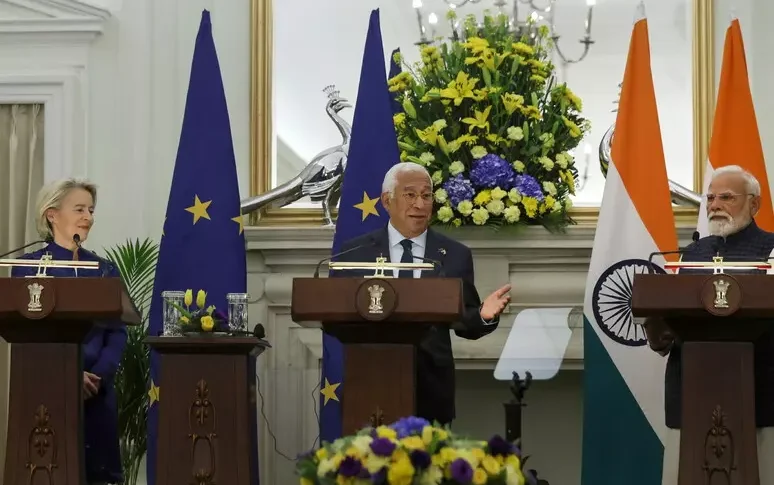
“We did it dear Narendra, we signed the mother of all trade agreements”. Ursula von der Leyen is radiant, very elegant in her Indian-style outfits that won over the local press during this two-day mission. Modi draws heavily on the rhetoric: “It is a historic day, we see a turning point in our relations, the two largest democracies in the world work together and there will be global benefits.” The President of the European Council, Antonio Costa, instead weighs heavily on the part dedicated to security and defence. “We are reaching a new level of strategic trust between us and it is the first step towards even more ambitious cooperation in the future.”
Trade, defense and mobility: the agreements
The Indian Prime Minister welcomed “friends” Costa and von der Leyen to the Hyderabad House in New Delhi for the official signing of the agreements (three main ones, on trade, defense and mobility of people) and, during the meeting with journalists (where, however, Modi as usual does not take questions, democracy will deal with it), he goes on to outline the CVs of the European guests. “Antonio Costa is known for a simple lifestyle and his affection for ordinary people, therefore he is also considered the Gandhi of Lisbon.” The former Portuguese prime minister laughs and when it is his turn he shows off his Indian passport – his parents are originally from Goa – underlining how the agreement is “special for him on a personal level too”.
A clear message to the changing world
“Our summit sends a clear message to the world: at a time when the global order is undergoing a profound transformation, the EU and India present themselves as strategic and reliable partners and are working together to broaden the spheres of shared prosperity.” Any reference to Donald Trump’s America is not accidental.
The desire to feel similar
Going into specifics, in defense matters there will be greater cooperation on maritime security, cyber and counter-terrorism. And the possibility of co-production for their respective defense industries. Modi also mentioned the India-Middle East-Europe corridor (Imec), which ends in the Mediterranean and where a lot is cooking. In short, the free trade agreement (FTA) is certainly historic but there is more: the desire to discover that we are similar on many crucial aspects, such as respect for international law, multilateralism, the need to reform the UN. The agreement on mobility (students, researchers, high-level and seasonal workers) was particularly important for India, which has an exploding young population looking for opportunities.
Customs tariffs were the highlight of the banquet
“We will launch the first EU Legal Gateway Office in India: it will be a single reference center to support Indian talent moving to Europe, in full harmony with the needs and policies of EU member states”, highlighted von der Leyen. That said, FTA represents the highlight of the banquet. Customs tariffs on more than 90% of European goods exports to India will be eliminated or reduced, saving up to €4 billion a year in tariffs; there will be a competitive advantage for exporters, “with the greatest opening that India has ever granted to a partner”, with privileged access for service providers in key sectors such as finance, maritime services, telecommunications. The Indian Trade Minister, Piyush Goyal, expects concrete progress for India in the textile sector, which today enjoys exports to the EU amounting to 7 billion. “We can now reach 30-35 billion, generating 6-7 million jobs here.” However, the benefits will come over time.
Historical relations between India and Russia
On defence, for example, Foreign Undersecretary Vikram Misri highlights that India could eventually participate in the Safe programme, when conditions are possible. Does this mean that India will, in return, reduce its cooperation with Russia? “As you know, we have historical relations with Moscow, agreements are made out of mutual interest and the two things run on separate tracks”. At first glance, it seems like a no.