

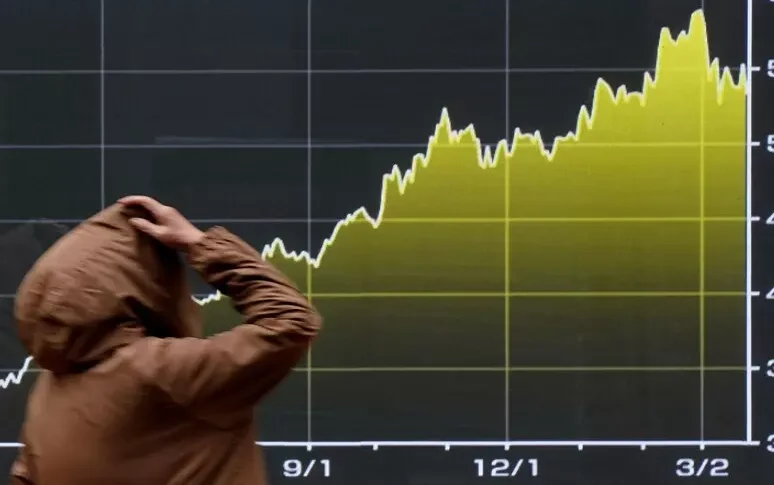
European stock markets worsened mid-morning with investors worried about a further escalation in the war in the Middle East, where tepid attempts at diplomatic solutions between the US and Iran are failing to take root. Frankfurt lost 1.6%, Milan and London 1.1% and Paris 1% while in New York futures lost almost 1%.
Oil is flying, with Brent rising by 3.8% to 106.1 dollars and WTI by 3.5% to 93.5 dollars. Sell-off also on bonds due to fears of a surge in inflation: BTP yields jumped by 11 basis points to close to 4%, to 3.94%, while the spread with the bund rose to 92 basis points.
The OECD: “If the war continues, there are risks for world growth and inflation.” Estimates for Italy cut
“If it persists, the conflict” in the Middle East “will weigh on global growth and increase inflation”: this is what we read in the OECD’s Interim Economic Outlook presented today in Paris. Furthermore, according to the international body, “any public measure to cushion the impact of rising energy prices should be well targeted on those who are most in need”.
Member States are also advised to “maintain incentives” and “reduce energy consumption”. In the longer term, the OECD suggests multiplying measures to “improve energy efficiency at the national level and reduce dependence on imported fossil fuels”. Necessary steps, the organization underlines, to “allow countries to reduce their exposure to future geopolitical tensions”.
The OECD cuts Italy’s growth estimates to 0.4% in 2026, 0.2 points less than the previous Economic Outlook in December. For 2027, the international body forecasts Italian growth at 0.6%, equivalent to a cut of 0.1 points compared to the December estimates. Italy’s inflation is expected to grow from 1.6% in 2025 to 2.4% in 2026. According to the OECD, inflation in our country will be 0.7 points higher than what was indicated in previous estimates.
For the Eurozone, growth is expected to “contract from 1.4% in 2025 to 0.8% in 2026 due to rising energy prices weighing on economic activity”, before “restarting at 1.2% in 2027”.
Again according to the OECD, “if expansionary policy in Germany will support growth, especially in 2027, a more restrictive budget policy will represent an obstacle in Italy and France. Furthermore, the expected budget tightening and the increase in energy prices are expected to weigh on activity in the United Kingdom, even if the impact will be limited by the rate cut next year and GDP growth will go from 0.7% in 2026 to 1.3% in 2027”
Global GDP growth is expected to slow to 2.9% in 2026, before recovering to 3% in 2027. According to the international body, ”rising energy prices and the unpredictable nature of the conflict in the Middle East will increase costs and reduce demand”
“The ongoing conflict in the Middle East has human and economic costs for the countries directly involved and will test the resilience of the world economy”: we read in the Economic Outlook.
“The paralysis of maritime transport in the Strait of Hormuz and the closure or deterioration of energy infrastructure – continues the OECD – have caused a surge in energy prices and disrupted the global supply of energy and other important basic products, such as fertilisers”. According to the OECD, “the scope and duration of the conflict are very uncertain but a prolonged period of increases in energy prices will have the effect of significantly increasing costs for businesses and inflation (…), with harmful consequences for growth”.
Finally, the OECD recalls that “before the escalation of the conflict, global growth was holding up well, with activity stimulated by the vigor of investments and production linked to artificial intelligence (AI), as well as by favorable financial and budget conditions”. According to the OECD, world GDP is expected to fall from 3.3% in 2025 to 2.9% in 2026, an unchanged percentage compared to previous estimates in December. For 2027, the OECD forecasts global growth at 3% (a 0.1 point drop compared to the previous December Outlook).
In the United States, GDP is expected to contract from 2.1% in 2025, to 2% in 2026, to 1.7% in 2027. In the USA, the international body specifies, “the strong expansion of investment linked to AI” will be counterbalanced by a “partial slowdown in the increase in real incomes as well as consumption”. As for the euro area, GDP growth is expected to slow down to 0.8% in 2026, especially in due to the increase in energy prices, before “recovering to 1.2% in 2027 thanks to the increase in defense-related expenditure”.
“Confronted with the shock linked to energy prices, central banks must remain vigilant and ensure that inflation forecasts remain well grounded. Monetary policy adjustments may prove necessary in the event of generalized price tensions or if growth prospects worsen significantly”, we read again in the OECD Interim Economic Outlook.
According to the international body, G20 inflation will grow to 4% in 2026, up 1.2 points compared to previous estimates in December. The figure, specifies the OECD, should then fall to 2.7% in 2027. ”In the G20 countries – writes the OECD – inflation should be 1.2 points higher than previous forecasts for 2026, stabilizing at 4%, before falling to 2.7% in 2027, thanks to the expected decline in tensions on energy prices”.
OECD: ‘Growth in Italy is weaker than expected, energy weighs on consumption’
“For Italy, growth is weak and consumption is also falling. We think that the Pnrr will continue to support growth, at 0.4% this year, and also next year. Italy’s growth estimates were, however, slightly better at the end of 2025, but the increase in energy prices is affecting consumption and has led us to revise our forecasts downwards”: said OECD economist Asa Johansson, responding to a question on Italy during the press conference to present the OECD’s Intermediate Economic Outlook together with the secretary general, Mathias Cormann.
In the Interim Economic Outlook presented today in Paris, the OECD has cut its growth estimates for our country: according to the document, Italy’s GDP will be 0.4% in 2026, 0.2 points less than the previous December estimates. For 2027, the international body forecasts Italian growth at 0.6%, equivalent to a cut of 0.1 points compared to the December estimates.