

Add the Gazzetta del Sud as a source
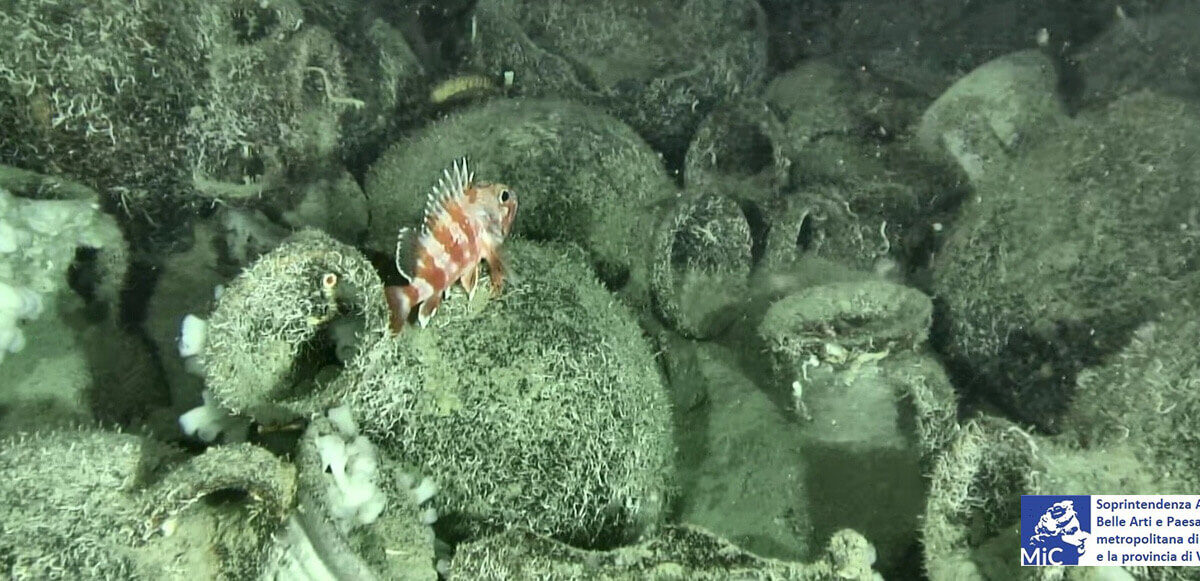
A submerged treasure of over three hundred amphorae dating back to the 5th-4th century BC is about to re-emerge from the seabed of Calabria. The Ministry of Culture (MiC) has officially started the study and recovery operations of the wreck identified off the coast of Monasterace, in the province of Reggio Calabria. The extraordinary discovery is presented today, Friday 29 May, in Pozzuoli, as part of the VIII National Conference of Underwater Archeology at the Campi Flegrei Archaeological Park.
The exceptional discovery promises to rewrite part of the trade routes of Magna Graecia and Sicily, offering unprecedented data on the production and diffusion of the wines of the Ionian coast in antiquity.
The accidental discovery thanks to wind turbines
The wreck was identified in 2023 during preventive archeology investigations for the construction of an offshore wind farm. The discovery was possible thanks to the use of advanced technologies for seabed mapping, employed by a multidisciplinary team made up of marine archaeologists, geologists, physicists, chemists and biologists.
After the transmission of the technical report, the Superintendency of Archaeology, Fine Arts and Landscape for the Metropolitan City of Reggio Calabria and the province of Vibo Valentia triggered the protection procedures, launching the deep-sea project “Protection-recovery-conservation and valorization”, entirely financed by the MiC.
The cargo broken by the fishing nets: emergency recovery is triggered
The scientific investigations and photogrammetric surveys launched on the site starting from 2025 have highlighted a critical situation: the load of amphorae is divided into two distinct blocks, about ten meters away from each other. According to experts, this separation was caused by the destructive action of trawling.
Precisely for this reason, the Superintendence decided to derogate from the 2001 UNESCO Convention (which normally favors the conservation of finds in situ, i.e. on the seabed). The concrete risk of new and irreparable damage pushed the designers towards a radical choice: the total recovery of the load to make it safe, restore it and return it to the public in an exhibition itinerary.
A team of scientists and divers to save history
The delicate intervention on the seabed involves a real task force coordinated by the architect Roberta Filocamo (RUP) and directed on a scientific level by Dr. Alessandra Ghelli, official underwater archaeologist of the Superintendence.
External experts collaborate on the project, including marine archaeologists Laura Sanna and Francesco Tiboni, the restorer Francesco Lia and prof. Mauro La Russa, director of the Department of Biology, Ecology and Earth Sciences of the University of Calabria. The complex underwater and safety operations are conducted in close synergy with the specialized departments of the Carabinieri: the Carabinieri Underwater Unit of Messina and the TPC (Cultural Heritage Protection) Unit of Cosenza.
Detailed photogrammetric surveys and the collection of archaeological samples are currently underway. These chemical and physical analyzes will serve to evaluate the state of degradation of the materials and to define the most suitable restoration protocol before the definitive lifting of the three hundred amphorae.