

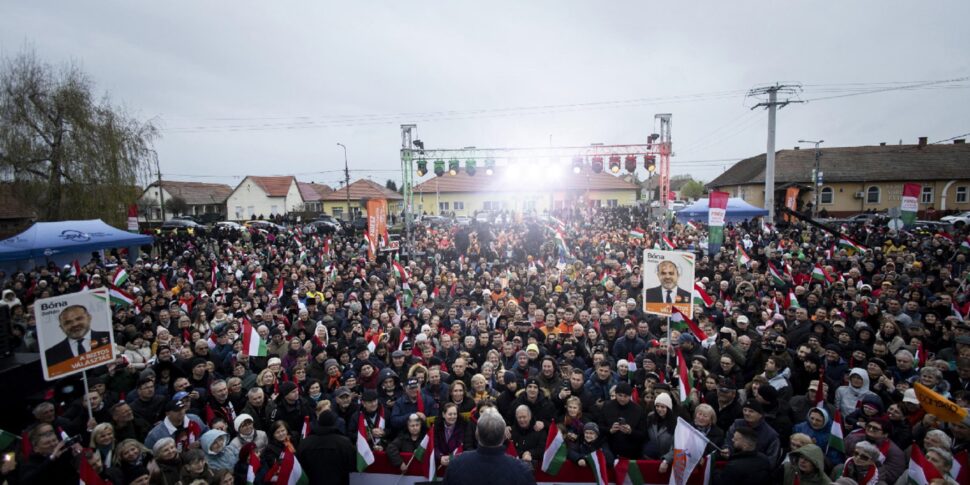
«Russians, go home!». The slogan that has crossed Hungarian history – finding its voice in the barricades of 1956 against the Red Army and then in the squares of the post-Soviet transition – has once again echoed in Budapest, ten days after the vote considered a watershed for the whole of Europe.
In the Duna Rendezvenyhaz conference center, on the banks of the Danube, the pro-EU front challenging Viktor Orban met under the aegis of the European Democratic Party, choosing clear and programmatic words: freedom, democracy, rule of law. Values to be defended – was the message of the conference against interference from Moscow – “against any authoritarian drift”, supporting the opposition leader Peter Magyar who, on 12 April, will try to capitalize on a growing consensus especially in rural areas.
For now, the numbers are smiling at the prime minister’s challenger – who grew up within the system that he now contests – so much so that it presents Orban with the most insidious challenge of his long season in power. The latest poll by the Publicus institute, conducted between 27 and 30 March, sees Magyar ahead among already oriented voters – 41% of his Tisza against 35% of Fidesz – while on the total sample the margin narrows slightly (36% to 30%).
But the fact that should not be underestimated is another: almost one in four voters is still undecided. A vast gray area that could prove decisive. The opposition has been denouncing a structural imbalance for weeks – media control, tailor-made constituencies, accusations of bought votes – while the government rejects all charges. But what makes the picture more fragile is the constant suspicion of interference, which in the various narratives leads to Moscow, or to Kiev and Brussels.
“Orban is unable to defend Hungarians from Russian influence,” thundered Orban’s latest challenger, Peter Marki-Zay, from the stage of the PDE conference, urging Hungarians to “fight for freedom”. The prime minister “is transforming the country into Putin’s dependency”, he attacked the former rival who in 2022 tried to take the scepter away from the prime minister, today an active voice in calling for “a government that protects its citizens, defends its sovereignty and places the country firmly in the European democratic family, instead of pushing it towards fear, isolation and dependence”.
The stakes, in the reading of the secretary of the European Democratic Party, Sandro Gozi, “go beyond national borders: the vote is a test for the whole of Europe”, called to “not look the other way” and “be present” in the face of a polarized challenge, between those who read the vote as a referendum on the European anchoring of the Hungarian country and those who claim a sovereignty increasingly detached from Brussels and in the orbit of the Kremlin.
Opposing narratives that now touch even the referees of the game. The OSCE, as per practice, is already on the ground to monitor the regularity of the vote, but the controversy over an official with a past linked to the Russian Foreign Ministry has sparked doubts from the opposition, leading to questioning the very credibility of the mission. The front close to the government, however, is moving – in an unprecedented way – on a parallel track, with its own system of observers.
A move that risks multiplying the readings of the numbers. The fear, shared by analysts, is to find ourselves immediately after the vote faced with two opposing truths of the same arithmetic. Without anyone being willing to recognize the other’s victory.