

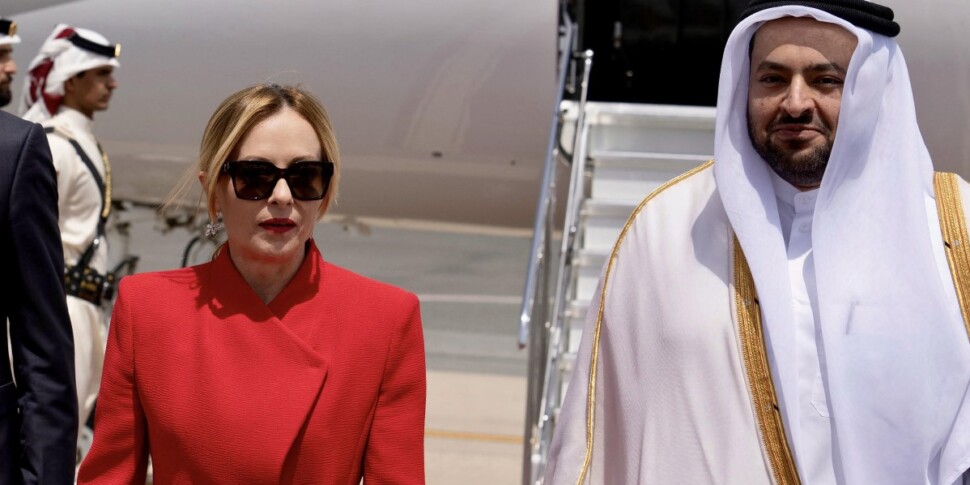
Giorgia Meloni closes a complex two-day visit to the Arabian Peninsula between diplomacy and pragmatic strengthening of bilateral relations with the Gulf countries. The primary objective is to secure energy cooperation in a decidedly critical phase of gas and fuel supplies which Italy (but with it the entire European continent) badly needs to make the country’s system work.
Hormuz as a priority
In this context, the game for the reopening of the Strait of Hormuz has become one of the priorities. The safe passage of commercial ships and oil tankers is becoming an emergency to avoid the dangerous escalation of prices and rationing of raw materials. An issue that is also forcefully entering the internal political debate and which the Prime Minister will most likely have to take into account when she appears in Parliament next Thursday for her information on the relaunch of government action. For all these reasons, the visit to the Gulf countries takes on a very high “strategic” but also “symbolic” value for the Executive, since in this phase Giorgia Meloni is the first European leader to deal with the highest authorities of the Arabian Peninsula.
The relationship with Saudi Prince Mohammad bin Salman
Starting with Saudi Crown Prince Mohammad bin Salman. A character considered controversial at an international level but today fundamental for any initiative that will involve that area of the world. Relations between Italy and Riyadh under the leadership of the crown prince have intensified significantly. And with her presence the prime minister wanted to express her closeness to Saudi Arabia in a phase marked by strong regional instability. The discussion between the two leaders touched on several sensitive dossiers, from the defensive military assistance provided by Rome to the prospects of the ongoing conflict, up to the diplomatic efforts deemed necessary to emerge from the current crisis. Avoiding the head-on clash, which other actors would instead like to fuel, the countries of the region are navigating a delicate diplomatic ridge that Rome follows with the utmost attention. Riyadh, Doha, Abu Dahbi and Muscat are connected by a thin thread stretched between internal demands and external pressures, in an attempt to safeguard their role of “stability”. A perspective that is redefining the internal structures of the Arabian Peninsula. And it is on this effort that Italy is counting, guaranteeing all assistance to achieve this objective. A premise that allowed us to enter more directly into the discussion on the energy needs of the old continent to ensure supplies and reduce the impact of the crisis on businesses and citizens. With a reasoning that inevitably focused on the priority of guaranteeing freedom of navigation in the Strait of Hormuz as soon as possible. But also on “how to consolidate” this process towards stability, starting from wide-ranging cooperation on investments, strategic infrastructures, security and defence.
The stop in Doha and the meeting with the Emir of Qatar
Concepts taken up again in the next stop in Doha where Meloni was received by the Emir of Qatar, Sheikh Tamim bin Hamad Al-Thani. Here Italy, through the excellence of its production system, has expressed its willingness to contribute to the rehabilitation of Qatar’s energy infrastructure, fundamental for energy security on a global scale. The Prime Minister also thanked the Emir for the assistance provided in the evacuation of the numerous Italian citizens, in particular tourists in transit, who wanted to leave Qatar at the beginning of the conflict. And he underlined the message of closeness that his presence intends to express in the face of Iranian attacks.
The confrontation with the president of the United Arab Emirates Al Nahyan
Last stop of the Arabian tour, Al Ain, in the United Arab Emirates, with a conversation with President Sheikh Mohamed bin Zayed Al Nahyan during which all the topics already discussed with other interlocutors in the area were explored in depth, starting with the strengthening of investments in the strategic energy sector.
At the center of the visit – according to an official note from Palazzo Chigi – is Italy’s “strong closeness to a friendly nation”, with an explicit reference to regional tensions and the repeated attacks suffered by Iran. The Prime Minister expressed deep gratitude for the Emirati support during the repatriation operations of tourists and the thousands of Italian citizens present in the country at the outbreak of the conflict.
The results
The tour touched crucial points of the Middle Eastern crisis: in Doha, the Emir Tamim bin Hamad Al Thani and Giorgia Meloni strongly reiterated the need for de-escalation and the use of dialogue to stem the regional crisis. In the meeting in Al Ain, particular attention was paid to freedom of navigation through the Strait of Hormuz, a vital hub for international trade. The leaders analyzed the conditions necessary to put an end to the ongoing conflicts, examining the developments of the international situation.
In addition to geopolitics, the visit made it possible to consolidate economic relations between Rome and Abu Dhabi. Palazzo Chigi confirmed its desire to strengthen mutual investments in three strategic pillars: guaranteeing security of supplies; technological and industrial collaborations; common commitment to the stability of the area.