

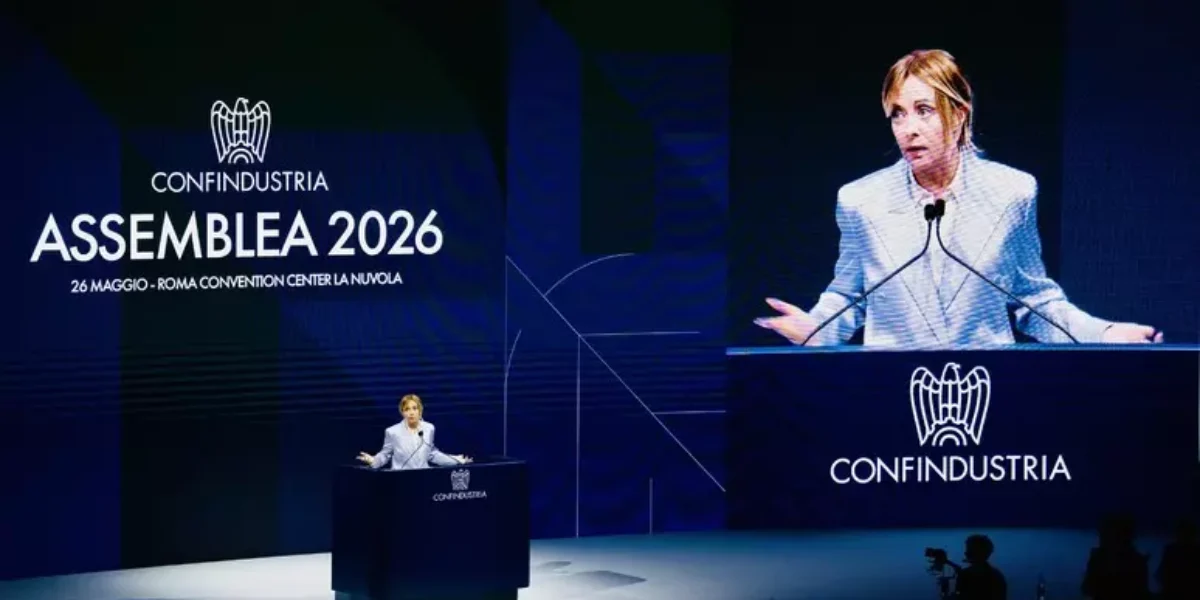
The EU must “do less and do better”, stop being “a bureaucratic giant”. It must guarantee Italy the same flexibility for energy investments as for military spending, because “defense is freedom, but today we must defend families and businesses” from the effects of the Iranian crisis. Giorgia Meloni speaks at the Confindustria assembly in Rome, but her attacks are aimed at Brussels, which in a few days – perhaps on June 3 – will reply to her letter sent to Ursula von der Leyen.
While he proposes to companies “to immediately start a common construction site to arrive at a common reform of bureaucracy in Italy”, urging their managers “not to be afraid”: “Be courageous and I promise you that I will do the same”.
The prime minister speaks from the stage for 36 minutes, and some passages in the aftermath of the administrative round with which the center-right hopes to have definitively cushioned the referendum debacle do not sound casual. His government, he assures, has not lost its way, “it is there and does not intend to retreat a single millimetre”. The audience is one of those friends, even if there has been no lack of comparisons in recent years, “without prejudice, without discounts, with frankness”, recalls Meloni, thanking the president Emanuele Orsini “for having recognized the efforts made by the government to put work, business and production back at the centre”.
A year ago in front of the assembly of industrialists the main themes were more or less the same: energy prices, with the announcement of zero tolerance on speculation, and Europe, which Meloni urged to remove self-imposed internal duties. The scenario, however, is now even more critical. It is a phase of “polycrisis”, the Prime Minister likes to repeat. The evolution depends a lot on Donald Trump, but no one directly mentions him from the stage of the La Nuvola conference center. The prime minister only notes that “in the most difficult year of transatlantic relations” exports recorded “+7.2% with the USA”.
A fact that helps her to claim that “we are no longer the weak link in Europe” but a “credible, authoritative” nation. For the prime minister, “the main, enormous, fragility” is “the configuration of the European Union”, which “multiplies the rules on every aspect of common life” but is “hesitant when it comes to making its voice heard in global dynamics”. He recalls the action launched with German Chancellor Friedrich Merz to “clear the regulatory jungle”, because “bureaucracy cannot replace politics”. But the tug of war with Brussels is now above all about the request for flexibility for measures against high energy prices, “to mitigate the impact that the closure of the Strait of Hormuz is having on our families and our businesses”.
They are circumstances “which are beyond the control of EU member states and which justify, in our view, amply” to extend the scope of application of the National Escape Clause. It does not mean, Meloni reiterates, “new debt” but “allocating in the best possible way what is already foreseen. Pure and simple common sense”. The prime minister also relaunches the battle on ETS, and on the Italian front “the resumption of nuclear production is an objective within our reach”. He wants to “proceed quickly”, “the enabling law will be approved by the summer”, and indicates as a reference “modular, safe and clean mini-reactors”.
Claiming a series of measures, from the work decree to the housing plan, Meloni then made a series of overtures to Confindustria’s requests: on hyper-depreciation, on the reorganization of tax expenditures, on the reform of corporate responsibility, on the relaunch of individual savings plans, on the mechanisms for increasing pension fund investments in the real economy, and on training young people on artificial intelligence.
Confindustria calls for ‘responsibility’: ‘No to electoral battles’
The loudest and most heartfelt applause from the audience of industrialists at the Confindustria assembly is when president Emanuele Orsini warns: the discussion on fundamental decisions must not transform “into an electoral battlefield”. The leader of the industrialists asks for a “great act of responsibility” from politics, from the unions, from the business associations themselves, he calls “the whole society” to face the challenges with “a common, strong shared sense of responsibility”.
The words “responsibility”, “trust”, “courage” recur: they are “the foundations for returning to growth of 2% per year”, it is “not only necessary but possible”. And he warns: “If in Italy and in Europe we are not capable of a common effort we will lose our industry, i.e. 15% of the GDP and millions of jobs”. Even for the colonization of China, there is a risk of an “industrial desert”.
The assembly is in the presence of the President of the Republic. Prime Minister Giorgia Meloni goes on stage to speak. “We have not always found ourselves in agreement on some points, but – says Orsini – I believe that the key word is ‘dialogue’, I also said it to the unions: ‘let’s start from the points that unite us’. Growth must be at the centre”. The priorities today? “Energy, energy, energy.” The leader of the industrialists raises the alarm again: for companies “the price of energy is now a real existential threat”, action must be taken – he reiterates -, from unblocking concessions for renewables to accelerating the return to nuclear energy. Energy is the first of the five levers to be moved – this is the industrialists’ proposal – “to put business back at the centre”.
They also ask for an industrial policy that supports and encourages the growth in size of small and medium-sized enterprises; to strengthen development contracts and push for innovation; simplifications and reform of law 231 on administrative responsibility, “an almost exclusively punitive instrument”; to guarantee adequate resources for the objectives, promoting “an action of national responsibility to mobilize private resources alongside public ones”. And maintaining “the government’s prudence on public finances” which Confindustria “recognizes and appreciates”.
Then there is the tax chapter. “Italy is fourth in terms of tax burden among advanced countries and there are 575 tax measures that erode around 120 billion of the tax base”:
Orsini launches “a proposal to the Government and the social partners. Let’s work together on these measures, some of which have lost their raison d’être or overlap with each other. Let’s analyze them together. And let’s identify the 20 billion to be reallocated, without increasing the debt: a third to growth, a third to healthcare, a third to schools”. With the unions “Confindustria has returned to a direct and continuous dialogue”, it also calls for “a responsibility pact to overcome pirate contracts”. While “the salary question remains open. I say it clearly: we alone, with our best contracts, cannot resolve it”.
The leader of the industrialists returns to ask Europe for “the suspension of the ETS”, “a true single energy market”, to “complete the union of savings and investments”, the “turnaround of the common debt to support industry” and not “to finance the current expenditure of the States”. Industrialists continue to worry about Europe’s “lunar” bureaucracy: the latest “confirmation” is that of the “72 conditions set by Brussels for the green light to the bill decree”.
Orsini says of European bureaucracy: “Our appeal is only one: stop it.” Hyper-depreciation is good, “but we need to take another step forward: we also include business investments in software and cloud in the incentives”, they are “essential tools”. And for the South, “Italy’s potential growth basin”, “a strategy dedicated to attracting investments” is needed.