

The ideas, words, thoughts and images are clear, full of an artistic commitment that is the result of very specific visions of one’s surrounding world. This, at least, is what easily transpires during a chat with Francesco Costabile, director, originally from Cosenza, who last signed the successful «Familia»: eight nominations for the David di Donatello, five for the Nastri d’argento, two awards in Venice and the great joy – a renewed pride for a region that sometimes suffers from low self-esteem like Calabria – of the Italian selection for the 2026 Oscars.
The film – a raw and bloody reinterpretation of the true story which in 2008 saw Luigi Celeste kill his father after repeated violence against his mother – ultimately failed to enter the short list of 15 titles that the Academy will compete for as Best International Film, but Costabile has no doubts about this matter either: «The surprise for me was being selected! We were aware that it would be almost impossible.”
In short, a lucid examination of what is above all a market discussion. «The films that make it to the top five are those that come from the big international festivals, mainly from Cannes and Venice, those films that usually have American distributors who invest; in the fifteen titles, in fact, there are films that have had a very strong festival run.” Dynamics of that film market which is making great strides especially in the main supply chain in the States. A speech for which Costabile also closes any controversy – some have been heard in recent weeks – on an institutional support that according to some has been far too weak: “It’s a fake controversy” he reiterates, bringing the problem back to large distribution spaces.
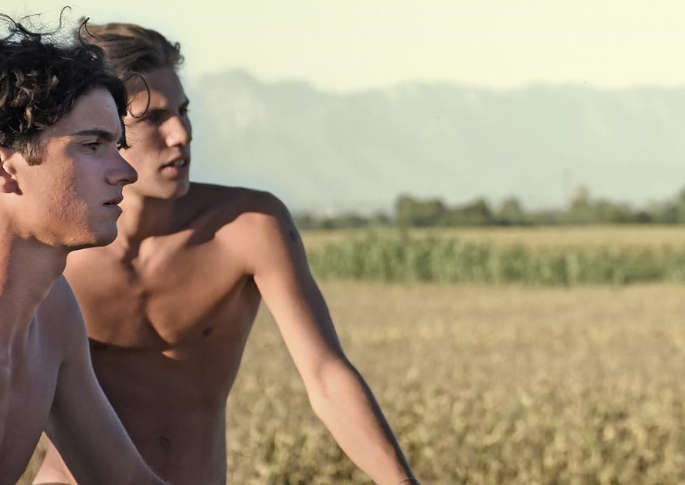
In any case, the story remained in the background of the pleasant dialogue with Francesco Costabile on the occasion of his visit to Lamezia Terme for the closing of the «Pasolini and…» exhibition. The long program of events, curated by Carlo Fanelli and hosted by the Lametino Library System, two intense months dedicated to the great intellectual, still all too “contemporary” and very tied to Calabria. Closing the show was Costabile himself with the 2019 docufilm, «In a future April», shot together with Federico Savonitto, a delicate and poetic portrait of the poet from Casarsa focused on his childhood years, on his relationships with his family, on his Friulian roots, and with the beautiful direct participation of his cousin, the poet Nico Naldini (in his last appearance: he disappeared the year after the release of the film).
«I discovered Pasolini a bit by chance in high school – says Costabile – and starting from the end, because the first book I read was “Petrolio”. Already at the Experimental Center, for my diploma, I made a short film, “Dentro Roma”, which was inspired by a chapter of “Ragazzi di vita”. In my own way I had meanwhile approached the Friulian writings: I sowed the first seeds, feeling this desire to work on his work. Then, after many years, this proposal came to make a Friulian portrait through the voice of his cousin, Nico Naldini. In short, Pasolini accompanied me throughout my training path. He is an author who returns cyclically, and is so layered that he continues to speak to you every time. Pasolini is a sort of oracle: he is consulted to understand the present.” A period, therefore, very specific to Pasolini’s parable, «a period in itself – continues Costabile – a moment still of hope in the future, in which the Marxist vision was concrete. Pasolini truly believed in change, something he would lose already in the mid-1960s.”
But what remains of his Friulian roots for the mature Pasolini?
«Everything: the language of the mother, the language of the peasants, is the first step towards that reality which he will then go on to explore in Rome. Ultimately in Rome he does nothing but recover what was the approach to the Friulian world, that is, he embraces the Romanesque language, the language of the villages, just as he had done from Bologna in Friuli by embracing the language of the Casarsesi. It is the love for reality, the love for bodies, for faces, the love for that peasant world whose disappearance he already felt. And this comes back in all of his works, in his poems, in his novels, in his cinema.”
We also talk about Pasolini’s current affairs with Costabile. Of its importance in the precise historical moment in which – as recent months have demonstrated – we still crumple in clumsy attempts at “political” labels for the author who, perhaps, deserves labels less than any other. «I can’t imagine a contemporary Pasolini – Costabile states lucidly – because the cultural prerequisites are no longer there. Today they would have arrested him first of all, it would have been such an uncomfortable rumor that they would have silenced him in some way, as has already been the case, right? He had understood that he had given voice to a historic defeat. We are experiencing this historic defeat today: it is the Pasolini-esque resignation of the films of the mid-Seventies, a resignation that today – the Trumpian world, the capitalist vision that won, etc. – it’s normal.”
Finally, we share a sharp smile of irony: «We are moving towards this perspective, capitalism dominates, social inequalities are increasingly extreme, something that will probably lead us towards the end. To be optimistic.”
«In future April», however, ends with one of Pasolini’s most poignant songs, that «Resistance and its light» in which the Marxist hope of a change was still tangible.
«We can only cling to culture – concludes Costabile – culture and civil conscience, network in some way, maintain a sort of resistance, against the standardizing leveling».