

A story about migration that concerns us all because we are all migrants, “On the Greenwich Meridian” by the Egyptian writer Shady Lewis, translated for the first time into Italian by Alba Rosa Suriano who also signs the detailed afterword, and published in the beautiful “La Piccola” series by Mesogea. Four stops, Messina, Ragusa, Catania and Cosenza for a novel that tackles real and complex themes with an ironic-visionary twist.
«A story born not to tell the story of migration – says Lewis – because in London over 50% of people come from other countries, this is why migration has become an important part of the narrative and of life. As in my other autofiction novels, I imaginatively tell real things, experiences of loneliness, the fear of dying alone, because the imagination in a true story is much stronger.” A story also “to imagine the place of migrants in other countries” like Lewis himself, who was born in Cairo where he studied engineering before moving to the United Kingdom in 2006, where after studying psychology he works as a social worker.
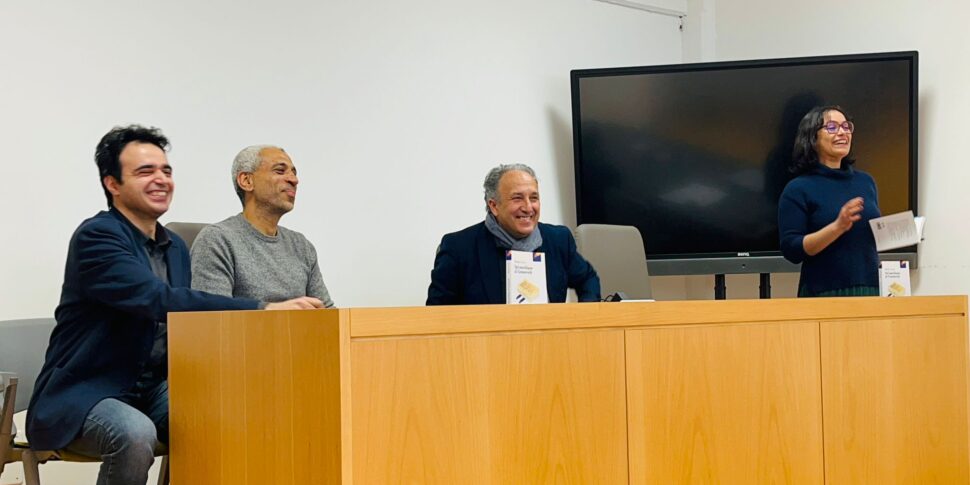
The writer spoke about it in the two meetings in Messina on 24 March: at the DICAM with Daniela Potenza (professor of Arabic language and literature), Salvatore Speziale (professor of history and institutions of Africa) and Shadi Al-Jaqqal linguistic collaborator who translated it from Arabic, and at the Mondadori Ciofalo bookshop with Giuliana Sanò (professor of Social Anthropology), Elena Grimaldi (of the Mesogea publishing house) and Mariagrazia Costa who translated it from English.
Many themes are unraveled with a fluid but articulated story by the narrator, whose Kafkaesque life path «is like a continuous test that serves to test the resistance of those who migrate» recalls Lewis: between disenchantment and paradox, «without fear and without hope» (mantra of the writer himself), the protagonist observes, giving voice to other characters, the system, between mechanisms of discrimination, dehumanizing bureaucratic labyrinths and marginalization that the “migrant” of any part of the world has to face. Remaining poised between east and west, “on the Greenwich meridian”, always with that “condition of estrangement caused by exile (the ghurba, a theme dear to contemporary Arab fiction)” writes Suriano.
The protagonist is an Egyptian from a Coptic Christian family (like Lewis) who lives in London and does a low-profile job for an office that deals with assigning housing to the bottom of the social chain. One day he receives a phone call from a friend from Cairo who asks him to take care of the funeral of a young Syrian refugee who died alone in London after countless vicissitudes told in a fable-like tone (the khurafat of the postmodern but also classical Arab tradition) and symbolically attributed all to him to recount the terrible vicissitudes of many others. Therefore, the theme of death is present from the beginning to the end of the narrative, since in Egypt, Lewis recalls, «the rituals linked to death are very important and serve to strengthen social bonds», but reflecting on the fact that if «every death is the end of a unique world with its unrepeatable details», there are nevertheless many «small deaths, every relationship, everything that ends is a small death», even losing one’s individuality when one is cataloged in a category: the “blacks”, the “whites”, the “refugees”, the “Muslims”, like the protagonist who is always considered “Muslim” despite being Christian.
Without ever diverting attention from the Egyptian reality, the political-sociological gaze of the narrator ranges from the process of integration at the time of the workers’ struggles of the early 1980s in Northern Italy to the British austerity policy with cuts to the welfare state and the emptying of the function of assistance to citizens, from Thatcher’s neoliberal policy to the “capitalist dystopia of the culture of the 21st century – writes Suriano in the afterword – in which the characters of this novel move”.

Find out more in the digital edition
To read everything, buy the newspaper
or download the digital version.