

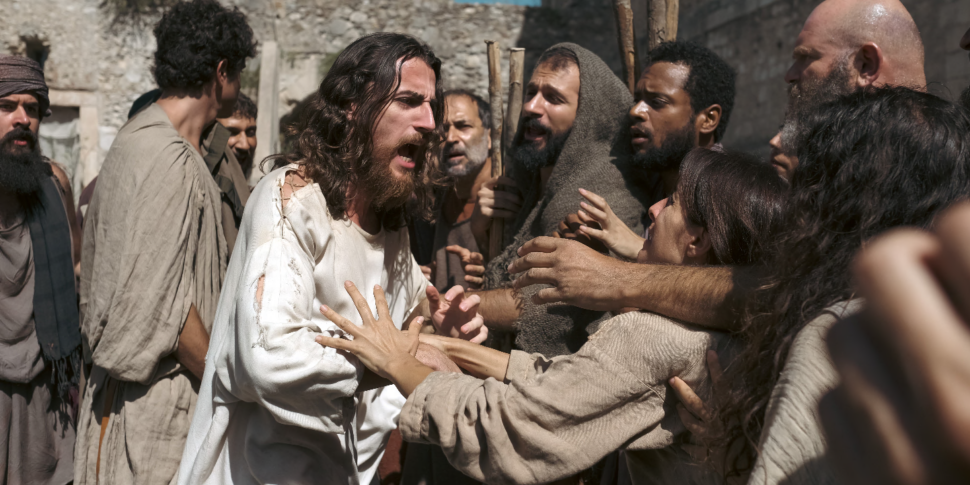
Judas doesn’t speak. He doesn’t show his face. It exists only through the voice of Giancarlo Giannini, who tells it like a heartbreaking confession. Giulio Base wrote and directed «The Gospel of Judas». He chose Calabria, natural light, silence. Ninety minutes without dialogue. Only bodies, gestures, looks. The support from the Calabria Film Commission made it possible to pass through ancient villages and landscapes capable of evoking Palestine without resorting to digital effects. Cast of stars, with Rupert Everett, Tomasz Kot, Paz Vega, Abel Ferrara, Ada Roncone and with Darko Peric and John Savage. Vincenzo Galluzzo is Jesus.
Base will be at the Citrigno cinema in Cosenza tonight, 8.30 pm, and tomorrow at the Lumiere cinema in Reggio Calabria, 8 pm, to present the film. We talked about it with him.
No dialogue, the protagonist never shown frontally. A bold bet for an incandescent subject. How did the idea come about?
«From a personal, almost intimate need: to look inside myself and deal with my contradictions. I wondered about mistakes, lies, small and large betrayals which, despite the desire to improve myself, continue to surface. From this internal tension, the idea of taking reflection to the extreme arose, embodying it in the figure of Judas, the traitor par excellence, always condemned to the image of the absolute guilty. But how much guilt is there in him? And how much of destiny? If his gesture had been necessary for the Passion and then the Resurrection to take place, can we really consider him just a culprit? Everything comes from this question: from the human possibility of feeling tenderness even towards those who have always been described as symbols of evil.”
Judas and Jesus are seen as mirror figures, intertwined destinies that are fulfilled together…
«The central question is that between predestination and free will: how much of what we do is already written and how much really depends on our choices. If everything were already established, then would Judas really be so guilty? Or would it just be a necessary tool for a larger plan? And if instead his gesture had been completely free, then yes, it would have been a terrible act. I didn’t start from a preconceived thesis. I didn’t want to absolve him or condemn him. I tried to enter into his thoughts, to give him a voice, also restoring him in his fragility, in his contradictions.”
The film was shot in Calabria. What relationship was created between your vision of the story and the landscapes?
«In the summer of 2022, during the inspections, I crossed it almost entirely, looking for places capable of evoking Palestine and Galilee of two thousand years ago. What I found was beyond all expectations. Extraordinary landscapes and professionalism of the highest level: people animated by passion, energy and a availability that I will hardly forget. And then I wanted to convey a different imagery of the Gospel story. I looked for a more alive, greener, almost spring-like land. Because the Promised Land cannot be just dust and desert. It must also have a vital, generative dimension. And in this sense Calabria proved to be perfect.”