

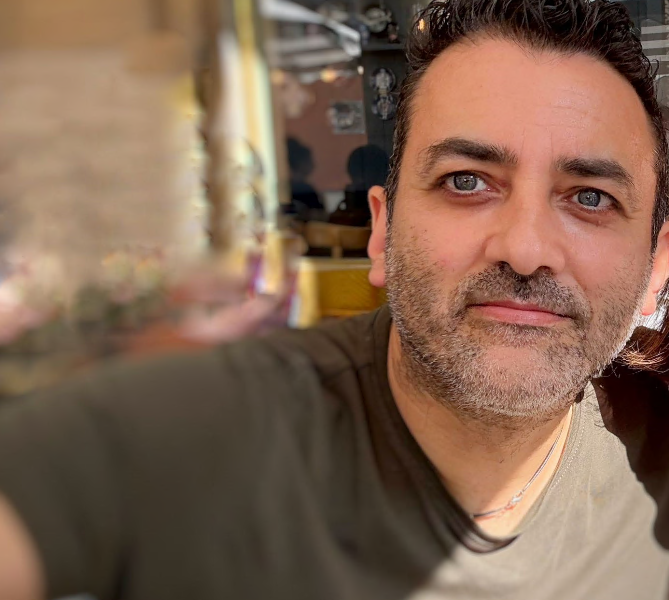
You can breathe Paris in the beautiful book by Luigi La Rosa, author of «In Paris with the Impressionists. A city, the novel of its artists”, published by Perrone in the original Passaggi di Dogana series. Not a scientific essay, but a real novel, the novel of the city and its artists, is this book by the writer from Messina who lives between Paris and Catania. And he feels the fascination of Paris, where – he tells us – changing 37 houses in all 20 arrondissements not only because in his steps as a flâneur he finds himself in the breath of the whole city and embraces the great beauty of its corners, streets, museums, neighbourhoods, but because he transforms that beauty, those emotions into his novels, as already in his literary debut with “The Man Without Winter” (Piemme 2020) in which he enters the story with sensitivity personal exhibition by Gustave Caillebotte, impressionist painter and philanthropist, as well as in the successful novel «Nel furor delle tempest» (Piemme 2022) which traces the brief parable of Vincenzo Bellini’s life.
And sensitivity, together with attention to words, is an advantage of La Rosa’s writing thanks to which he was able to imagine being «In Paris with Marcel Proust» (2022, again for Passaggi di Dogana by Perrone). «The true voyage of discovery does not consist in seeking new lands but in having new eyes» said Proust, and it is with new eyes that together with La Rosa we travel through Paris and recognize the Impressionists. «Impressionism could only be born in Paris, its breath is the same as the city» says the writer from Messina who has been teaching creative writing for 27 years, collaborating with magazines and authoring essays and who today at 6.30pm will talk about “his” Impressionists at the Mondadori Bookstore in Messina, in conversation with Ivana Cammà, Silvia Messina and Simone Caliò.
It all starts with an obsession, the first lemma of your particular glossary which is titled, as you say, not “chapters but stations of the soul”.
«The theme of obsession is very dear to me, because it belongs to the lives of all of us, and especially to that of creatives. Artists live on obsessions, on obsessive dreams, and art feeds on them abundantly. Marcel Proust reminds us that the masterpieces of all time are the result of suffering and the work of neurotics. And my impressionists are no exception.”
Why did it “intoxicate you to tell it”?
«The love and discovery of the Impressionists date back to my passion for painting and the research carried out for my first novel on Gustave Caillebotte. Living in Paris I realized that nothing more than the city is linked to the breath of impressionist art. Without Paris we would not have had Impressionism and, vice versa, without Impressionism perhaps the face of the city would have been different.”
It was not easy to talk about it, as you observe, after countless specialist studies. You write that you measured Impressionism with the places of the city. So, what figure, what method did you choose to tell it?
«I stole the method from the painters. I worked by moving through emotional stations, through impressions, precisely, which were magical doors to spiritual dimensions and atmospheres. We couldn’t approach such an emotional and narrative painting differently. This is why the pages of the book compose a sort of novel, an epic of stories, existences, personal parables.”
It was, as you write, a movement “of liberation and above all of resistance, not just of strength, courage or novelty”. What was the “lesson” of that “breath of the new era”?
«The lesson is the one announced by Émile Zola: the birth of the modern world. The world as we conceive it. The Impressionists revolutionized the very idea of painting: not to obey smoky and passé epics, but to celebrate the moment in its intact splendor. A moving carriage, a boulevard, a still life, the glimpse of a river, the cut of a face, a sky. Impressionism celebrates all this, making it contemporary and eternal.”
In one passage you call the Impressionists “martyrs of beauty”.
«They are martyrs because their revolution, as always happens in history, required a blood made of renunciation, loneliness, exile, madness, poverty. They all paid first hand, slipping into the cruel spaces of history with difficulty and often with pain. A tribute that made them immortal.”
And you put “your” Caillebotte inside. A rightful place among the impressionists?
«My Gustave Caillebotte rightfully enters among the Impressionists due to similarity of thought, vision and sensitivity. And then, let’s not forget that he was the main financial supporter of the current, personally paying for what others didn’t have. At his death, over 160 impressionist works were in his living room, purchased with hard cash. Caillebotte is the most generous father of the Impressionists and favored the destiny of each of them.”
Your soul stations end with “Scandal” and “Last Dance.” To tell what?
«The scandal, which permeated the lives of the Impressionists, represents the hallmark of the Belle Époque, the thrill of a time in revolt, which renounces the old in view of originality and change. Every great artist generates scandal and through it shakes the sleepy apathy of the spirit. Scandal is a bit like the salt of the earth. The last dance, inspired by Renoir, celebrates the tail end of a season of great transformations and profound melancholy. When closing the book, I want the reader to retain the painful music, the melancholy melody. It is the music of what ends, which ends, but which, thank goodness, leaves its mark.”