

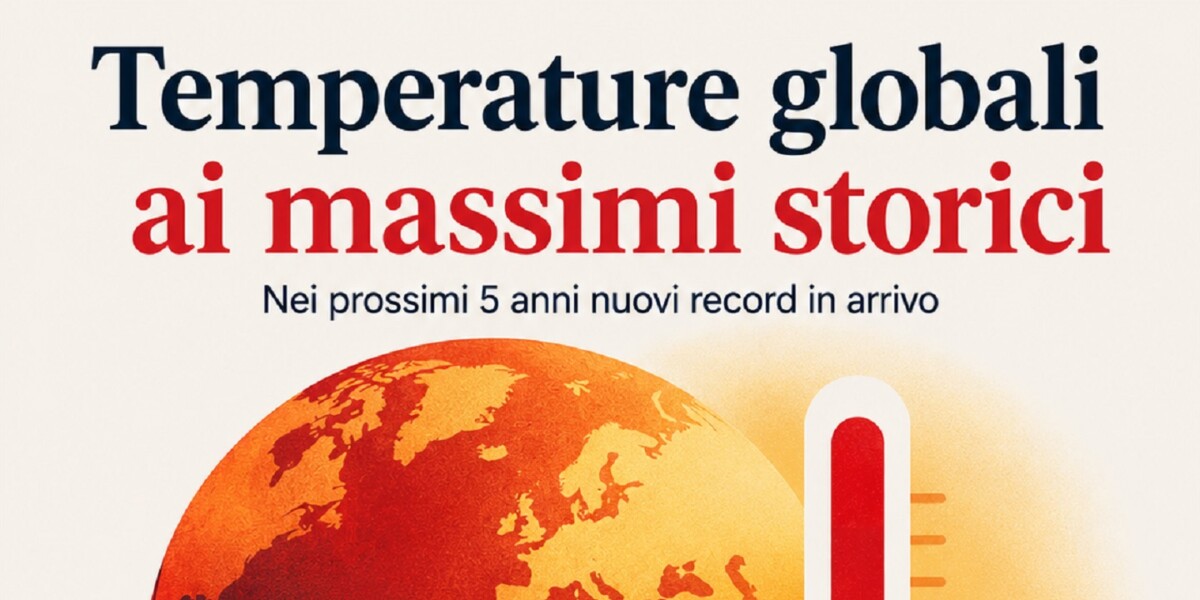
New temperature records are expected in the next five years: the new report from the World Meteorological Organization (WMO) predicts that average annual global temperatures for the period 2026-2030 will be between 1.3 and 1.9 degrees above the average compared to the period 1850-1900. There is also an 86% chance that one of these 5 years will surpass 2024 as the warmest on record. The special watch is 2027, which could prove particularly hot due to the arrival, at the end of 2026, of El Niño: the climatic phenomenon that returns on average every 5 years and which causes a strong warming of the surface waters of the Pacific.
The report from the Met Office and the WMO centres
The report, produced by the UK Met Office as the WMO’s reference centre, offers a summary of forecasts provided by 13 institutions from around the world. Among these, four Global Production Centers (GPCs), i.e. meteorological institutes designated by the WMO to generate climate and weather forecasts on a global scale: the Barcelona Supercomputing Centre, the Canadian Center for Climate Modeling and Analysis, the German Meteorological Service and the Met Office itself.
The 1.5 degree threshold is getting closer and closer
The new report confirms the forecasts provided by the 2025 report, which already indicated that average global warming would exceed pre-industrial levels by more than 1.5 degrees in the following 5 years. Furthermore, the probability that at least one year will surpass the current record holder (2024) as the hottest year increases: it goes from 80% in last year’s document to 86%.
The latest data indicates that there is a 91% probability, in the next 5 years, that the average global temperature will temporarily exceed the average levels of the period 1850-1900 by 1.5 degrees. This level was also exceeded in 2024, when the temperature surpassed that threshold of 1.55 degrees. However, it is considered extremely unlikely (less than 1%) that in one of these years the temperature will exceed the average by 2 degrees.
The Arctic and the reduction of sea ice
The Arctic will continue to be particularly affected by global warming: in the next 5 winters in the Northern Hemisphere, Arctic temperatures are expected to be 2.8 degrees higher than average, a value 3.5 times higher than the global one. Furthermore, sea ice will suffer further reduction particularly in the Barents Sea between Norway and Russia, in the Bering Sea between Alaska and Siberia, and in the Okhotsk Sea between Siberia and Japan.
Precipitation forecasts
Regarding precipitation, the 2026-2030 forecast indicates wetter-than-average conditions at high latitudes in the Northern Hemisphere, especially during the winter season from November to March. A reduction in rainfall is instead likely in the subtropical areas, particularly in the southern hemisphere. Humidity anomalies are also expected for the summer seasons of the next 5 years: a greater amount of precipitation will probably fall on northern Europe, Alaska, Siberia and the Sahel belt in sub-Saharan Africa, while the Amazon summers will be drier.