

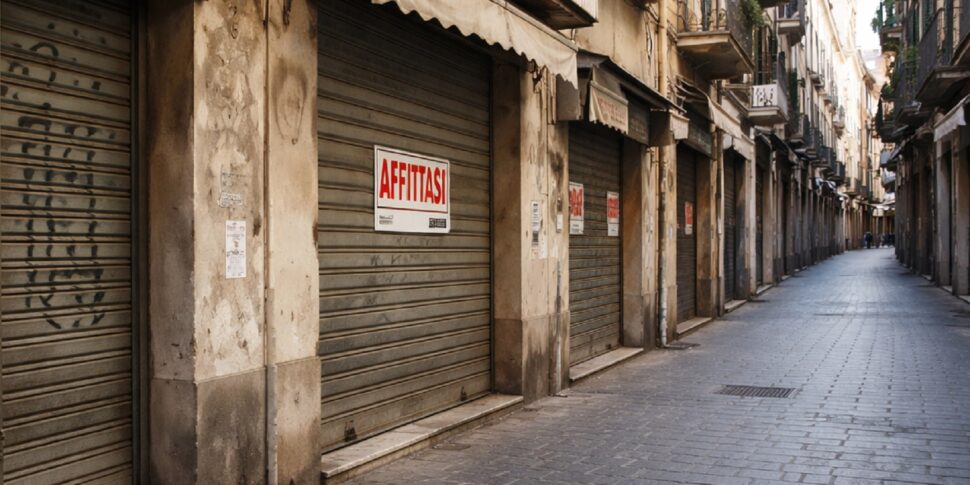
Over 86 thousand neighborhood shops have disappeared in the last ten years, with a negative balance exceeding 106 thousand units compared to the peak of 2018. This is the “worrying” photograph that emerges from the first edition of Nomisma’s Local Reciprocity and Commerce Observatory, created with Percorsi di Secondo Welfare, and presented today in Bologna.
Among those present were Paolo De Castro, president of Nomisma, Roberta Frisoni, councilor for tourism and commerce of Emilia-Romagna and Francesco Capobianco, Head of Public Policy Nomisma.
Fewer shops but busier: catering is growing
Despite the contraction of the physical network (-6.7% of local units at a national level), the report indicates that there has been an increase in the number of employees, which grew on average by 21.2% between 2015 and 2025. The growth engine is catering, with a leap of +26.2% in local units and a growth in employees of +69.4%. The personal care sector (+0.4% units, +27.5% employees) and construction items (+21.4% employees) are also doing well.
Fashion, culture and traditional shops are in crisis
On the contrary, the culture and leisure (-28.0%) and textile-clothing sectors (-21.4%, equal to 55,570 closed shops) collapsed. Furniture, jewelery and traditional food stores are also doing badly, while hardware stores show surprising stability in revenues (+41.0%). «The local trade sectors that present the best performances – reports Capobianco – are supported by exogenous factors such as the tourist boom, the Covid pandemic and construction bonuses».
Messina and Reggio Calabria are among the few growing cities
“Commercial desertification” affects almost all metropolitan cities: Bari (-14.8%), Rome (-9.7%), Turin (-9.3%) and Bologna (-8.3%), while it holds the south, with Naples (+4.6%), Messina (+1.1%) and Reggio Calabria (+1.9%). The most drastic drops were recorded in Ancona (-21.3%) and Pesaro-Urbino (-20%).
Prices falling but rents rising
On the employment front, the records for growth in employees are held by Matera (+37.2%), Sassari (+36.8%) and Syracuse (+35.9%). The real estate market reflects the crisis: shop sales prices fell by 9% (peaks of -35.8% in Ancona and -22.8% in Rome), but rents increased by 12.9%. The increase in rent is highest in Syracuse (+35.2%) and Piacenza (+31.7%), while among the large cities, Milan records a +16.1% against a drop in purchase prices of 7%.