

The underpass in Piazza Batthyany gets clogged before the numbers even arrive. The crowd presses in, crowds in, fills every space until it almost stops the city. The cries of Peter Magyar’s supporters echo across the Danube: “the wind of spring” is blowing.
Then the data arrives, and leaves no room for doubt. The former adept has surpassed the master Viktor Orban, breaking his long season of power. A clear victory, projected towards an absolute majority, which marks the beginning of another Hungary. Legitimizing it is a monstrous turnout: almost 80% of voters, above the already high figure of 2022 and even above 1990, the first free elections after the fall of the Wall.
A strong political signal, which rewarded the leader of Tisza and dealt the decisive blow to the prime minister of “illiberal democracy”. “Orban congratulated us on our victory,” the challenger wrote on Facebook, using a few words to seal an era that is coming to an end. “A clear and painful result”, admits the Hungarian prime minister who promises to “continue to serve the country from the ranks of the opposition”.
Election day in Budapest opens early, with a still cold light on the sidewalks and queues starting to form before the polls even open. Throughout the country, the vote immediately took on the pace of an out-of-scale mobilization: orderly queues in front of schools, slow entrances, volunteers handing out directions.
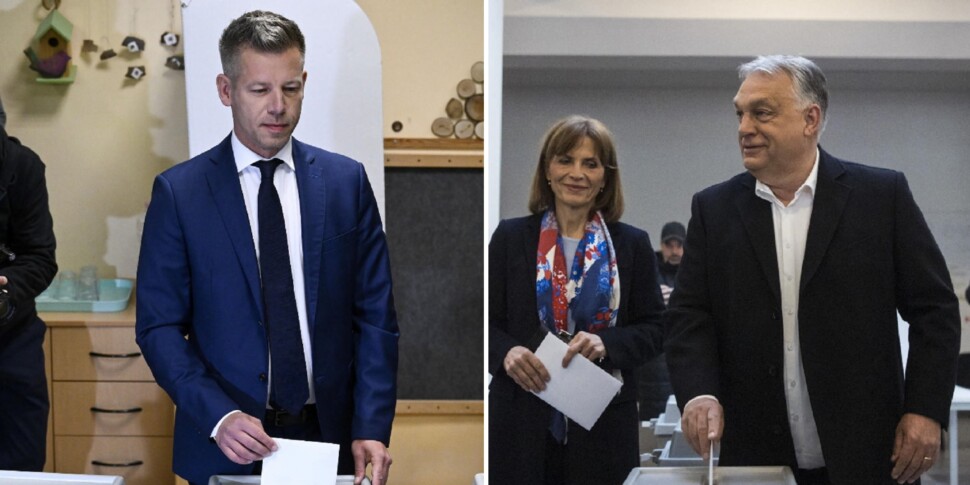
In the 12th district, on the hills of Buda, Orban showed up to vote at the Zugliget primary school together with his wife Aniko Levai, before stopping with journalists, maintaining the register that has been with him for weeks: security, control, no visible cracks.
“I’m here to win,” he said, but leaving room for democratic formality: “The people’s decision must be respected.” To the most uncomfortable question – whether he would have been able to recognize defeat – the prime minister responded without being upset: «Congratulate me? I always do it, there are civil rules.” Then he clung to the data that had been his most faithful ally for years: turnout.
“The more people vote, the better”, he repeated, recalling how historically high participation has rewarded Fidesz and comparing the vote to the historic one of 1990, evoking the dawn of the new Hungary. On the international level – and on the dialogue with Vladimir Putin – he remained faithful to his line as a solitary tightrope walker: “Friendly relations with all the main leaders”. On Volodymyr Zelensky, a sharp jab: “I’m lucky I’m not him.” A few hundred meters away, in the same district, just outside the Hegyvideki Mesevar kindergarten polling station, Magyar continues to challenge him: “We will win.” The only doubt, he continued to repeat, is “whether with a simple or absolute majority”.
His campaign ended as it began: relations to be mended with Europe, funds to be released, a break with the system. “We must strengthen Hungary’s position in the EU and in NATO”, he highlighted, immediately attacking anti-corruption measures and once again indicating the route for a new Constitution to be rewritten with a popular referendum, to bring the country back onto the tracks of the rule of law.
In bars and on trams we only talk about the vote, with our eyes glued to the news scrolling quickly on our cell phones. The discussion always returns there: to the electoral system. Of the 199 seats in Parliament, 106 are decided in single-member constituencies, often in rural areas, where the weight of the vote changes scale. Here 50-60 thousand voters are enough to elect a deputy, compared to 90-100 thousand in the cities. A detail that seems technical, but is not at all: over the years it has become a multiplier for the government party, capable of being worth up to five percentage points.
It is on this imbalance that the opposition has built its strategy: it is not enough to win, you have to win big, aiming for two thirds of Parliament. The mobilization, as expected, brings with it its trail of shadows. Accusations, counter-allegations, suspicions chasing each other.
From the government front, Orban’s advisor speaks of a “wave of reports” against Tisza: pressure, attempts at buying and selling, tensions at the polls, once again evoking interference from Brussels and Kiev. From the other side, speculative accusations are bouncing back: voters added without their knowledge to the minority lists, alleged shopping vouchers in exchange for voting for Fidesz, checks exceeding the limit in the booths. The OSCE observers will clarify the matter the next day. But at the end of the evening, Hungary chose Magyar. And, with him, it raised its gaze towards Europe twenty-three years after that referendum which made it enter the Union.