

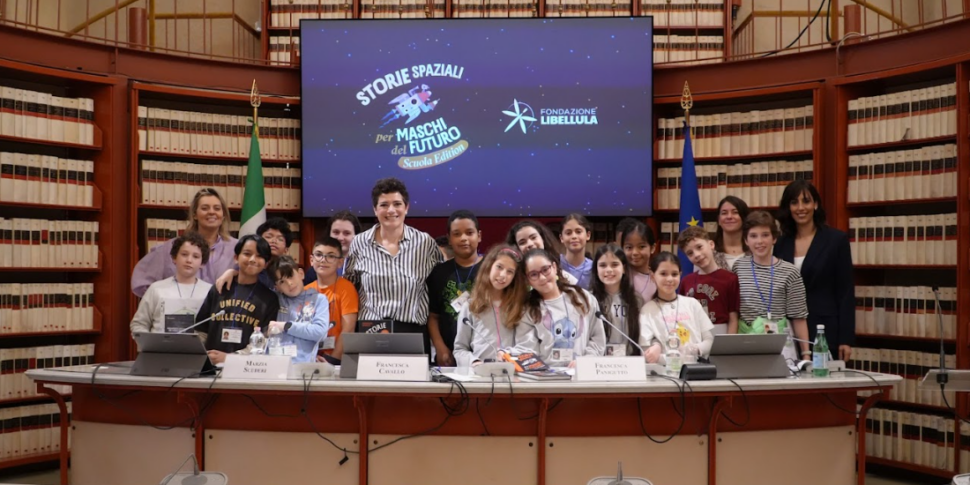
“Violence does not arise suddenly in adulthood, but is built much earlier, in the imagination and in relationships.” From this awareness, summarized by president Debora Moretti, the Libellula Foundation project “Spatial stories for males of the future – School edition” was born, in collaboration with the author Francesca Cavallo, to offer new and effective relationship education tools in primary schools. The project, presented in recent days at the Chamber at Palazzo San Macuto, has received the support of the European Commission and is already involving numerous schools: it is free and the hope is that it will be widely used, including in Sicily and Calabria.
«The data and over 10 years of work guide our choices – explains Moretti – As the Libellula Foundation, we start from the 2024 Teen Survey, conducted on a sample of approximately 1,600 adolescents between 14 and 19 years old, and from years of field work. This is why we chose to work in the 6-11 year range, when the models are not yet consolidated.” «The project – he adds – born from a spontaneous collaboration with Francesca Cavallo, has an educational approach: it does not propose “right” or “wrong” models, but works to expand the possibilities. We work on emotions, respect, consent and relationships, with the aim of giving girls and boys concrete tools to get to know each other better and get along better with others.
The project was also born from a real need: since its launch, at the end of 2025, it has been families, teachers and more generally the educational community who have asked us for tools to address these issues in an accessible and structured way. The project has obtained the patronage of the European Commission, an important recognition that strengthens the direction undertaken and opens up the possibility of developing it over time on a larger, national and international scale.” The route focuses on the “spatial stories” of Francesca Cavallo, an author committed to the issues of gender equality and against the toxic culture of virility, offering new and more welcoming emotional horizons.
The Spatial Stories for Boys of the Future – School edition project with the Libellula Foundation proposes new models: how urgent is it today to intervene specifically on the little ones to build healthier and more equal relationships?
The fairy tales contained in “Space Stories for Males of the Future” offer a broader idea of the masculine. For this reason the project developed starting from the book with the Libellula Foundation concerns both boys and girls: at the moment, when we think about what it means to be male, we have a series of preconceptions about the fact that boys can never show their vulnerability, about the fact that it is not in their nature to take care of the little ones, that they must avoid any situation in which they could run the risk of being “ridiculous”. These cultural conditionings concern the expectations that males have of themselves, but also those that we have of them. Working on expanding the expressive possibilities of males reduces the risk of violence, which often arises from the parts of us that we have been taught to be ashamed of and which, because of that shame, have remained unexplored.
How important is it to structure activities at school to educate about emotions and deconstruct stereotypes, and what tools can be offered to teachers and families?
School has a central role in this work, because having the possibility to process one’s emotions in a healthy way should not be a privilege of those born into families that already have adequate tools, but a right of everyone. Educating on affectivity at school is not only an investment in well-being and safety, it is also an investment in one of the most critical areas that hinder the economic growth of our country: the difficulty of women accessing the world of work. The tools we provide allow boys and girls to stand in front of each other, guaranteeing equal dignity, being able to recognize skills and potential regardless of gender. This is a leap that Italy needs if we want to get out of the stagnation we find ourselves in.
What resistances or stereotypes emerge most frequently when addressing issues such as consent, respect and male vulnerability?
The discussion with boys and girls is the most interesting and meaningful moment of the entire project. There were children who told us that they were afraid that other friends would discover that they liked playing certain games considered “for girls”. We have had children tell us that it takes more courage to ask for a kiss than to remove your arm from a crocodile’s mouth. And children who told us they felt “cool” when they managed to embarrass a little girl. At this age these types of beliefs are still “soft” and can be worked on. Clearly the more you grow, the more they solidify. The work done at school is delicate because you have to build a space in which everyone feels comfortable sharing their thoughts without fear of being judged.
This activity is the mirror image of books like “Goodnight Stories for Rebel Girls”, in which the theme of female empowerment often emerges: is the other front of commitment actually educating girls towards awareness and independence?
Certain. “Spatial Stories for Boys of the Future” is the completion of the work begun ten years ago with “Goodnight Stories for Rebel Girls”. At a certain point I simply realized that if I really cared about the emancipation of girls, I couldn’t help but work with boys too. Because the battle for gender equality is not a battle of females against males, but a journey of mutual liberation.
The 2024 Teen Survey: one in 5 teenagers does not recognize abuse The Survey
TEEN 2024, collected in the eBook “Senza Confine”, is the investigation conducted by the Libellula Foundation, to understand how Italian adolescents interpret the dynamics of power and control within romantic relationships, offering ideas for targeted educational interventions. On a sample of 1,592 adolescents between 14 and 19 years old, alarming data were provided on the degree of awareness and perception of relational dynamics, highlighting the need for specific educational interventions to combat gender violence and promote relationships based on mutual respect. Data shows that 1 in 5 teenagers does not recognize abuse in relationships, demonstrating a confusion between what constitutes love and what is control and possession. 20-25% of adolescents do not consider invasive actions such as touching, kissing or sharing intimate information without consent as violence. 40% do not consider the insistent sending of messages to the desired person to be stalking.
The free project: kits, training and workshops by Giovanna Bergantin
Spatial Stories for Males of the Future – Scuola Edition is an educational proposal that brings a new way of talking about emotions, respect and freedom from stereotypes to Italian primary schools. At the center there are six stories taken from Francesca Cavallo’s book, selected and adapted to become teaching tools capable of opening conversations that often, in the early years of school, do not yet find a shared language. Fairy tales thus become a starting point to allow girls and boys to recognize what they feel, give a name to their boundaries and build more aware relationships. A structured educational path is developed around the stories: a complete kit for classes, an accredited training course on the SOFIA ministerial platform and a series of live workshops with the author and the pedagogues of the Libellula Foundation. It is a model that supports teachers in their daily work and involves families, because cultural change requires communities that accompany it. The first experiment involves 250 primary schools, with particular attention to the most peripheral and vulnerable areas. The intervention will reach 12,500 girls and boys, 5,000 teachers and over 50,000 family members, generating a widespread impact. The project is promoted by the Libellula Foundation and Francesca Cavallo, united by the belief that a fairer future begins with the words we choose to tell it. The objective is ambitious: to build a pioneering protocol for the prevention of gender violence, designed for primary school and replicable on a large scale. Not an episodic initiative, but a long-term cultural investment, an act of responsibility towards the next generation. Schools can apply directly on the Libellula Foundation website to enter the program and receive kits, training and dedicated support.