

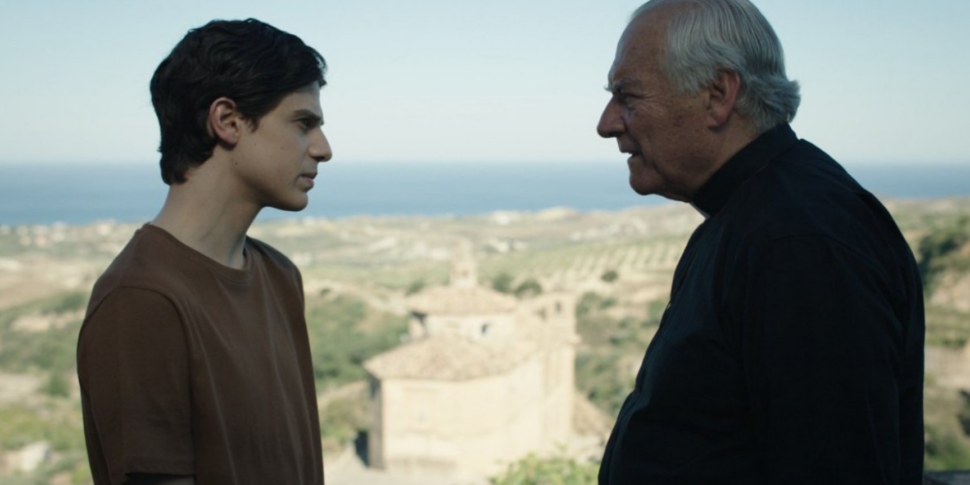
Some stories never end. They make immense rounds then return… or they are born in reverse. It happened to «The Orator», the film by Marco Pollini, director and producer, which arrives in theaters today: first it was a screenplay, then Covid-19 stopped everything and that screenplay became a novel (published by Santelli), then the novel returned to cinema. The story is that of Felice, twenty years old, who grew up in a working-class neighborhood in the South. He dreams of music, buys a grand piano with money from a loan shark, plays in the squares. Then the neighborhood kids destroy it for him. Felice runs away, finds himself in a church, improvises a speech at a funeral. The words come out by themselves, clean, exciting. From that moment he becomes “the orator”, the funeral boy.
Produced by Ahora! Film with the contribution of the Calabria Film Commission Foundation, the film stars Marcello Fonte (Marco Macrì, a charismatic and ambiguous character, a sort of mentor/antagonist), Manuel Nucera (Felice), Paola Lavini, Giorgio Colangeli (don Antonio), Saverio Malara and the young pianist Alessandro Gervasi. The cast will be in theaters on Saturday 2 May at the Supercinema in Soverato (6.30 pm) and at the Multiplex Lumière in Reggio Calabria (9 pm), and on Sunday 3 at the San Nicola in Cosenza (8 pm). We chatted with Marco Pollini…
«The Orator» was born as a novel in 2020 and has now become a film. What pushed you to translate this story from literary to cinematic?
«In reality it was born first as a film project. The initial idea was to make a film, so much so that the first form of the story was a screenplay. Then came 2020: the sector stopped due to Covid-19 and cinema times came to a halt. At that point, I chose to transform that material into a novel, without betraying the original structure. The book is also written with a very visual outlook, all in the present tense. This is why the return from the page to the screen was natural: the DNA of the story was already cinematic. I always think in images, even when I write.”
The protagonist, Felice, passes by chance from music to words, from the piano to the funeral oration. How did you construct this dramaturgical transition?
«Felice grows up in a difficult context, marked by precariousness and the absence of points of reference. His first refuge is music. In the first part the piano represents the dream, the talent, the ingenuity of those who invent a job playing on the street. But then reality overwhelms him. Some problems with the neighborhood kids force him to flee. It is there that the turning point occurs: almost by chance he finds himself in a church and discovers another possibility, that of the word. The funeral oration becomes a new form of survival. The passage from sound to speech has a precise symbolic value: music is the expression of the dream, the word is forced maturity, the ability to transform pain into redemption.”
Badolato, Soverato and Cosenza are the Calabrian locations. Is there something in the chosen urban spaces that redefined your vision of the story?
«The locations were searched with great attention after a real journey through Calabria. I needed places that had a strong identity. I found extraordinary scenarios: popular neighborhoods full of tension and social truth, villages like Badolato, rich in churches and memories. Cosenza Vecchia played an important role. It is an evocative place, full of soul, with alleys and views that already look like cinema. This contrast between everyday hardship and historical beauty was perfect for the film. Calabria is not just a backdrop, it becomes the protagonist of the narrative.”
You worked with around 50 Calabrian workers. What kind of relationship was created during filming?
«For us it’s not simply about shooting a film in a place, but about really involving it. In Calabria we have chosen to give space to many local professionals: over 50 workers involved, together with several interns. A very positive atmosphere was created on set. A sincere human relationship was born with many. The cast also followed this line. The protagonist Manuel Nucera was discovered at the casting in Cosenza. He’s from Reggio Calabria, he came from a film school, he was just starting out. We believe a lot in giving space to new faces: independent Italian cinema also thrives on this.”