

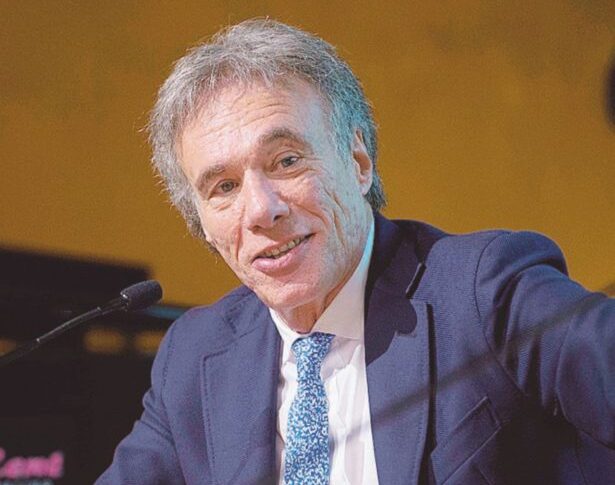
«Controtempo», a new novel by Michele Ainis, constitutionalist and narrator from Messina, is the story of a man who would like to rewrite his past and gets lost in the mystery of time. Orlando lives his life as a pharmacist in Rome and lives his life as a painter in Messina, discovers himself, finds himself divided in two and then, almost inevitably, gets lost in the personal multiverse of his existence. Maybe he travels, maybe not. Perhaps he never moves, yet in his mysterious “movements” he involves others, from a daughter perhaps never born to a seasoned neighbor, to the young pharmacist colleague, up to the priest who loves cigars (and not only) and is not as expert in the transcendent as one might think. We talked about it with the author (who today returns to his native Messina for the presentation of the novel, at 7.30 pm in the Flag Hall of the Town Hall; the meeting will be moderated by Milena Romeo, the actor Antonio Lo Presti will read some passages from the book).
The mystery of time and the idea that it can also go backwards is at the center of his new novel. Why? Is it a narrative device or does it respond to an intimate need?
«Each of us has probably found ourselves thinking sooner or later: if I had made another choice, if I could go back to correct a mistake, or maybe just to see a dear face again. In reality it is not possible, in literature it is. This is its fascination, at least as far as I’m concerned.”
Today’s quantum physics as well as yesterday’s multiverse theorized by Giordano Bruno are the basis of his book. Why? And is it more physical or metaphysical?
«I don’t know, we know so little about the world and things. And time is the greatest mystery. Perhaps metaphysics can help us more than physics itself. But above all, imagination can help us. In any case, if there were infinite universes besides the one we are tenants of, this interview would also be repeated infinite times. Poor readers!».
«The past doesn’t go away», «Things happen twice» are some of the phrases that his characters utter. Even without the laws of physics, is this somehow always the case?
«Yes, we are all formed, and sometimes deformed, by our past. But memory is a liar, it brings to light facts that are different from how we experienced them, it hides others. In “Controtempo” I tried to investigate these aspects. But it is a novel, not a philosophy book. There is a plot, there are stories and characters. I hope someone finds them interesting, but every book belongs to those who read it, not those who write it. And everyone can read it in different ways.”
This time, more than in his beloved Calvino, he seems to have found narrative models in Pirandello (I’m thinking of «Fu Mattia Pascal») and in Sciascia (I’m thinking of «A simple story», but also in other things). Confirm or not? And why?
«Calvino is always there, he is there in the attempt to build a fluid, light prose, as in his “Invisible Cities”. And then there is Borges, with the idea of telling the absurd through a rational scaffolding, with a double narrative level. Sciascia, however, no, he never bewitched me. Pirandello is the Master. However, if I have to confess a more direct influence in this novel, then it is that of the Mexican Juan Rulfo, with his “Pedro Páramo”, inhabited by characters who are shadows, who you don’t know if they are alive or dead. A beautiful, disturbing book.”
As always in the novels she returns to her Messina, a city that between the atmosphere impregnated with the sirocco and the ambiguity deriving from the present that is and the present that would have been without the caesura of the earthquake, creates an air of unfathomable mystery in her writing. And more. What?
«Messina is the root, the place where things begin. For the protagonist of the novel and for the author of the novel. Messina is also history and myth, although the people of Messina are not always aware of it. Let’s say that with my books I try to help them recover their memory, but I don’t know how much I succeed. I had tried especially in “Risa”, a novel published a few years ago. On that occasion I met students from all the Messina high schools, surprised to discover how many myths swim in the waters of the Strait. It would be nice to create a museum of city myths, from Colapesce to many others. An immaterial museum, the opposite of that stupid mastodon that is the bridge over the Strait.”
It is impossible to forget, in such a recent referendum, that you are a constitutionalist: in a quantum reality, how do you see our Constitution?
«Quantum physics is governed by the uncertainty principle, formulated a century ago by Werner Heisenberg. It means that of an electron revolving around the nucleus, we can establish either the position or the speed and the closer we get to one of these two quantities, we move away from the other. It therefore means that the state of reality is unknowable in exact terms. This also applies to the Constitution. The indeterminacy of constitutional rules is a virtue, already known to the Romans, because it allows a Constitution to cross the different seasons of History. Too precise rules would form a straitjacket that history could shatter. And it also applies, I would like to say, to literature, because the quality of a novel, of a literary work is, once again, a certain indeterminacy, that is, the possibility of lending itself to multiple interpretations and different levels of reading.”