

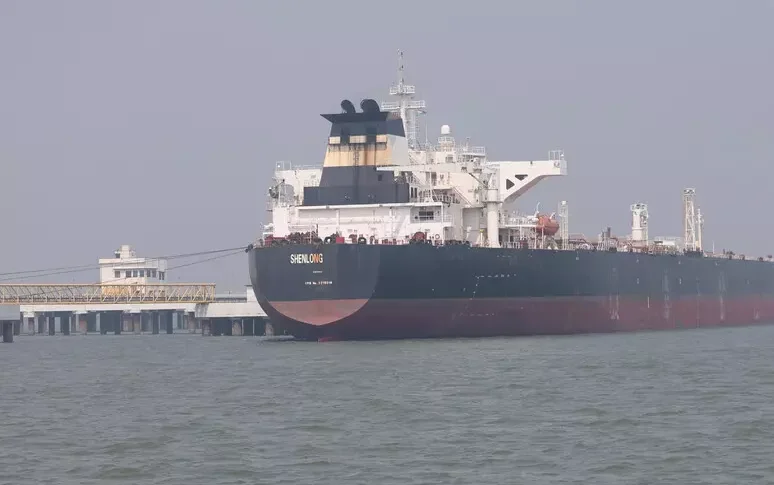
Closed, open, targeted, undermined. A month and a half after the start of the war between the United States and Israel against Iran, everything is at stake around the Strait of Hormuz, a 60 kilometer long strip of water through which most of the global crude oil passes and on whose fate the economy of half the world hangs.
Tehran’s army “categorically” denies US ships in Hormuz
The Iranian armed forces have categorically denied US statements according to which two naval ships crossed the Strait of Hormuz. “Centcom’s claim regarding the approach and entry of American ships into the Strait of Hormuz is categorically denied,” Central Command spokesman Khatam al-Anbiya said.
“The initiative for the passage and movement of any vessel is in the hands of the Iranian armed forces,” he reiterated. Centcom previously said that two US ships “passed through the Strait of Hormuz and operated in the Persian Gulf as part of a broader mission to ensure the strait is completely free of sea mines placed by Iran’s Revolutionary Guard Corps.”
The toughest clash between the US and Iran over Hormuz
The toughest clash between Washington and Tehran is currently taking place on the Strait, which intends to use its power over Hormuz to obtain concessions from the Americans. On the day the peace talks began in Pakistan, where one of the main issues will be Hormuz, Donald Trump announced that a reclamation of the sea strip is underway. «It is a favor to countries around the world, including China, Japan, South Korea, France, Germany and many others. Incredibly, they do not have the courage nor the will to carry out this task independently”, wrote the American president in Truth, returning to point the finger at those nations that did not support him in the ‘Epic Fury’ operation. The tycoon has repeatedly repeated that the United States has no use for the crude oil passing through Hormuz and that the countries concerned should take responsibility for fighting for a safe reopening.
Passage of American ships? It would be the first time since the war
Now he has gone even further by claiming, again in a social media post, that “huge numbers of completely empty oil tankers, some of the largest in the world, are heading to the United States to load the world’s best oil and gas.” «We have more oil than the two largest oil economies in the world combined and of higher quality. We are waiting for you. Fast delivery times!”, he claimed. But beyond the tycoon’s bombastic declarations, America also needs the strait to be secured as soon as possible. And if the passage of American ships were confirmed it would be the first time since the beginning of the war.
Two US warships are sailing on a mine clearance operation
The American Central Command then explained that two warships are sailing through Hormuz for a mine clearance operation. “The USS Frank E. Peterson and the USS Michael Murphy passed through the strait as part of a broader mission to ensure it is completely clear of naval mines previously placed by the Pasdaran,” explained Admiral Brad Cooper. Tehran immediately denied that US naval ships crossed Hormuz, claiming that it had repelled them. Iranian state TV explained that a warning was issued to an American military ship: it would be attacked within 30 minutes if it crossed the strait, and it – it is claimed – immediately withdrew. A circumstance, however, denied by Washington: “We have not received any threat from Iran”, an American official declared to Axios. Ahead of this tug-of-war between the US and Iran, press rumors emerge according to which Tehran would not have been able to reopen Hormuz to greater maritime traffic because in reality it is unable to locate all the mines it has laid in the canal, as well as not having the capacity to remove them. According to what was reported by the New York Times, this could be an obstacle in the talks in Pakistan between the negotiators Iranian and American ones. Iran used small boats to mine the strait last month, leaving a passage open for ships paying a toll to pass through. The Pasdaran have issued warnings of possible collisions between ships and sea mines, and semi-official media outlets have published nautical charts showing safe alternative routes. derives. To complicate the situation even more, naval mines are easier to place than to remove and in reality neither the United States nor Iran have specific means to do so quickly.